Sources, review date and section shortcuts
Editorial review: October 20, 2026. Use scoped, evidenced answers and explain exceptions before making a customer commitment.

Reference documentation · Related practical guide
Go straight to: Decision check · Main workflow · Further detail
Open the practical working record to connect this guide to your scope, evidence and next decision.
Separate current capability from planned work
Check the question against the actual service, tenant and time period. Use qualified answers where coverage is partial, and route contractual commitments to the appropriate owner. Reused answers need review when evidence or scope changes. Approval of a response is different from verification that every described control operates effectively. Reference and scope.
Enterprise Sales Security Guide
How to Answer a Customer Security QuestionnaireWithout Delaying the Deal
Use scoped, evidenced answers and explain exceptions before making a customer commitment.
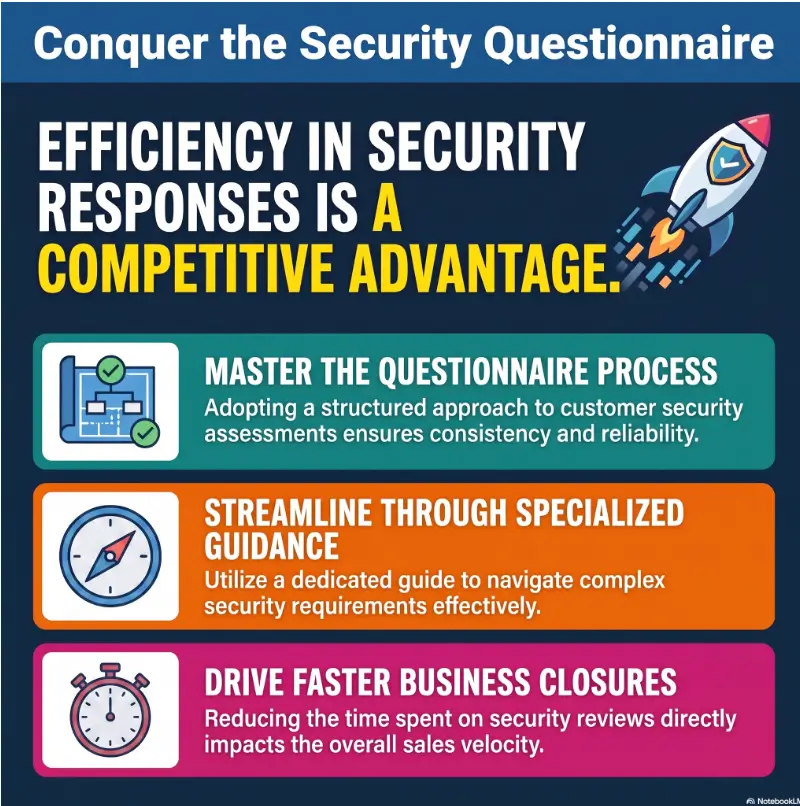
The fastest response is not the one filled with the most enthusiastic “Yes” answers. It is the one built from verified facts, clear product scope, approved evidence, disciplined wording, and a review path that keeps unsupported promises out of the final submission.
This guide shows SaaS vendors, founders, security teams, compliance leads, and sales engineers how to complete customer security reviews with less rework. You will learn how to organize ownership, answer partial-control questions, compare response tools, protect sensitive evidence, and create a reusable answer library that gets faster without becoming stale.
Answer precisely
Describe controls that exist today, in the product and environment under review.
Share safely
Match every attachment to the customer’s need, access level, and confidentiality terms.
Move faster next time
Turn recurring questions into approved, scoped, dated, evidence-backed answers.
The goal is not to make every answer sound stronger. It is to make every answer easier to trust. 🔐
Snapshot
Built for: SaaS vendors, startups, managed service providers, sales engineers, security teams, and compliance leads. Problem solved: slow, inconsistent, or risky questionnaire responses. Next result: a repeatable process for assigning questions, validating evidence, handling gaps, and submitting one approved version.
Before You Act
This article provides general operational guidance, not legal advice, audit assurance, or a promise that a customer will approve your security posture. Questionnaire wording can create contractual, regulatory, privacy, or disclosure obligations. Ask qualified security, privacy, compliance, or legal reviewers to confirm high-risk statements before submission.
Start With Scope, or Answer the Wrong Company
The first job is not answering questions. It is defining what the questions are about.
A SaaS company may operate several products, deployment models, legal entities, regions, cloud accounts, support systems, and development environments. A control that applies to one service may not apply to another. When scope is vague, perfectly accurate facts can combine into a misleading response.
Identify the product, environment, and customer data
Before assigning individual questions, capture the commercial and technical boundaries of the review. A one-page scope note can prevent hours of correction later.
- Product: Which service, module, API, mobile application, or managed offering is the customer purchasing?
- Environment: Will the customer use production, sandbox, dedicated, shared, on-premises, or customer-managed infrastructure?
- Data: What customer, employee, financial, authentication, operational, or regulated data may be processed?
- Geography: Where may data be stored, accessed, backed up, or supported?
- Entities: Which parent company, subsidiary, affiliate, or contracted provider delivers the service?
- Dependencies: Which cloud providers, subprocessors, support tools, and external systems are relevant?
Separate company-wide controls from product-specific controls
A corporate access control policy may apply across the business, while multifactor authentication, log retention, encryption, backup testing, or regional hosting may differ by product. State which layer each answer describes.
| Question type | Likely scope | What to verify |
|---|---|---|
| Security awareness training | Company-wide workforce | Covered workers, cadence, completion tracking, exceptions |
| Encryption at rest | Product and storage service | Data classes, databases, object storage, backups, exceptions |
| Single sign-on | Product capability | Plans, protocols, tenant configuration, administrative access |
| Background screening | Role and jurisdiction dependent | Worker categories, lawful limits, timing, contractors |
| Disaster recovery | Service-specific | Recovery objectives, architecture, test scope, dependencies |
When the questionnaire is really a contract in disguise
Informational questions ask what your organization currently does. Contractual questions tell you what the organization must do, how quickly it must act, or what it guarantees.
Pay close attention to words such as shall, must, guarantees, at all times, immediately, and without exception. A spreadsheet cell can be copied into a security addendum, order form, or renewal record with surprising ease.
Key takeaway
Put the scope at the top of the working file. Reviewers should know the exact product, environment, data types, entities, and customer use case before they approve a single “Yes.”
Build a Response Team Before the Spreadsheet Starts Spreading
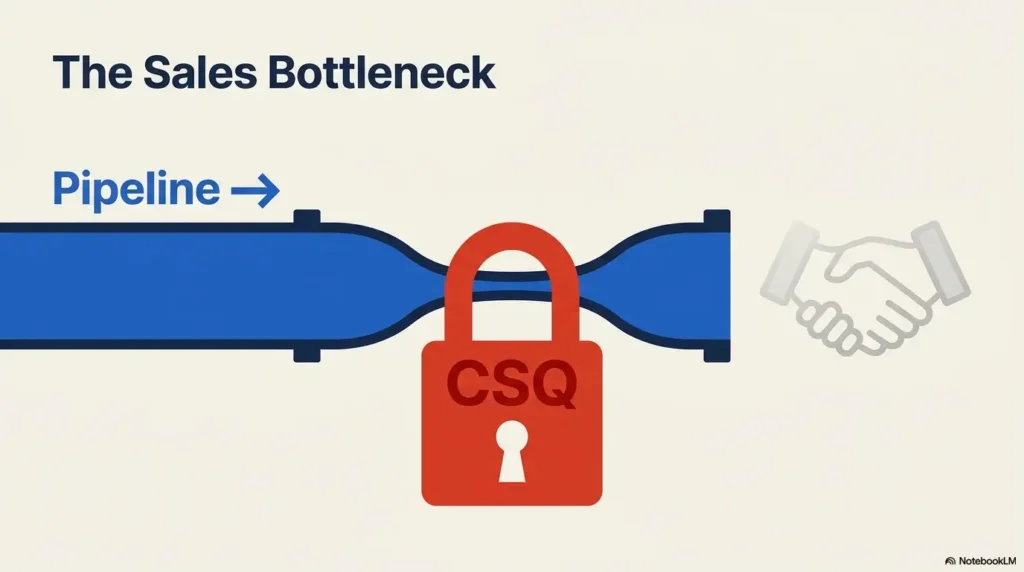
Security questionnaires become slow when everyone is involved but nobody owns the response. The file travels through email, chat, shared drives, desktops, and private copies until several versions begin claiming to be final.
Name one questionnaire owner
The process owner does not need to know every technical answer. The owner needs enough authority and discipline to keep the response moving.
- Confirm scope and submission instructions.
- Assign each control domain to a named reviewer.
- Track unanswered, disputed, and blocked questions.
- Control the working version and evidence folder.
- Resolve duplicated or contradictory responses.
- Obtain final security, compliance, privacy, or legal approval.
- Archive the submitted version with its date and customer context.
Route questions by control domain
Assign questions to the person who can verify the control, not merely the person most likely to answer quickly. Speed without authority produces a second round of work.
| Control domain | Typical primary reviewer | Possible second reviewer |
|---|---|---|
| Governance and policies | Security or compliance | Legal or executive owner |
| Application security | Engineering or product security | Security leadership |
| Cloud and infrastructure | Platform, DevOps, or cloud security | Engineering leadership |
| Privacy and data use | Privacy or legal | Product or data governance |
| Business continuity | Operations or service owner | Infrastructure or risk |
| Incident notification | Security incident lead | Legal and privacy |
| Insurance and liability | Finance, risk, or legal | Insurance broker or counsel |
Keep sales involved without making sales the source of truth
Sales owns the customer relationship, deadline, commercial priority, and expectation setting. Security and compliance own the accuracy of technical control statements. Legal owns contractual interpretation. Engineering verifies product behavior.
This division is not a wall. It is a relay team. Sales should explain why the customer is asking, whether an answer is blocking the deal, and what level of evidence will satisfy procurement. Technical reviewers should then provide a response that is both accurate and useful.
Use a status board that reveals the actual bottleneck
A simple tracker is often enough. Use statuses that reveal what must happen next rather than a vague percentage-complete bar.
- Unassigned: No owner yet.
- Drafted: An answer exists but has not been verified.
- Evidence needed: The statement cannot be approved without support.
- Scope question: Product or customer context is unclear.
- Legal review: The wording may create an obligation.
- Customer clarification: The question cannot be answered reliably as written.
- Approved: The answer and evidence are ready for submission.
The Evidence Ladder: What Makes an Answer Credible?
A questionnaire answer is a claim. Evidence gives the claim weight. Not all evidence carries the same weight, and a beautiful policy cannot prove that a control operates every Tuesday afternoon.
Use a four-level evidence ladder
- Approved policy: Shows that a control is formally required, owned, and reviewed.
- Documented procedure: Shows how people or systems are expected to carry out the policy.
- Operating evidence: Shows that the procedure has actually been performed.
- Independent assurance: Provides external assessment or attestation over a defined scope and period.
Operating evidence might include access review records, security training completion reports, backup restoration results, vulnerability scan summaries, incident exercise records, approved change tickets, or screenshots from a controlled system.
Independent assurance may include a SOC report, ISO certification, external penetration-test summary, or another third-party assessment. AICPA describes SOC as a suite of services addressing controls at service organizations, while SOC 2 examinations use trust services criteria related to areas such as security, availability, processing integrity, confidentiality, and privacy.
Match evidence to the question being asked
A certification may support the maturity of a security program without answering a specific question about a product feature, data location, customer deletion request, or incident-notification deadline.
Use the narrowest evidence that proves the relevant point. When a customer asks whether privileged access is reviewed, an approved access control policy explains the rule. A completed access review record shows operation. An independent report may provide broader assurance over the control environment. Each item answers a slightly different question.
Check the evidence before sharing it
- Is the document current and approved?
- Does its scope include the service being reviewed?
- Is an NDA, secure portal, or named-recipient restriction required?
- Does it contain customer names, employee data, credentials, internal IP addresses, architecture details, findings, or remediation notes?
- Can a summary, attestation, cover page, or redacted excerpt satisfy the request?
- Does the evidence have a permitted audience or distribution limitation?
- Will sharing it conflict with another contract or third-party restriction?
For a deeper evidence-handling workflow, review this guide to reading and evaluating a penetration-test report before attaching technical assessment material.
Evidence strength at a glance
1. Policy
The organization has formally defined the requirement.
2. Procedure
The organization has documented how the control is performed.
3. Operation
Records show that the control has operated in practice.
4. Assurance
A qualified external party has assessed a defined scope.
Write Answers That Are Accurate, Useful, and Hard to Misread
A strong questionnaire response should make the customer’s next decision easier. It should not force the reviewer to interpret marketing language, reverse-engineer scope, or ask three follow-up questions to discover what “Yes” actually means.
Use the four-part answer formula
- Status: Yes, No, Partially, Not applicable, or Planned.
- Scope: The product, system, personnel, data, or environment covered.
- Control: What the organization actually does today.
- Evidence: What approved support can be provided and under what conditions.
Consider a question asking whether administrative access is protected by multifactor authentication.
Too thin: “Yes.”
Clearer: “Yes. Multifactor authentication is required for workforce administrative access to the production environment. Access is limited to authorized roles and reviewed through the company’s access management process. Supporting policy and assurance documentation may be provided under the applicable confidentiality terms.”
The second answer does not reveal unnecessary technical detail. It tells the customer what is protected, who is covered, and how the answer may be supported.
Replace polished fog with verified detail
| Weak wording | Why it causes trouble | Safer pattern |
|---|---|---|
| Reviewed regularly | The cadence is unclear | State the verified frequency or triggering event |
| Industry-standard encryption | The data, state, and implementation are undefined | Identify the covered data and relevant context |
| All employees are screened | May ignore contractors, regions, or legal limits | Describe the worker groups and applicable conditions |
| We follow best practices | There is no testable control statement | Name the actual process, control, or framework used |
| Incidents are reported immediately | “Immediately” may become a contractual promise | Separate internal escalation from approved customer-notification terms |
Distinguish policy from implementation
Use verbs that reveal what kind of statement you are making.
- “Our policy requires…” describes a documented expectation.
- “The service currently uses…” describes product implementation.
- “The organization performs…” describes an operating process.
- “The assessment covered…” describes assurance scope.
- “This capability is available when…” describes a condition or configuration.
- “This control does not currently apply to…” states a limitation plainly.
Illustrative example: one word, three different answers
A customer asks, “Is all customer data encrypted?” Three internal reviewers answer “Yes,” but each is picturing something different.
The engineer is thinking about production databases. The compliance lead is thinking about the control description in an assurance report. The salesperson is thinking about the product’s security page.
Then the customer asks about file exports, support attachments, log stores, backups, and data moving through subprocessors. The confident one-word answer begins to wobble.
The safer response identifies the covered data, relevant states, systems, and known exceptions. The lesson is simple: an answer can be factually correct inside one person’s mental frame and still mislead the recipient. Scope turns private assumptions into shared meaning.
Key takeaway
A precise partial answer is usually more useful than an unqualified “Yes.” Customers can evaluate a boundary. They cannot evaluate an assumption they cannot see.
When the Truth Is “Partially” or “Not Yet”
A missing control does not require panic, euphemism, or an accidental confession containing every internal debate since Tuesday. It requires a factual status, the relevant limitation, any compensating controls, and tightly controlled roadmap language.
State the gap without writing a miniature incident report
Do not speculate about root causes, individual decisions, unapproved projects, or past internal disagreements. Answer the question the customer asked.
A useful partial-control response can follow this pattern:
Partial-control answer template
Status: The requested control is partially implemented. Scope: It currently applies to [systems, users, or environments]. Limitation: It does not currently apply to [defined boundary]. Risk reduction: The organization uses [verified compensating controls]. Roadmap: Any future implementation information is subject to approved planning and should not be treated as a contractual commitment unless included in a signed agreement.
Explain compensating controls that address the same risk
A compensating control should reduce the risk behind the customer’s request. It is not a decorative list of unrelated security activities.
- If automated approval is unavailable, a documented manual approval and review process may reduce unauthorized change risk.
- If a specific authentication feature is unavailable, restricted administrative access, network controls, monitoring, or shorter session limits may reduce exposure.
- If complete deletion from immutable backups is not technically immediate, controlled retention, access restrictions, expiration processes, and restoration safeguards may address part of the risk.
- If continuous scanning is not used, scheduled assessments, change-triggered testing, code review, and remediation tracking may provide other layers of control.
Keep roadmap language on a short leash
A product manager may consider a feature likely. An engineer may consider it technically possible. A salesperson may hear “next quarter.” The contract team may later discover that a questionnaire answer has become an expected delivery date.
- Do not provide implementation dates unless the date is approved for external commitment.
- Separate planned work from funded, scheduled, and contractually committed work.
- State dependencies or scope limitations when they materially affect delivery.
- Do not imply that a planned certification has already been earned.
- Route customer reliance on a future control through the appropriate contract process.
The roadmap trap
“We expect to have this soon” can return months later as “Your team promised this during diligence.” Record only approved external commitments, and keep aspirational planning out of the response.
The Questions That Deserve a Second Review
Some answers carry more contractual, operational, or security weight than others. Mark these questions for a second reviewer even when the first draft appears straightforward.
Encryption and key management
- Which data types and storage services are covered?
- Does the answer concern data at rest, in transit, in use, or several states?
- Who manages keys, and where are responsibilities divided?
- Are customer-managed keys actually available for the reviewed product?
- Do backups, exports, logs, attachments, and temporary files follow the same controls?
- Are any protocols, algorithms, or rotation statements documented and current?
Incident notification commitments
Separate internal incident handling from external customer notification. Internal teams may begin triage quickly, but the decision to notify a customer can depend on confirmed scope, data impact, legal requirements, contract terms, and available facts.
Avoid converting an internal escalation target into a universal contractual notification deadline. Legal, privacy, and incident-response reviewers should align the questionnaire answer with existing agreements and approved notification language.
Testing, deletion, and recovery promises
| Topic | Common hidden boundary | Second-review question |
|---|---|---|
| Penetration testing | Only selected products or environments are assessed | What scope, date, tester independence, and sharing limits apply? |
| Vulnerability remediation | Targets may vary by severity, exploitability, or service | Is the stated timeline a policy target, contract, average, or guarantee? |
| Data deletion | Backups, logs, legal holds, and subprocessors may behave differently | What is deleted, when, from where, and under what exceptions? |
| Disaster recovery | Recovery objectives may not cover every feature or dependency | Are the RTO and RPO approved, tested, and service-specific? |
| Business continuity | Corporate plans may not prove product recovery capability | Which scenarios, teams, facilities, and services were tested? |
When the questionnaire asks about secure software development, the NIST Secure Software Development Framework provides a common set of high-level practices that organizations can integrate into software development processes. NIST describes the framework as outcome-oriented and broadly applicable rather than tied to one development model or toolchain.
Subprocessors and international data transfers
Security, privacy, legal, and procurement documents should tell the same story about third parties. Compare the response with the current subprocessor list, data processing agreement, privacy notice, hosting description, and customer configuration.
Do not assume that a cloud provider’s certification automatically covers your configuration, application controls, support process, or contractual obligations. Inherited controls and vendor assurance are useful, but your organization still owns its statements about the service it provides.
Show me the nerdy details
Treat each questionnaire response as a structured record rather than a block of prose. Useful fields include control identifier, question text, normalized control family, product scope, answer status, evidence reference, evidence classification, control owner, reviewer, approval date, expiration date, customer restrictions, and contract-review flag.
This structure allows teams to map different customer wording back to the same verified fact. It also makes conflicts visible. Two questions may appear unrelated while asking about the same underlying control, such as privileged access review or backup restoration.
A mature library should preserve the submitted answer as a historical record while maintaining a separate current master answer. Editing last year’s customer file to create this year’s response erases context and encourages silent drift.
Build an Answer Library and Choose the Right Tools
Answering every questionnaire as a fresh writing project is expensive. Copying last year’s file is risky. The middle path is a controlled answer library that stores reusable facts without pretending those facts will remain true forever.
Store approved answers by control family
Organize answers around durable subjects rather than customer file names. Useful control families include identity and access management, encryption, secure development, vulnerability management, logging, incident response, workforce security, privacy, resilience, vendor management, and data retention.
Every standard answer should include metadata:
- Named answer owner
- Product and environment scope
- Approved answer text
- Short, standard, and detailed versions
- Evidence location and sharing classification
- Approval date and next review date
- Required security, privacy, or legal reviewer
- Customer or industry restrictions
- Known exceptions and compensating controls
Set expiration rules based on change risk
Stable governance statements may need less frequent review than product capabilities, cloud architecture, subprocessors, security testing dates, certifications, insurance documents, and incident-notification terms.
| Answer category | Change risk | Review trigger |
|---|---|---|
| Policy ownership | Lower | Policy revision, ownership change, scheduled annual review |
| Product security feature | Medium to high | Release, architecture change, plan change, deprecation |
| Subprocessor information | High | Vendor addition, removal, service change, location change |
| Penetration-test statement | High | New assessment, scope change, report age or customer recency requirement |
| Certification or assurance report | High | New period, renewal, exception, scope change |
| Recovery objective | High | Service redesign, test result, contractual change |
Free checklist, shared system, or paid platform?
The right tool depends on questionnaire volume, product complexity, evidence sensitivity, number of reviewers, and how much revenue is delayed by the current process. A two-person startup answering four reviews a year has different needs from a multi-product vendor handling several reviews each week.
| Setup | Best for | Advantages | Hidden cost or risk | What to verify before paying |
|---|---|---|---|---|
| Good: Controlled spreadsheet | Low questionnaire volume and one product | Low direct cost, flexible, familiar | Version drift, weak permissions, manual searching | Whether a simple owner and review process solves most delays |
| Better: Shared knowledge base | Growing teams with recurring questions | Searchable answers, ownership, linked evidence | Content can still become stale without workflows | Permissions, history, review reminders, export quality |
| Best: Dedicated response platform | High volume, multiple products, many reviewers | Automation, mappings, approvals, analytics, customer portals | Subscription cost, implementation work, poor data hygiene at scale | Security, integrations, evidence controls, AI review, audit logs, data export |
Before buying a questionnaire automation tool, calculate the full cost of the current process. Include sales-engineer hours, security review time, legal review time, duplicate work, missed deadlines, and opportunities delayed while the document waits for approval. A broader security tool stack cost calculator can help frame direct and operational costs.
If SOC 2 work is a major driver of your questionnaire program, compare the expected assurance scope, readiness work, internal staffing, evidence collection, and audit costs. This SOC 2 budget planning guide can support that discussion without assuming an assurance report alone will answer every customer question.
What to ask before buying questionnaire software
- Can answers be separated by product, region, deployment model, and customer type?
- Can evidence permissions be managed independently from answer permissions?
- Does the system preserve approval history and submitted versions?
- Can high-risk words or contract-like questions be flagged?
- How does the platform handle spreadsheet imports, portals, PDFs, and custom formats?
- Can AI-generated drafts be limited to approved source material?
- Does the tool show why an answer was suggested and which evidence supports it?
- Can answers expire automatically and return to their owner for review?
- Can all content and evidence references be exported if the service is replaced?
- How is your questionnaire data stored, used, retained, and protected?
The Cloud Security Alliance’s Consensus Assessments Initiative Questionnaire is designed to help cloud service providers document security controls in a structured format aligned with the Cloud Controls Matrix. It can also help teams identify recurring cloud-security question categories before selecting a paid workflow.
Key takeaway
Automation makes approved knowledge easier to reuse. It does not make weak, outdated, or incorrectly scoped answers safe. Clean the library before putting a rocket engine behind it.
Final Review: The Five-Minute Contradiction Hunt
Most questionnaire risk does not hide in the longest technical response. It hides where two reasonable answers disagree, an attachment has expired, or one absolute word stretches a limited control across the entire company.
Check every “Yes” for scope
Scan the document for every affirmative answer. Ask whether the control applies to the exact product, environment, data, personnel, and customer configuration under review.
Search for absolute words
- Always
- Never
- All
- None
- Guaranteed
- Fully
- Immediately
- Without exception
- Completely secure
An absolute statement may occasionally be accurate. It simply deserves a deliberate review because one overlooked exception can make the entire sentence false.
Compare the answer with every nearby source of truth
- Security and trust pages
- Privacy notices
- Data processing agreements
- Security addenda
- Assurance reports and certification scopes
- Sales decks and implementation guides
- Product documentation
- Subprocessor lists
- Previous customer responses
- Internal policies and procedures
NIST’s Cybersecurity Framework 2.0 includes resources for describing current and target cybersecurity outcomes through organizational profiles. That current-versus-target distinction is also useful in questionnaires because it separates controls operating today from future improvement goals.
Run this five-minute submission checklist
- Minute 1: Confirm customer, product, environment, and data scope.
- Minute 2: Search for absolute words, future promises, and unsupported dates.
- Minute 3: Compare repeated answers for conflicting frequencies, terminology, and control coverage.
- Minute 4: Open every attachment and confirm approval, currency, redaction, and permitted audience.
- Minute 5: Obtain one final approval, lock the version, and archive exactly what was submitted.
Preserve the customer’s original questions, your final answers, all approved attachments, the submission date, and the reviewers involved. Future teams should be able to reconstruct what was represented without searching through an archaeological site of chat threads.
Key takeaway
One final approver should resolve conflicts and lock the submission. Shared contribution is useful. Shared ambiguity is not.
Customer Security Questionnaire FAQ
How long should it take to complete a security questionnaire?
Timing depends on questionnaire length, product complexity, customer data, evidence readiness, reviewer availability, and whether the document contains contractual requirements. A short questionnaire with approved answers may take hours. A regulated-industry review involving new architecture, legal terms, and restricted evidence may take considerably longer.
Track waiting time separately from writing time. The real delay is often an unassigned question, missing evidence, unclear scope, or legal review rather than the number of spreadsheet rows.
Who should own customer security questionnaires?
One person or function should own the workflow, version, deadline, and final approval path. Subject-matter experts should approve answers in their domains. In a small startup, the process owner might be a security lead, technical founder, compliance manager, or sales engineer with formal review support.
Can a sales representative complete the questionnaire?
Sales can coordinate the request, clarify customer priorities, reuse approved answers, and manage deadlines. Sales should not independently invent, broaden, or approve technical claims unless the organization has explicitly authorized that process and supplied verified source material.
What should we write when a control is not implemented?
State the current status, define the affected scope, describe verified compensating controls, and include only approved roadmap information. Avoid excuses, blame, unsupported completion dates, and language that suggests a planned control already exists.
Should we share our full penetration-test report?
Not automatically. Confirm the customer’s need, contractual rights, NDA coverage, report distribution limits, finding sensitivity, remediation status, and third-party restrictions. A redacted report, executive summary, attestation letter, or controlled review session may provide adequate assurance with less exposure.
Are SOC 2 and ISO 27001 enough to answer every question?
No. They can provide valuable assurance over a defined scope, controls, or management system, but customers may still need product-specific answers about architecture, features, data flows, privacy, deletion, subprocessors, recovery, contractual obligations, and customer responsibilities.
How often should standard questionnaire answers be reviewed?
Use a risk-based cadence. Review high-change answers when products, cloud services, subprocessors, policies, certifications, test reports, or contractual terms change. Stable answers can follow a scheduled review cycle, but every reused answer should still be checked against the current customer scope.
What is the difference between a security questionnaire and a security addendum?
A questionnaire generally gathers information for due diligence. A security addendum generally creates binding obligations between the parties. The boundary can blur when a questionnaire contains mandatory language, signed attestations, incorporated terms, or promises that the customer later places into the contract.
Your Next 15 Minutes: Build a Verified Answer Pack
You do not need a new platform, a finished certification program, or a 400-row master database to make the next questionnaire easier. Start with the questions your customers already ask.
Create the first 20-question pack
- Open the three most recent customer security questionnaires.
- Identify the 20 questions or control topics that repeat most often.
- Write one direct, verified answer for each.
- Add the product scope and any known limitation.
- Name the answer owner and required reviewer.
- Link an approved evidence source.
- Add a last-reviewed date and next-review date.
- Mark any answer requiring legal or privacy review.
Prioritize access control, encryption, vulnerability management, penetration testing, incident response, data retention, deletion, backups, disaster recovery, security training, subprocessors, and secure development. These topics often attract follow-up because small wording differences can change the customer’s interpretation.
You can also compare the pack with your existing vendor security questionnaire process. Answering customer reviews and assessing your own vendors are opposite sides of the same table: both depend on clear scope, credible evidence, and honest treatment of gaps.
Use a simple definition of done
An answer is ready when:
- Its scope matches the product and customer use case.
- Its wording describes the current state without unsupported absolutes.
- Its evidence is approved, current, and safe to share.
- Its limitations and compensating controls are visible.
- Its required reviewers have approved it.
- Its submitted version can be found later.
That modest pack becomes a seed crystal. Each new questionnaire adds validated variations, stronger evidence, and clearer ownership. Over time, the spreadsheet stops feeling like a surprise examination and starts behaving like a controlled business process.
The deal may still require negotiation. The customer may still ask difficult questions. Yet your team will spend less time reconstructing the truth and more time explaining it clearly, which is exactly where trust begins.
Last reviewed: 2026-10-13
Technical guidance updated: 2026-10-13. Corrected assurance terminology, updated the CAIQ resource link, removed exposed citation placeholders, and repaired section navigation.
Correct an answer after it has been submitted
If an approved answer becomes inaccurate, pause reuse of that answer. Ask its control owner to confirm which product, environment, time period, and previously submitted claims are affected. Keep the original submission and approval record; record the corrected wording as a new version.
Security and legal reviewers should assess any contractual notification duties and the materiality of the difference. Where a correction is required, send the approved explanation through the agreed customer contact and retain its delivery record. Do not quietly overwrite the library and assume earlier recipients have the correction. An active incident also needs the incident-response process; editing a questionnaire is not incident notification.
Editorial review: 16 October 2026. Examples are illustrative; this review does not represent an audit or live control test.
Customer security answer approval record
Use this when: you are a SaaS team preparing a scoped answer for a specific customer request. Copy these fields into your notes and replace each prompt with a dated response. Keep assumptions and unresolved questions visible.
| Field | What to record | Your evidence / owner / next check |
|---|---|---|
| Question and context | Record the exact request, service, environment and date. | To complete |
| Current capability | Separate implemented operation from planned or partial work. | To complete |
| Supporting record | Link evidence and the owner who can explain its limits. | To complete |
| Approved response | Keep final wording, qualifications, reviewer and any later correction. | To complete |
Next action: Review the answer whose wording makes the strongest external commitment. Mark the relevant row confirmed, provisional or unresolved. Keep the supporting record, responsible person and next check beside it so another reader can continue the work without treating an assumption as a result.
This is an editorial working aid. Complete it with your own scope, source records and accountable reviewers. Filling the table does not by itself establish coverage, compliance or acceptance.
Worksheet change record — October 20, 2026
Added this customer security answer approval record with four article-specific fields and an evidence-based next action. Existing source notes retain their own review dates. This addition is not a fresh verification of every statement or a newly executed test.