
Beginner Penetration-Testing Roadmap
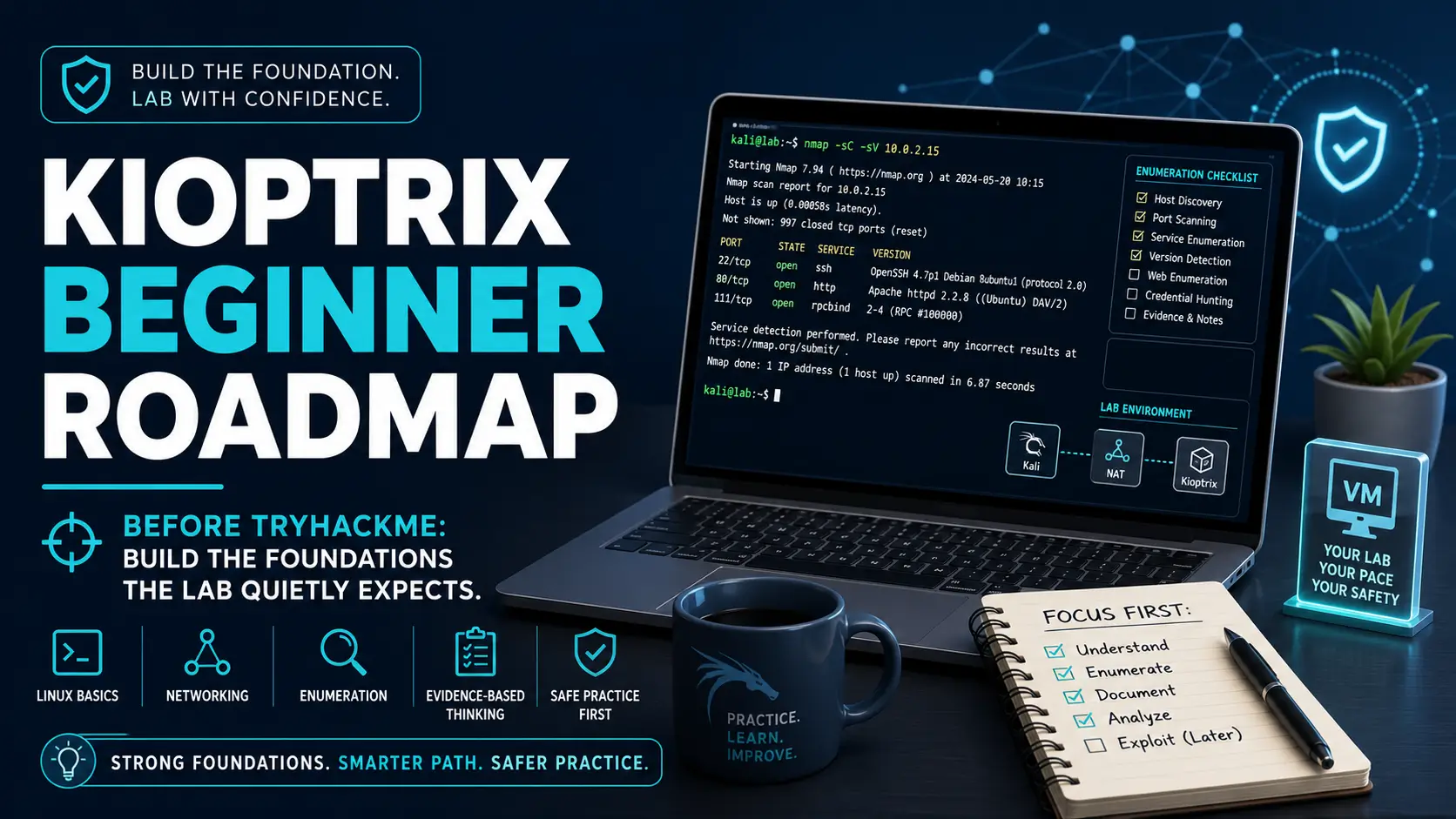
Kioptrix Beginner Roadmap Before TryHackMe: Build the Foundations the Lab Quietly Expects
Kioptrix can feel strangely silent when you first boot it. There is no friendly prompt asking which port to inspect, no progress bar glowing in the corner, and no cheerful checkpoint confirming that your last command was sensible. You receive a vulnerable machine, an IP address to discover, and a wide patch of uncertainty.
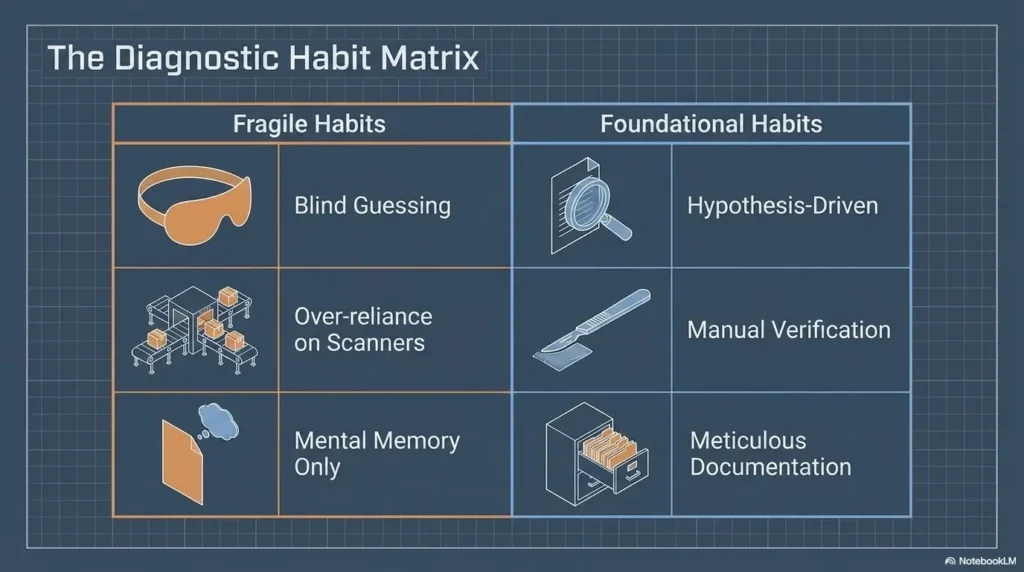
That silence is useful. It exposes the gap between knowing a few security tools and having a repeatable investigation process. Before you chase exploit names, you need enough Linux, networking, virtualization, enumeration, web, research, and note-taking skill to turn raw observations into defensible next steps.
This roadmap gives you that missing bridge. It will not hand you a Kioptrix solution. Instead, it shows you how to build an isolated lab, ask better questions, recognize weak evidence, recover from dead ends, and decide when guided TryHackMe practice would strengthen a specific skill gap.
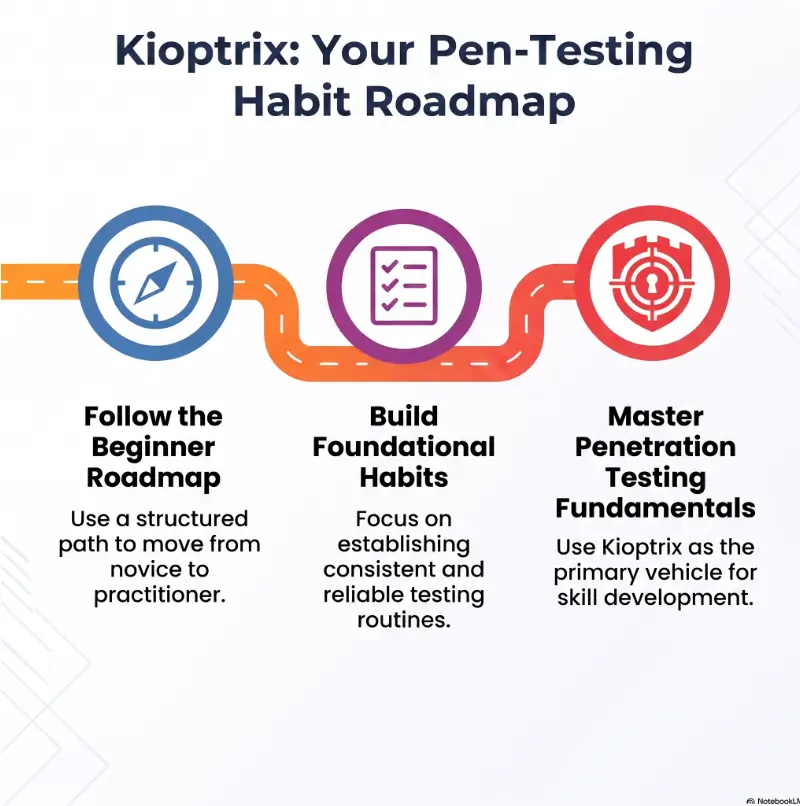
Build safely
Create an isolated, recoverable virtual lab before touching the target.
Think clearly
Convert ports, banners, pages, and errors into ranked hypotheses.
Learn independently
Use hints without surrendering the reasoning that makes practice valuable.
Your goal is not to collect commands. It is to make every next step answerable with evidence. 🧭
Snapshot
This guide is for cybersecurity beginners who understand ordinary computer use but lack a dependable lab workflow. It helps you identify the skills Kioptrix assumes, prepare a safe practice environment, compare free and paid learning options, and complete an evidence-first enumeration session before attempting exploitation.
Table of Contents
Before You Boot Kioptrix: Permission, Isolation, and Expectations
Keep every technique inside an authorized lab
Kioptrix is intentionally vulnerable. That makes it useful for education and unsuitable for careless network placement. Use it only on systems you own or have explicit permission to test.
Do not reuse lab scanning, enumeration, authentication testing, or exploitation techniques against public websites, workplace systems, shared Wi-Fi devices, school networks, or somebody else’s cloud account. A command does not become harmless merely because it appeared in a beginner tutorial.
Before You Act
This article teaches general lab preparation and investigative habits. It does not authorize testing of any real system and does not provide a guaranteed route through a particular machine. Confirm the scope of every exercise, keep vulnerable targets isolated, use non-destructive methods, and follow the platform or lab owner’s rules.
Why Kioptrix feels harder than a guided room
A guided platform often breaks a task into questions. One prompt may ask you to identify an open port, another may request a service version, and a later prompt may point toward a particular weakness.
Kioptrix usually removes that scaffolding. You must decide what to inspect, what evidence matters, how deeply to follow a service, and when a theory has become too weak to justify more time.
The first scan is rarely the true difficulty. The hard part is choosing the second, third, and fourth action without turning the terminal into a slot machine.
Define success before you chase root access
Root access is one possible milestone, not the only measure of a productive session. A beginner can have an excellent practice day without exploiting anything.
- You identified the correct target and documented the virtual network.
- You discovered services and saved the original output.
- You separated confirmed facts from guesses.
- You researched one service carefully instead of searching for a full walkthrough.
- You recorded failed theories without repeating them.
- You ended with a clear next test tied to observed evidence.
Key takeaway: Kioptrix tests whether you can create structure when the lab provides very little. Confusion is not failure. Undocumented confusion is where learning begins to leak away.
The Kioptrix Readiness Check: Skills You Need Before Starting
Score your foundations honestly
You do not need to be an experienced penetration tester. You do need enough familiarity to recognize what a tool is doing and notice when the lab itself is misconfigured.
| Foundation | Ready enough | Practice first |
|---|---|---|
| Linux navigation | You can move, list, read, search, edit, and manage files from a terminal. | Every command feels isolated and directory paths are confusing. |
| Networking | You can explain IP addresses, ports, TCP, services, and basic routing. | You treat an IP address, URL, port, and protocol as interchangeable. |
| Virtual machines | You can import a VM, change its network mode, and restore a snapshot. | You cannot tell whether a failure belongs to the target, attacker, or hypervisor. |
| Scanning | You understand the difference between finding a host, port, and probable service. | You run copied flags without knowing how they change the result. |
| Web basics | You understand paths, parameters, methods, headers, status codes, and source code. | You open a page, see no login form, and assume the web service is irrelevant. |
| Documentation | You record commands, outputs, interpretations, and next steps. | Your notes contain screenshots and commands but no conclusions. |
Four or more “ready enough” answers usually indicate that Kioptrix can become productive practice. Fewer than four does not mean you should abandon it. It means you should use the missing rows as a study plan.
Three beginner profiles, three sensible starting points
The practical IT beginner may already understand IP addresses, permissions, and virtual machines from help-desk or system-administration work. This reader can often begin Kioptrix immediately, provided they slow down and document security assumptions instead of racing toward tools.
The course-first learner may know security vocabulary but feel lost without numbered tasks. A few guided networking, Linux, and web rooms can build confidence before returning to Kioptrix for independent practice.
The budget-conscious career changer may be assembling a lab on an older laptop. This reader should prioritize a lightweight setup, clean snapshots, plain-text notes, and free official documentation rather than buying a large collection of courses.
You do not need to memorize every port or command
Reference use is part of technical work. The useful skill is knowing what to look up, how to judge the source, and how to connect the answer to your own evidence.
A small working vocabulary is enough at first: files, permissions, processes, IP addresses, ports, protocols, services, requests, responses, users, groups, and evidence. The larger vocabulary will arrive through repeated contact.
Readers who need a focused terminal refresher can begin with the Kioptrix guide for Linux beginners. Those who struggle to connect ports with services may find the networking foundations for Kioptrix beginners more useful before proceeding.
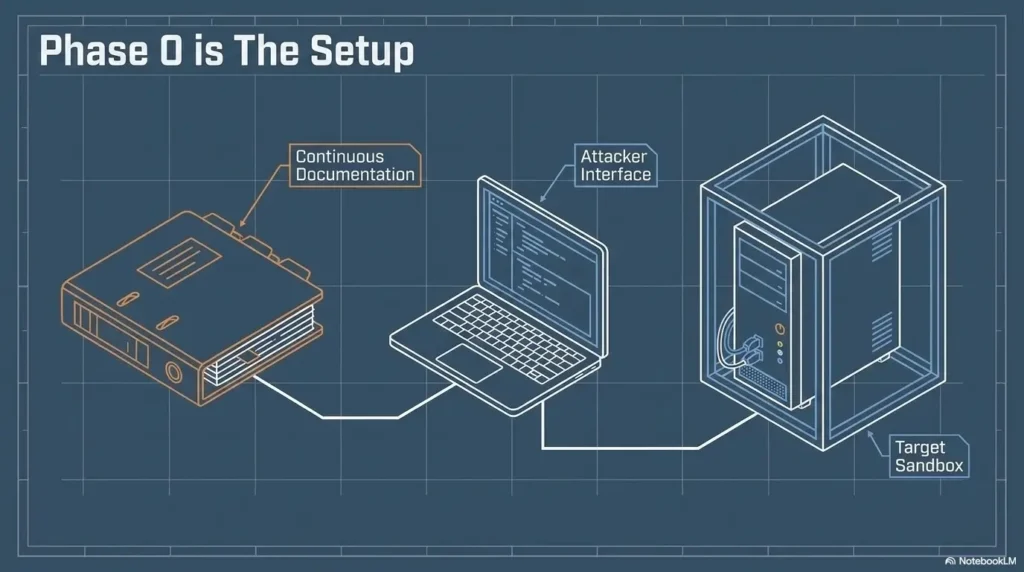
Build an Isolated Kioptrix Lab That Is Easy to Repair
Choose the virtual network mode before booting the target
Your attacker machine and Kioptrix target need to communicate with each other. They do not need to sit openly on your home network, and the vulnerable target does not need direct public internet exposure.
| Network option | Typical use | Beginner concern |
|---|---|---|
| Host-only network | Attacker and target communicate inside a private virtual segment. | Usually the clearest option for isolated practice. |
| Internal network | Selected virtual machines communicate without direct host access. | Useful isolation, but troubleshooting may feel less convenient. |
| NAT network | Virtual machines may share controlled outbound connectivity. | Review the hypervisor settings carefully before using a vulnerable target. |
| Bridged networking | The VM appears more directly on the physical network. | Avoid for intentionally vulnerable beginner targets unless you fully understand the exposure. |
Hypervisor labels and behavior can vary, so confirm the documentation for your chosen software. Record the network mode in your notes. That one line can save an hour when a target suddenly appears unreachable after a reboot.
Verify the lab before blaming the security tools
Begin by checking the attacker machine’s address and route. Identify the target using the lab’s intended discovery method, then confirm that both systems belong to the expected private range.
ip addr ip route ping -c 3 <lab-target-ip>A failed ping does not always prove that a host is down because systems may ignore those requests. It does tell you to verify addressing, adapter status, virtual switches, firewall behavior, and discovery assumptions before hunting application weaknesses.
Use snapshots as experimental bookmarks
Create a clean snapshot after the attacker and target can communicate. Take another before making a major configuration change or running a test that may alter the target.
- Name snapshots by state, not mood: “clean-import,” “network-confirmed,” or “before-test-01.”
- Record the snapshot name in the session log.
- Restore deliberately instead of stacking unexplained changes.
- Keep the original vulnerable machine file separate from the working copy.
The detailed Kioptrix lab setup guide can help when you need a separate checklist for importing, networking, and validating the machines.
Key takeaway: A vulnerable lab should be easy to identify, easy to isolate, and easy to reset. When those three conditions are missing, ordinary troubleshooting becomes foggy and safety margins shrink.
Linux and Networking Foundations That Prevent Blind Guessing
Linux skills Kioptrix quietly assumes
You should be comfortable working without a graphical file browser. This does not require wizard-level shell knowledge. It requires enough fluency to inspect your environment without becoming disoriented.
- Move between directories and understand absolute versus relative paths.
- List hidden files and inspect file metadata.
- Read, create, edit, copy, move, and remove files carefully.
- Search file contents and filter command output.
- Recognize users, groups, ownership, and permission bits.
- View processes and listening network connections.
- Install or update packages without treating every error as a tool failure.
Pipes and redirection deserve special attention. Scans can produce more output than your eyes can comfortably hold. You should know how to save results, search them, and compare them later.
What an open port means, and what it does not mean
An open port indicates that something is listening and responding under the conditions of the scan. It does not prove the service is exploitable, correctly identified, reachable by every protocol, or useful to the intended attack path.
Think of an open port as a lit office window. You know activity exists behind the glass. You do not yet know who is inside, what they are doing, or whether the name on the directory is current.
| Observation | Reasonable question | Unsafe conclusion |
|---|---|---|
| Port 80 is open | What web server, pages, headers, paths, and technologies are visible? | The web server must contain the intended exploit. |
| An SSH banner shows a version | Can the version be confirmed through other evidence? | The banner is unquestionably accurate and vulnerable. |
| SMB responds | What dialect, hostname, workgroup, shares, or access conditions can be identified? | Anonymous access must be available. |
| A database port is exposed | Is the service remotely accessible, authenticated, or connected to a discovered application? | Default credentials will work. |
A useful TCP mental model without the textbook fog
TCP is connection-oriented. A client and server exchange control information before ordinary application data flows. Scan results may differ because tools use different packet types, privileges, timing, retry behavior, and assumptions about host availability.
You do not need to reproduce every flag from memory. You should be able to explain why one scan looked for live hosts, another checked ports, and another attempted service or operating-system identification.
Show me the nerdy details
Service identification is an inference process. A scanner may compare response patterns with a probe database, inspect banners, observe protocol behavior, and assign a confidence level. Operating-system guesses may depend on TCP/IP stack characteristics rather than a direct statement from the target.
Older lab machines can produce awkward results because modern tools, protocol defaults, and client libraries have changed. A failed negotiation may reveal a compatibility issue rather than the absence of a service.
This is why raw output matters. A summarized tool label can hide the exact response that would help you distinguish a network failure, protocol mismatch, authentication requirement, or misleading fingerprint.
The Evidence-First Enumeration Loop
Begin broad, then narrow one service at a time
Your opening scan should create a map, not attempt every possible test. Identify the target, discover exposed ports, estimate the services behind them, and save the output.
nmap -sV -oA kioptrix-initial <lab-target-ip>This example performs service-version detection and writes results in several useful formats. Run it only against your isolated lab target. Read the official option descriptions before adding flags simply because they appeared in somebody else’s notes.
After the broad scan, choose a service based on evidence. Web, file-sharing, remote administration, mail, name services, and databases each have different questions. Avoid opening six terminals and launching unrelated scanners before reading the first result.
Turn every result into a narrower question
- What software appears to be running?
- How reliable is the version evidence?
- What information is available without credentials?
- Does the service reveal usernames, paths, hostnames, modules, or configuration clues?
- Does another discovered service confirm or contradict this result?
- What observation would support the next hypothesis?
- What result would prove that the hypothesis is weak?
That last question is important. A useful hypothesis must be falsifiable. “There is probably something vulnerable here” is not a testable statement. “The reported server version may fall within an affected range, so I need to confirm the module and required conditions” is much stronger.
Use a small evidence ledger
| Field | Example entry |
|---|---|
| Observed fact | TCP port responds and service detection suggests an HTTP server. |
| Source | Initial scan file and manually opened page. |
| Confidence | High for the open port, medium for the exact version. |
| Interpretation | The web service deserves targeted content and technology inspection. |
| Next test | Inspect headers, source, visible links, error behavior, and common paths. |
| Stop condition | No new evidence after manual review and one focused discovery pass. |
A dedicated Kioptrix note-taking workflow can help you turn this structure into a reusable session template.
Real-world example: two ordinary clues become one useful lead
A beginner scans a lab target and notices a web service plus a file-sharing service. The web page looks nearly empty, so the learner spends twenty minutes launching additional web scanners. None produces a convincing result.
After returning to the notes, the learner inspects the file-sharing response more carefully and finds a hostname. The same name appears inside an error message on the website. That connection suggests the services belong to the same older application stack rather than two unrelated dead ends.
The learner does not immediately run an exploit. Instead, they update the evidence ledger, confirm the server technology through headers and page behavior, then research the exact version conditions.
The lesson is quiet but valuable: the breakthrough came from joining two modest observations, not from adding a louder scanner.
The Evidence-First Kioptrix Loop
1. Bound
Confirm scope and isolation.
2. Discover
Find the target and ports.
3. Identify
Estimate services and versions.
4. Verify
Corroborate the evidence.
5. Hypothesize
Rank plausible weaknesses.
6. Test
Use the least destructive check.
7. Record
Save meaning, not just output.
Web Enumeration and Vulnerability Research Without Roulette
Use the browser before adding more automation
A visible website is not decorative furniture attached to port 80. Read it. Follow its links. Inspect the page source. Note titles, comments, file extensions, form actions, cookies, headers, redirects, error pages, and unusual wording.
Manual observation often gives context that a scanner cannot. A scanner may report an old header or possible directory. Your browser can show whether the page is genuinely reachable, requires authentication, redirects elsewhere, or belongs to a different application component.
Search for hidden content methodically
Directory and file discovery can reveal administration panels, backups, test pages, scripts, documentation, and forgotten content. The goal is not to spray enormous wordlists until the laptop fan becomes a small aircraft.
- Choose a wordlist appropriate to the likely technology and age of the application.
- Record status codes, response sizes, redirects, and repeated patterns.
- Verify interesting results manually.
- Watch for custom error pages that make missing paths look successful.
- Stop when the scan produces duplication rather than new evidence.
Research exact conditions, not exciting titles
Before searching for exploit code, confirm the product, probable version, operating system, module, authentication requirement, and network condition as closely as the lab allows.
- Which versions are affected?
- Is authentication required?
- Does the issue depend on a specific module or configuration?
- Is the proof of concept designed for the same operating system and architecture?
- Could the test alter files, crash a service, or create a persistent account?
- What evidence would demonstrate that the weakness applies to this lab target?
A vulnerability title is a lead, not a verdict. Older banners may be patched, customized, or inaccurate. Newer clients may also fail to communicate with legacy services unless compatibility settings are understood.
Read proof-of-concept code before running it
Even in an authorized lab, inspect what a script expects and changes. Look for hard-coded addresses, callback settings, compilation requirements, dependencies, destructive file operations, credential assumptions, and commands that execute with elevated privileges.
The “perfect exploit” may fail because the banner is wrong, a module is absent, a dependency changed, the target architecture differs, or the proof of concept was written for a related but not identical build. Failure should narrow your theory. It should not trigger random tool switching.
Key takeaway: Research begins after identification, not before it. The closer your evidence gets to the product, version, configuration, and required conditions, the less time you waste on impressive-looking dead ends.
What Changes After the First Shell
Treat initial access as a checkpoint
An initial shell answers one question: some form of authorized code execution or access was possible under the tested conditions. It does not automatically explain the business impact, persistence, privilege level, or remediation.
Pause and identify where you are. Record the current user, groups, operating system, hostname, network interfaces, accessible directories, available tools, running processes, and listening services. Preserve the steps that produced access before exploring further.
Understand permissions before hunting another exploit
- Users and groups
- File and directory ownership
- Read, write, and execute permissions
- SUID and SGID behavior
- Scheduled tasks and service accounts
- Writable scripts, paths, and configuration files
- Secrets exposed through readable files or process arguments
- Privileged programs that trust user-controlled input
Privilege escalation often rests on misplaced trust. A privileged process may trust a file, executable path, environment variable, scheduled script, service configuration, or user-controlled directory more than it should.
Prefer least-destructive validation
Observe before changing. Avoid deleting files, replacing services, altering passwords, disabling controls, or leaving persistent access unless a specific lab exercise requires it and provides clear instructions.
A good learner can explain both the technical path and the safer validation choice. That habit transfers into professional testing, where system stability and client trust matter as much as technical cleverness.
Report the chain, not merely the final privilege
- Scope: Which isolated systems were authorized?
- Finding: What weakness or trust failure was observed?
- Evidence: Which outputs, responses, and screenshots support it?
- Path: How did one finding lead to the next?
- Impact: What access became possible inside the lab?
- Remediation: Which configuration, version, permission, or design change could reduce the risk?
- Limitations: What was not tested or not confirmed?
The Kioptrix enumeration report template provides a useful bridge between rough terminal notes and a structured practice report.
Common Beginner Mistakes and a Better Hint Ladder
Six mistakes that make Kioptrix feel harder than it is
- Running every tool before reading the first result. Tool volume creates noise when no question guides the activity.
- Treating banners as unquestionable facts. Version strings may be incomplete, altered, or only partially reliable.
- Searching for a walkthrough at the first obstacle. This removes the exact reasoning moment the lab was meant to create.
- Recording commands without interpretations. A command log cannot tell you why a result mattered.
- Ignoring failed attempts. Unrecorded failures return later wearing a new hat.
- Exposing the target carelessly. An intentionally weak machine should never wander freely across a shared network.
Use a five-level hint ladder
| Level | Action | What it preserves |
|---|---|---|
| 1 | Recheck ports, paths, usernames, errors, and unexplored services. | Your independent reasoning. |
| 2 | Research the normal purpose and behavior of one service. | Technical understanding. |
| 3 | Request a directional hint, such as which service deserves more attention. | Most of the investigative path. |
| 4 | Read only the stage where progress stopped. | The remaining solution. |
| 5 | Reset and reproduce the path from memory. | Retention and explanation skill. |
Recognize the difference between discomfort and stagnation
Discomfort means you do not immediately know the answer. Stagnation means you are repeating the same actions without producing new evidence, refining a hypothesis, or ruling anything out.
Before requesting a hint, write three sentences:
- What I know
- What I suspect
- What I have already tested
This tiny ritual improves the hint you receive and prevents helpers from repeating work you have already completed.
Key takeaway: The best hint changes your direction without replacing your judgment. Use the smallest amount of help that restarts evidence production.
Free vs Paid Tools, Courses, and Lab Setups
Good, better, and best beginner setups
Kioptrix does not require an expensive security workstation or a subscription cabinet filled with blinking tools. Your budget should solve a real constraint, such as limited memory, weak note organization, slow guided learning, or difficulty maintaining a consistent practice routine.
| Setup | What it includes | Best for | Before paying |
|---|---|---|---|
| Good | Existing computer, free hypervisor, attacker VM, isolated target, plain-text notes, official documentation. | Budget-conscious beginners learning the basic workflow. | Confirm that the computer has enough memory and storage for two modest VMs. |
| Better | Additional RAM or storage, structured note application, guided beginner platform, regular backup routine. | Learners who need smoother multitasking and organized repetition. | Check whether the upgrade solves a measured bottleneck rather than a vague desire for “better gear.” |
| Best | Dedicated lab computer, segmented home-lab network, curated courses, reporting templates, scheduled review sessions. | Committed learners building a broader portfolio over several months. | Compare curriculum depth, update frequency, lab access terms, cancellation rules, and total annual cost. |
When free tools are enough
A free setup is enough when your computer can run the machines reliably, you can access official references, and your main challenge is practice rather than software capability.
- Use a free hypervisor that supports the imported target format.
- Use a maintained Linux distribution and install only the tools you understand.
- Save scan results in text-based formats that remain searchable.
- Keep a simple folder structure for scans, screenshots, notes, and reports.
- Use official manuals before buying command reference material.
When paid learning may be worth considering
Paid training can be useful when you repeatedly stall on the same foundation, need a structured sequence, value browser-based labs, or require accountability to maintain a study schedule.
Before purchasing a course or platform, compare:
- Whether the curriculum teaches Linux, networking, web basics, enumeration, and reporting
- How much lab access is included
- Whether hints explain reasoning or merely reveal answers
- How often material is updated
- Whether exercises require additional subscriptions
- Monthly versus annual cost
- Refund, renewal, and cancellation terms
- Whether the difficulty matches your present skill gap
A large course bundle is poor value when you need only two evenings of Linux practice. A modest guided path can be excellent value when it prevents months of random study.
How to avoid wasting money on beginner security tools
- Do not buy a scanner because its dashboard looks authoritative.
- Do not purchase hardware before measuring memory, storage, or network limitations.
- Do not pay for overlapping courses with nearly identical beginner modules.
- Do not assume a certification course will teach independent lab troubleshooting.
- Do not mistake tool automation for investigative skill.
- Do not store sensitive personal data inside practice notes or public write-ups.
The best beginner purchase is often not another tool. It may be enough RAM to keep two VMs stable, a course that fixes one clearly identified gap, or a quiet hour protected from notifications.
How to Know You Are Ready for TryHackMe
Use Kioptrix and guided practice for different jobs
Kioptrix is useful for testing whether you can create your own process. Guided rooms are useful for introducing concepts, correcting gaps, and exposing you to technologies you may not encounter in one legacy machine.
| Learning need | Kioptrix is stronger when | TryHackMe-style guidance is stronger when |
|---|---|---|
| Decision-making | You need to choose the next test independently. | You need examples of a sound sequence. |
| Foundational gaps | You want the gaps to become visible. | You need structured teaching to close them. |
| Confidence | You want proof that you can work without checkpoints. | You need smaller wins and immediate feedback. |
| Technology coverage | You want depth on one deliberately vulnerable machine. | You want exposure to broader systems and modern scenarios. |
| Documentation | You want to create your own evidence trail. | You want prompts that model what information matters. |
A deeper Kioptrix versus TryHackMe comparison can help when you are deciding how to divide your weekly practice time.
Seven readiness signals that matter more than speed
- You can explain why you chose each scan or manual check.
- You distinguish host discovery, port discovery, service identification, vulnerability research, exploitation, and privilege escalation.
- You save raw output and summarize what it means.
- You can recover from a dead end without restarting the entire lab.
- You use increasingly specific research queries instead of searching for the machine name plus “walkthrough.”
- You can write a short report with evidence and remediation ideas.
- You consistently respect authorization and isolation boundaries.
A practical way to combine both
- Complete one evidence-first Kioptrix enumeration session.
- List the exact points where you became uncertain.
- Match each uncertainty to a guided topic, such as Linux permissions, HTTP requests, scanning, or privilege escalation.
- Complete only the relevant guided modules.
- Return to a clean Kioptrix snapshot.
- Repeat the investigation without copying your previous commands line by line.
- Write a short comparison of what you noticed the second time.
This creates a useful rhythm: independent practice exposes the gap, structured practice repairs it, and independent replay confirms that the repair held.
Key takeaway: You do not graduate from Kioptrix into TryHackMe. Use each format as a different instrument: one teaches the notes, the other asks whether you can still hear the melody without a conductor.
FAQ About Starting Kioptrix Before TryHackMe
Is Kioptrix suitable for a complete cybersecurity beginner?
It can be, but a complete beginner should first learn basic Linux navigation, IP addressing, ports, protocols, virtualization, scanning, and service enumeration. Otherwise, ordinary lab setup problems may look like security puzzles.
Should I complete TryHackMe before Kioptrix?
No. A useful approach is to let Kioptrix reveal your gaps, then use guided rooms to repair those specific foundations. Learners who feel completely lost without prompts may benefit from completing a foundational path first.
Which Kioptrix machine should I start with?
Start with the earliest machine in the series and progress in order. Earlier entries are generally the most natural introduction to the lab’s older systems and evidence-driven workflow.
Do I need Kali Linux for Kioptrix?
No. Kali is convenient because many security tools and wordlists are readily available, but another maintained Linux distribution can work when you install and configure the necessary tools. Use an operating system you can troubleshoot responsibly.
How long should I try before reading a walkthrough?
There is no universal timer. Complete more than one enumeration pass, review your notes, document failed theories, and request a directional hint when you are repeating actions without generating new evidence.
Is Kioptrix safe to run on a home computer?
It is safer when the vulnerable target runs inside a properly isolated virtual network with clear adapter settings and recoverable snapshots. Do not expose it directly to the public internet or casually bridge it onto a shared household network.
What should I write down while solving the machine?
Record the target address, network mode, commands, raw outputs, service versions, discovered paths, usernames, screenshots, hypotheses, confidence levels, failed attempts, successful steps, and possible remediation.
Does solving Kioptrix prepare me for professional penetration testing?
It develops useful habits in enumeration, research, troubleshooting, evidence handling, and reporting. Professional testing also requires formal scoping, legal authorization, client communication, modern technologies, safe validation, data handling, and clear remediation guidance.
Your 15-Minute Next Step: Build the Evidence Worksheet
Do not begin by searching for the correct exploit. Begin by creating the page that will keep your investigation from dissolving into disconnected terminal history.
Open a plain-text or markdown file and create these seven headings:
- Authorized target and scope
- Virtual network mode
- Attacker and target IP addresses
- Discovered ports and probable services
- Supporting version evidence
- Three ranked hypotheses
- Next test and stop condition for each hypothesis
Then boot only the isolated attacker and target machines. Confirm the network, identify the target, and save one initial service scan. Stop before exploitation.
Your first session is complete when every proposed next step points back to an observed fact. That single standard changes Kioptrix from a dark room full of tools into a patient investigation with a visible thread.
The finish line for today
One isolated lab. One saved scan. Three evidence-backed hypotheses. No copied exploit commands. That is a small session with unusually strong bones.
Last reviewed: 2026-08