
Authorized lab learning guide
Kioptrix Level:
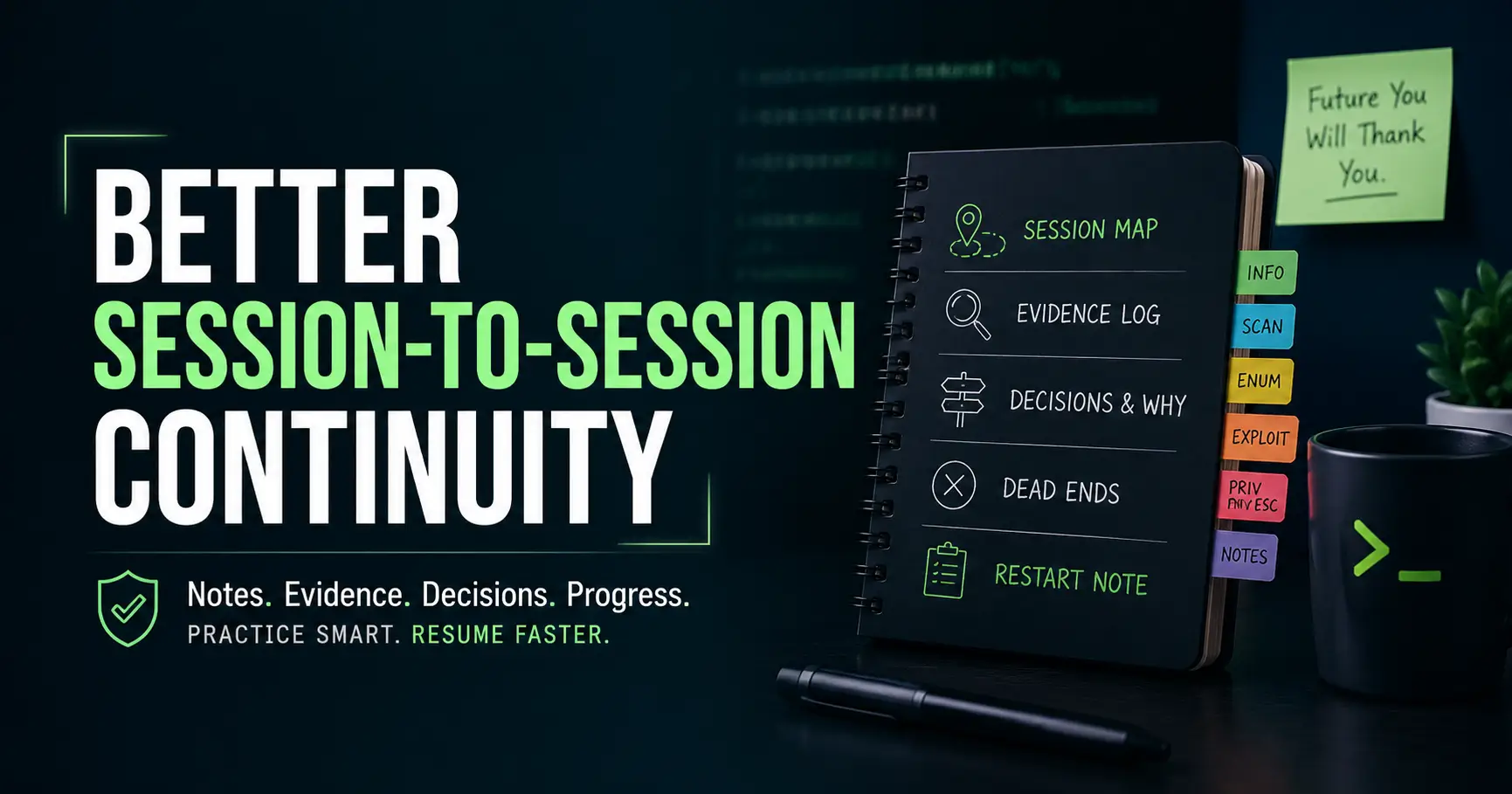
Better Session-to-Session Continuity
Kioptrix Level labs look simple from a distance: boot the vulnerable VM, find the target, enumerate, test, learn, repeat. Then real life enters wearing muddy boots. You close the laptop, come back two days later, and your notes feel like a drawer full of tangled cables.
This guide is not a shortcut to root. It is a method for remembering how you think. For beginner cybersecurity learners, bootcamp students, CTF writers, and junior pentesters, the hidden skill is continuity: preserving the trail well enough that tomorrow-you can restart without walking through fog.
The better Kioptrix practice habit is humble, almost clerical, and wildly useful: define scope, capture evidence, write why you made each turn, park dead ends, and end every session with a restart note. That is how a vulnerable VM becomes more than a solved box. It becomes a training room for professional judgment.
Resume faster
Build notes that tell you exactly where to begin next time.
Think cleaner
Separate facts, guesses, unknowns, decisions, and lessons.
Write safer
Keep lab posts educational, authorized, and defensively useful.
Best promise: by the end, you will have a restartable Kioptrix session note you can use today. 🧭
Snapshot
This article is for cybersecurity learners practicing Kioptrix-style vulnerable VMs in a legal, controlled lab. It solves the “I forgot where I left off” problem with a practical continuity system: session maps, evidence logs, decision notes, safer writeups, and a 10-line restart template you can use before your next practice session.
Table of Contents
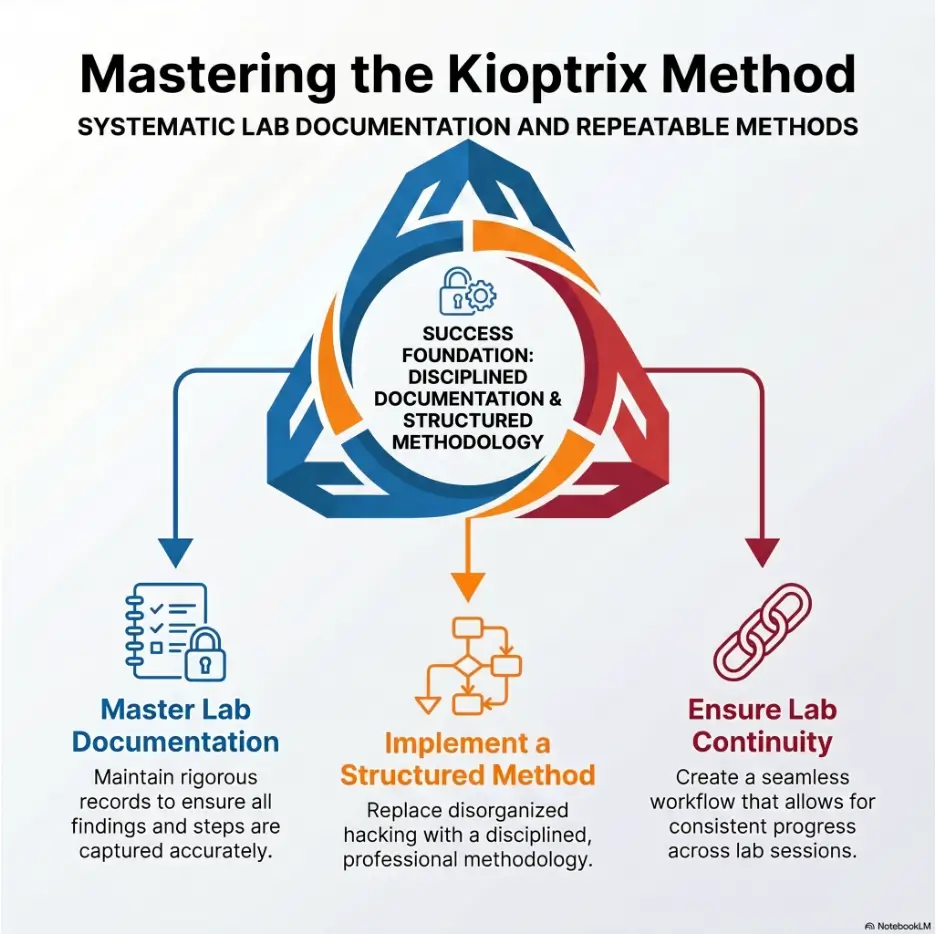
Before You Act: Keep the Lab Door Locked
Kioptrix Level practice belongs inside an authorized lab. That means systems you own, deliberately vulnerable VMs, training platforms, or environments where you have explicit permission to test. The whole point is to learn carefully, not to treat the public internet as a practice range.
This article focuses on continuity, documentation, and safer learning habits. It does not provide a live-target playbook, and it intentionally avoids copy-paste exploitation sequences that could be misused outside a lab. Think of it as a clean workbench, not a lockpick catalog.
What this guide can and cannot do
This guide can help you organize Kioptrix sessions, improve technical notes, prepare safer blog writeups, and build the kind of evidence habits that transfer into junior security work.
It cannot replace a formal course, legal advice, employer policy, rules of engagement, or professional supervision. If you are testing for a school, employer, client, or public program, confirm scope before touching anything. Scope is not decorative paperwork. It is the fence around the garden.
Key takeaway
Every Kioptrix note should make the lab boundary visible: VM name, network mode, target IP, date, and permission context. If your notes cannot prove you stayed inside the lab, they are incomplete.
Official resources worth bookmarking
For the original Kioptrix Level 1 lab page, start with VulnHub. For web testing structure, OWASP’s Web Security Testing Guide is a strong reference. For professional security testing process, NIST SP 800-115 is useful when you want your lab habits to sound less like a late-night scramble and more like a reportable method.
Who This Guide Is For, And Who Should Skip It
The reader who benefits most from this guide is not necessarily the fastest learner. It is the learner who keeps losing the thread. Maybe you practice after work, between classes, or on Sunday morning before the house wakes up. You have enough curiosity to begin, but not always enough continuity to return gracefully.
That is normal. Kioptrix practice is often squeezed into life’s leftover corners. Better notes turn those corners into a corridor.
For beginners who keep restarting from zero
If you open your lab and immediately think, “Wait, what was I doing?” this article is for you. The goal is not to make your notes beautiful. The goal is to make them restartable.
A restartable note answers five questions quickly: what target was I working on, what did I confirm, what did I guess, what did I ignore, and what should I do next?
For CTF writers and portfolio builders
If you publish Kioptrix walkthroughs, your job is not just to show the ending. A strong writeup teaches the decision process. Readers should see why you moved from one service to another, why one finding mattered, and what a defender could learn from the same evidence.
For deeper portfolio structure, pair this article with your own technical journal and consider linking related practice notes to a guide such as building a Kioptrix technical journal.
For junior pentesters building reporting habits
Professional work rarely happens in one heroic sitting. You pause for meetings, tool issues, client questions, retesting windows, and report deadlines. If your Kioptrix notes train you to preserve context, they become practice for real engagement handoffs.
This is where lab discipline becomes career-friendly. You are not only learning to find things. You are learning to explain what you found without losing the evidence trail.
Who should skip this guide
Skip this guide if you want real-world target exploitation, shortcut payloads without understanding, or instructions that ignore permission. That is not the table we are setting here.
If you want a more basic starting point, read a foundation guide first, such as what Kioptrix is and why beginners use it. Then come back when you are ready to build a repeatable practice routine.
The Hidden Skill Kioptrix Teaches Better Than Flashier Labs
Flashier labs can feel like neon arcades. Kioptrix is quieter. Its age and simplicity make it strangely useful because there is less decoration between you and the habit that matters: method.
Many learners think the lesson is “get root.” That is one outcome, but it is not the whole skill. The deeper lesson is whether you can preserve a chain of reasoning from first contact to final proof.
Continuity is the quiet muscle
Continuity means your work survives interruption. It means your notes can answer, “Why did I think this mattered?” after the caffeine has worn off and the terminal history has become cryptic bird tracks.
A learner with continuity can stop safely, resume quickly, and explain clearly. That is more valuable than looking busy for four hours and remembering nothing but the victory screenshot.
“Rooted once” is not the same as “learned”
You can solve a lab by following crumbs from a walkthrough and still fail to learn the route. The difference shows up when you try to repeat the process without the walkthrough open.
Learning means you can describe your method in plain English: how you identified services, how you prioritized leads, why a finding looked promising, what failed, and what defensive lesson came out of it.
The best notes are restartable, not pretty
Pretty notes often arrive after the work is done. Restartable notes are useful while the work is still messy. They contain half-formed guesses, dead ends, and tiny reminders that would look boring to strangers but priceless to tomorrow-you.
Do not confuse clean formatting with clear thinking. A plain note that gets you moving in three minutes beats a gorgeous document that hides the next step like a sock in a hotel duvet.
Key takeaway
In Kioptrix practice, the investigation trail is the product. Root access is the receipt, not the whole purchase.
Real-world example: the missing restart note
A learner spends two hours on Kioptrix after work. They identify several open services, chase one promising lead, hit errors, then close the laptop because dinner is getting cold. The next night, they remember only the feeling of being close.
They re-run broad scans, reopen old tabs, and waste 35 minutes discovering what they already knew. Nothing dramatic happened. No tool failed. The missing piece was one final sentence: “Tomorrow, test the web service hypothesis first, then compare the SMB notes only if that stalls.”
That sentence would have acted like a bookmark in a thick novel. Without it, the learner had to reread the chapter.
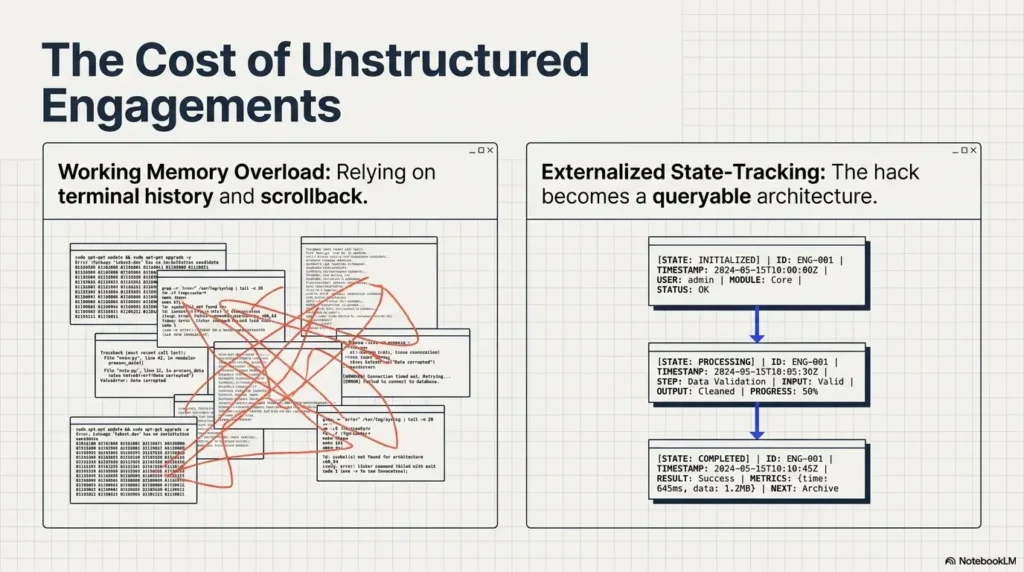
Start With a Session Map Before Touching the Keyboard
The first continuity mistake happens before scanning. Learners often start clicking, launching, and probing before they have written down the basic frame of the session. Then the notes become a weather report: lots of activity, little navigation.
A session map is a one-page anchor. It tells you where the work belongs, what you intend to learn, and what assumptions you are carrying into the lab.
Define scope in one sentence
Write a scope sentence at the top of every note. Keep it boring. Boring is good here.
Example: “Today I am practicing against the Kioptrix Level 1 VM on my local host-only lab network, with no testing outside my owned environment.”
That sentence does two jobs. It protects your ethical boundary, and it keeps your notes from drifting into generic internet advice.
Record the lab facts that change
Beginner confusion often comes from quiet changes: a VM IP changes, a network adapter moves, a tool version behaves differently, or a snapshot restores yesterday’s progress into a different state. These details feel small until they steal an evening.
- VM name and level
- Date and session number
- Hypervisor and network mode
- Target IP or discovery method
- Attacker machine and key tool versions
- Snapshot or reset status
- Session goal
If your lab networking is still shaky, review a setup guide such as how to build a safe hacking lab at home before pushing deeper into practice.
Separate known facts, guesses, and unknowns
This tiny structure prevents mental soup. Put confirmed information in one place, hypotheses in another, and unanswered questions in a third. Your brain will try to blend them together when the room gets noisy.
| Note block | What belongs there | Example wording |
|---|---|---|
| Known facts | Confirmed details from your lab | “Target responds on the lab network.” |
| Guesses | Reasonable ideas that need testing | “The web service may be the best first lead.” |
| Unknowns | Questions that block a decision | “I have not confirmed whether the service banner is reliable.” |
| Next action | The next test that answers a question | “Validate the service manually before choosing a path.” |
The Kioptrix Continuity Loop
1. Scope
Name the VM, network, permission, and session goal.
2. Observe
Record facts without rushing into theories.
3. Decide
Write why one lead deserves attention now.
4. Preserve
Capture evidence, errors, dead ends, and lessons.
5. Restart
End with tomorrow’s first action, not a vague wish.
Don’t Chase Root First: Chase a Repeatable Trail
Root-first learning feels exciting because it gives the session a finish line. The problem is that it can train you to skip the very habits that make you useful: evidence, reasoning, and careful review.
In Kioptrix, treat every discovery like a clue with a label attached. What did you see? Why did it matter? What did it suggest? What did it not prove?
Mistake: pasting commands without purpose
A command without a purpose is just noise with a timestamp. Before you run a test, write a short reason. After you run it, write what changed.
You do not need a novel. Use one sentence: “Purpose: identify exposed services so I can choose the first manual validation step.” That is enough to keep the action tied to thought.
Mistake: deleting failed paths
Failed paths are not clutter when they are labeled. They prevent you from testing the same weak idea again tomorrow. They also teach pattern recognition: why something looked promising, what proved otherwise, and what you would check sooner next time.
Create a small “parking lot” section. Move dead ends there with one line of evidence. This keeps your main note clean without erasing your learning.
Use the breadcrumb rule
For every major action, leave a breadcrumb. A breadcrumb is not a full explanation. It is a small marker that shows future-you where the path came from.
- Before the action: what question am I trying to answer?
- After the action: what useful evidence appeared?
- Decision: follow, park, or discard?
- Reason: why?
Key takeaway
A good Kioptrix session note should let you replay the investigation without rerunning every tool. The note becomes your mental packet capture.
The Continuity Notebook: What to Capture Every Session
A continuity notebook is not a diary, although it may occasionally contain a sentence that sounds like one: “I am tired and probably forcing this lead.” That is useful data. Fatigue changes decisions.
Your notebook should capture enough context to resume, compare, and explain. It should not become a landfill of screenshots and mystery outputs.
Session goal: one small win
Begin each session with one practical goal. Not “finish Kioptrix.” Try “confirm target services,” “validate the top web lead,” “organize yesterday’s evidence,” or “write the defensive lesson for one finding.”
Small goals reduce the pressure to sprint. They also make short sessions valuable. A clean 35-minute session with a clear exit note can beat a four-hour blur.
Commands need purpose, output, and next action
You do not need to paste every line of output into your working note. Preserve raw logs separately if you want accuracy. In the notebook, summarize what mattered.
| Capture item | Bad version | Better version |
|---|---|---|
| Purpose | “Ran scan.” | “Checked exposed services to choose a first manual validation path.” |
| Result | “Lots of output.” | “Confirmed several services worth separating into web, file sharing, and system leads.” |
| Decision | “Try web.” | “Start with web because it offers visible application behavior and lower setup friction.” |
| Next action | “Continue.” | “Validate the service manually and note any version clues before tool-heavy testing.” |
Evidence snapshots should be searchable
Screenshots are useful, but only if you can find them later. Name them with the date, VM, step, and short meaning. Then reference that filename in your notes.
For example, instead of “Screenshot 47,” use a pattern such as “2026-06-kioptrix-level1-service-summary.” A future report writer will quietly thank you. Possibly with snacks.
If screenshots are part of your study workflow, a guide like screenshot naming patterns for security notes can help you keep proof files from becoming a glitter storm.
Exit note: the first thing to do tomorrow
The exit note is the crown jewel of session-to-session continuity. It should be written before you are completely tired. End with one sentence that begins, “Tomorrow, start here.”
Not “keep working.” Not “figure it out.” Write the next physical action: open the note, verify the target, review the parked lead, test one hypothesis, or write one finding.
Key takeaway
The final two minutes of your session decide how expensive tomorrow’s first ten minutes will be.
The Three-Layer Note System for Kioptrix Practice
One note cannot do every job well. Raw accuracy, active thinking, and polished teaching each need a different texture. Put them in layers and your workflow gets calmer immediately.
This is especially helpful if you plan to publish, build a portfolio, or later convert lab work into a mock penetration test report.
Layer 1: raw terminal capture
Raw capture is for accuracy. It preserves the messy output that you may need to verify later. Keep it separate from your working notes so your thinking does not drown in text.
This layer can include copied output, saved logs, timestamps, and proof files. Do not edit it heavily. Raw means raw.
Layer 2: working notes
Working notes are where decisions live. They should be readable during the session and honest about uncertainty. Use headings like Facts, Guesses, Leads, Dead Ends, Evidence, and Next Action.
This is the layer you restart from. If you only maintain one layer, make it this one.
Layer 3: polished writeup
The polished writeup comes last. It turns messy practice into a teaching artifact, portfolio post, or report-style summary. It should not hide the decision points, but it should remove needless confusion.
When you are ready to shape a public post, compare your draft with a guide such as Kioptrix report writing tips so your writing explains evidence, impact, and remediation rather than only the win condition.
A tiny tag system for fast review
Tags make notes searchable without turning them into bureaucracy. Use a small set and keep it consistent.
- scan: discovery and service identification
- service: service-specific observations
- vuln: suspected or confirmed weakness
- proof: evidence worth preserving
- dead-end: tested path that did not pay off
- lesson: what you would do differently next time
Show me the nerdy details
The reason a three-layer note system works is cognitive load. During a lab, your brain is juggling observation, interpretation, memory, and tool output. If every artifact lives in one document, your note becomes both a warehouse and a steering wheel. That is clumsy.
Raw capture protects accuracy. Working notes protect reasoning. Polished writeups protect communication. When those jobs are separated, you spend less time grooming text during the session and more time making clean decisions.
Tools, Costs, And Paid Options Without Wasting Money
You do not need expensive tools to build good Kioptrix continuity. A text editor, folders, and discipline can take you far. Paid tools can help when they reduce friction, but they cannot think for you. A gold-plated notebook still sulks if you never write in it.
The best way to choose a note-taking setup is to match it to your actual study rhythm, not your fantasy version of yourself who labels everything at dawn.
Free is enough when the system is clear
A free setup is enough if you can create folders, save text, name screenshots consistently, and search your notes. Many beginners do better with fewer features because the tool does not become another lab to configure.
Start simple: one folder per VM, one working note, one raw output folder, one screenshot folder, and one final summary. If that feels too plain, good. Plain systems survive tired evenings.
Paid tools may help when search and linking matter
Paid note apps, training platforms, cloud backups, and report templates can be worth considering if you practice often, publish regularly, or need searchable archives across many boxes. Before paying, ask whether the tool will reduce a real bottleneck or merely decorate your procrastination.
Good paid features usually include reliable search, local export, version history, easy linking between notes, attachment handling, and backup options. Red flags include lock-in, poor export, confusing pricing, and a workflow that takes longer than the lab itself.
Good / Better / Best note setup table
| Setup tier | Best for | What it includes | What to watch |
|---|---|---|---|
| Good | Budget-conscious beginners | Plain text notes, local folders, named screenshots, raw output files | Manual organization can get messy if you skip naming rules |
| Better | Regular learners and CTF writers | Markdown notes, internal links, reusable templates, weekly review folder | Template tinkering can become a hobby tax |
| Best | Portfolio builders and junior pentesters | Structured evidence library, report template, backup system, separate polished writeups | More structure only helps if you actually maintain it |
Questions to ask before paying for a tool
- Can I export my notes in a readable format?
- Can I search across files, screenshots, tags, and dates?
- Does it work offline when my lab has no internet?
- Can I separate raw logs from polished notes?
- Will this tool still make sense after 20 VMs?
- Does the price match my actual practice frequency?
For a deeper comparison of security-focused note workflows, see note-taking systems for pentesting. Use it as a buying filter, not a shopping spell.
Don’t Publish a Walkthrough That Teaches the Wrong Lesson
Public walkthroughs can help learners, but they can also flatten a lab into a command dump. When the exploit becomes the hero of the story, the reader may miss the professional lesson: evidence, validation, context, and remediation.
A safer Kioptrix writeup should repeatedly remind the reader that the activity belongs in an authorized lab. It should also translate each major finding into a defensive takeaway.
Make the decision point visible
Instead of writing, “Then I tried the next thing,” explain why the next thing made sense. Was it the service type, version clue, application behavior, error message, configuration hint, or prior knowledge from the lab family?
Decision points are where learners grow. Commands are just footprints. Show the traveler.
Add defensive context after major findings
After each important lab finding, ask: what could a system owner have noticed earlier? What configuration choice contributed to the issue? What monitoring, patching, segmentation, or hardening idea would reduce similar risk in a real environment?
You do not need to turn every section into a policy manual. One clear defensive sentence can change the tone from “look what I did” to “look what this teaches.”
Remove copy-paste danger from public posts
Be careful with public instructions that can travel outside the lab. Keep commands tied to the authorized VM environment. Avoid presenting risky sequences as general recipes. Explain concepts, scope, and verification steps instead of writing as if every target is fair game.
For web testing structure that keeps evidence and test categories organized, the OWASP Web Security Testing Guide is a useful reference.
Walkthrough safety checklist
- State that the post is for authorized lab practice.
- Name the VM or training environment clearly.
- Explain why each major step was chosen.
- Include defensive takeaways after major findings.
- Avoid unnecessary copy-paste sequences that lack context.
- Do not imply the method should be used on systems without permission.
- Separate personal learning notes from public teaching notes.
Key takeaway
A strong walkthrough does not merely reveal what worked. It explains why it worked, where it was authorized, and how a defender could reduce the same risk.
Session Templates That Make Kioptrix Easier to Resume
Templates are useful when they save thought, not when they replace it. The best Kioptrix templates are short enough to use while tired and structured enough to prevent a messy restart.
Use these as working patterns. Adapt them to your style, but keep the core idea: every session should end with enough context to restart cleanly.
The 10-line restart note template
Copy this structure into your next Kioptrix note
- VM and session number:
- Lab scope:
- Target identity confirmed by:
- Known facts:
- Best current lead:
- Why this lead matters:
- Dead ends parked:
- Evidence saved:
- Unanswered question:
- Tomorrow, start here:
The “next three checks” template
When you are unsure where to resume, write exactly three checks. Not seven. Not a heroic scroll of possibilities. Three.
- Check 1: the fastest action that confirms the target state.
- Check 2: the best action that validates your leading hypothesis.
- Check 3: the fallback if the first lead fails.
This template works because it removes the blank-page panic. Tomorrow-you does not need to design the whole session. Tomorrow-you only needs to begin.
The failed-path parking lot
Dead ends deserve a tidy shelf. Use a small table so you can scan them later without feeling accused by your own notes.
| Path tested | Why it looked plausible | What disproved or weakened it | Revisit only if |
|---|---|---|---|
| Service lead A | Visible clue suggested a possible route | Manual validation did not support the assumption | New evidence changes the service picture |
| Service lead B | Older lab pattern made it tempting | The specific target behavior did not match | A later scan or error message connects back |
| Tool output clue | Automated result looked interesting | Manual review suggested low confidence | You can verify it with a second method |
The evidence-to-lesson table
This table is especially useful if you plan to publish or build a portfolio. It forces every technical observation to become a learning point.
| Evidence | What it suggested | How you validated it | Defensive lesson |
|---|---|---|---|
| Service or banner clue | A possible attack surface | Manual review and controlled lab testing | Inventory and version awareness matter |
| Application behavior | A configuration or input-handling concern | Repeated checks inside the VM only | Logging and secure defaults reduce blind spots |
| Error message | A hint about stack or misconfiguration | Compared against other evidence | Verbose errors can expose useful clues |
If you want a dedicated workflow around this idea, explore Kioptrix evidence tracking and connect it with your own restart template.
FAQ
Is Kioptrix Level 1 still useful for beginners?
Yes, especially when you treat it as a fundamentals lab rather than a modern production mirror. Its older design can help beginners focus on enumeration discipline, service identification, note-taking, and structured reasoning without too much noise.
How do I avoid forgetting what I did last session?
End every session with a restart note. Include the target, confirmed facts, best lead, dead ends, saved evidence, unanswered question, and exact next action. The more tired you are, the more valuable that final note becomes.
Should I follow a walkthrough while doing Kioptrix?
Use walkthroughs as comparison tools after your own attempt, not as steering wheels from the beginning. The learning value often lives in your wrong turns, provided you document them clearly and review why they failed.
What should I write down during a Kioptrix session?
Capture the command or action, the reason for doing it, the useful result, what it suggests, and what you plan to test next. A command without reasoning is a footprint without a traveler.
How long should each Kioptrix practice session be?
A useful session can be short if it has a clear goal. “Identify services and write hypotheses” is better than a long session that ends with no notes, six mystery tabs, and one haunted browser history.
Can Kioptrix help with real pentest reporting?
Yes, if you practice translating lab findings into evidence, impact, and remediation language. Professional security work often happens across multiple days and handoffs, so continuity is more than a study trick.
What is the biggest beginner mistake with Kioptrix?
The biggest mistake is rushing to the finish while losing the investigation trail. In real learning, the path matters more than the final screenshot because the path is what you can repeat.
Is it safe to blog about Kioptrix walkthroughs?
It can be safe when the post stays clearly inside authorized lab use, avoids reckless copy-paste framing, and includes defensive lessons. The article should teach reasoning, not unauthorized repetition.
Create One Restartable Session Note Today
The fastest next step is not another tool, another tab, or another heroic late-night sprint. Open one fresh note before launching the lab and give it a simple structure: scope, facts, guesses, unknowns, commands, findings, dead ends, evidence, and next action.
Within 15 minutes, you can create the note, write your scope sentence, record your VM details, and add the line that will save tomorrow’s momentum: “Tomorrow, start here.” That line is small, but it is a lantern in the hallway.
If you want to connect Kioptrix practice to career growth, review the NICE Cybersecurity Workforce Framework and compare your lab habits with the kinds of documentation, analysis, and communication skills used in security roles.
For your next internal step, link this habit to a broader routine such as a Kioptrix restart guide or a full Kioptrix lab workflow. Keep the system simple enough that you will use it when tired. That is the real test.
Your 15-minute action
- Create a folder for the VM.
- Create one working note.
- Write your scope sentence.
- Add Facts, Guesses, Unknowns, Dead Ends, Evidence, and Next Action.
- End with: “Tomorrow, start here.”
Last reviewed: 2026-07