
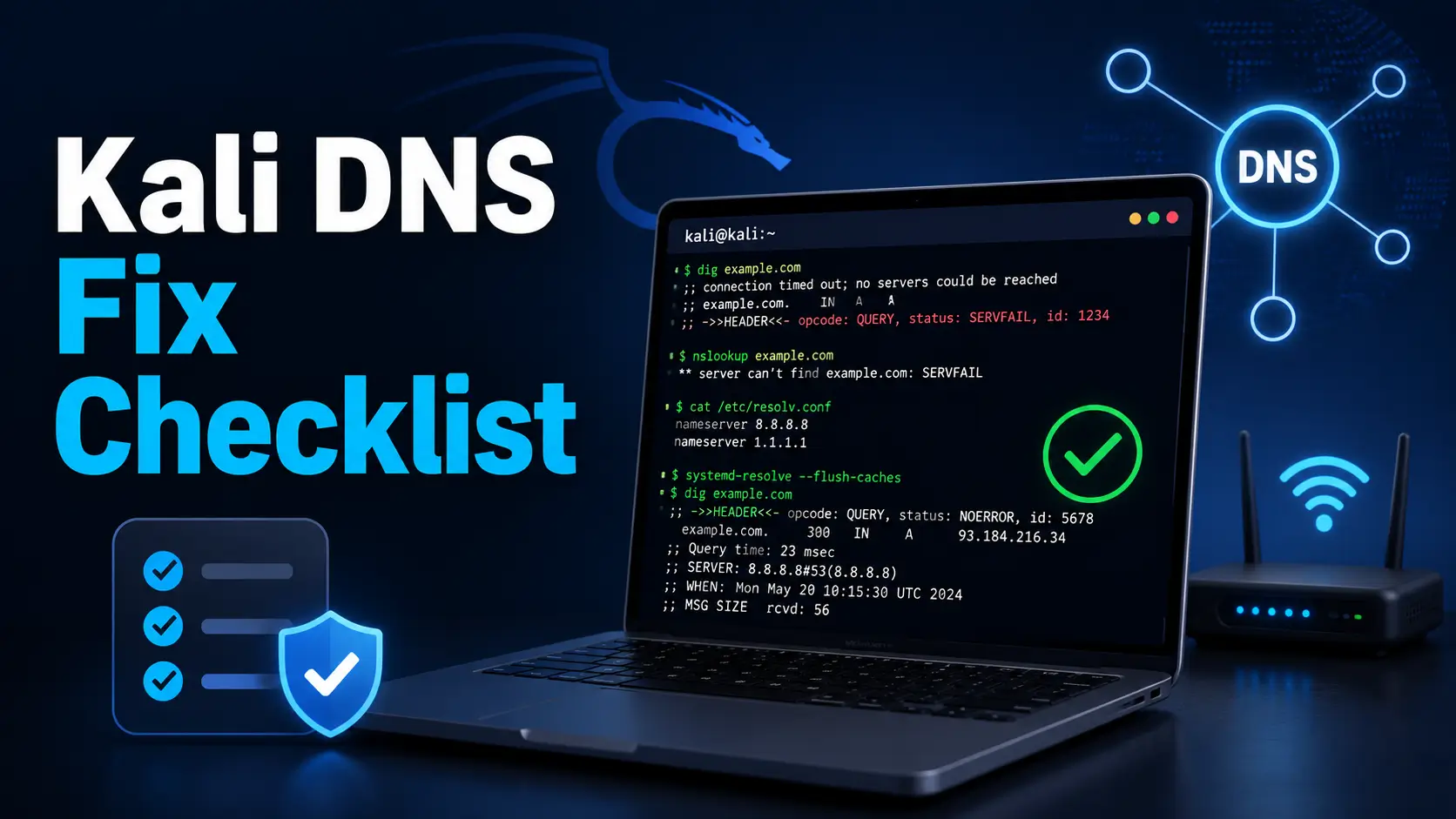
Beginner-friendly troubleshooting guide
Kali Linux DNS Problems:
Beginner Fix Checklist
When Kali can ping an IP address but refuses to load websites, update packages, or reach a VPN lab hostname, the problem often feels bigger than it is. DNS failure has a theatrical way of wearing every costume in the drawer: broken browser, broken mirrors, broken Wi-Fi, broken VM, broken VPN, broken everything.
The safer fix is not to paste public nameservers into every file you can find. The safer fix is to prove what layer is failing, inspect who controls your resolver settings, and make one reversible change at a time. That is the quiet difference between troubleshooting and spell-casting.
This checklist is built for beginners using Kali on a laptop, virtual machine, persistent USB, or home lab. It will help you separate DNS from general connectivity, VM networking, VPN routing, and damaged repository configuration before you reach for the tiny hammer called /etc/resolv.conf.
Prove the fault
Test gateway, IP reachability, domain resolution, and resolver ownership before editing anything.
Fix it cleanly
Use NetworkManager profiles, VM settings, DHCP, or VPN DNS routing instead of random file surgery.
Avoid false trails
Learn when an apt error is DNS, when it is a mirror issue, and when your repo config needs attention.
Start with evidence, then make the smallest fix that survives reconnects, reboots, and VPN toggles. 🧭
Snapshot
This guide is for beginner Kali Linux users who can connect to a network but still see browser failures, Temporary failure resolving, broken apt update, or VPN DNS weirdness. By the end, you will know how to run a clean three-test DNS snapshot, choose the right fix path, and avoid changes that make the real problem harder to trace.
Table of Contents
Before You Change DNS on Kali, Prove the Layer
Kali Linux DNS problems usually arrive with dramatic symptoms. The browser spins. apt update complains. VPN lab names do not resolve. A beginner opens a forum post, copies a command, and suddenly the network stack has more fingerprints than a glass door at a busy café.
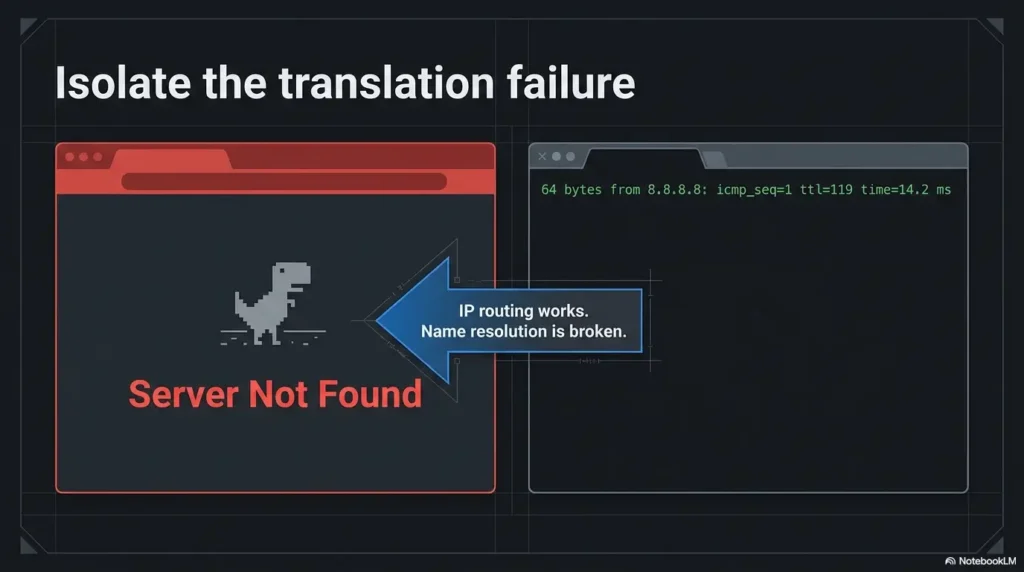
The better first move is plain and almost boring: prove whether this is DNS or general connectivity. DNS translates names like kali.org into IP addresses. If your Kali machine cannot even reach the router or a public IP address, DNS is not the first fire.
Think of this checklist as a troubleshooting funnel. Wide at the top, narrow at the fix. You start with the network path, then test IP connectivity, then test domain lookup, then inspect the resolver configuration.
What this guide can and cannot do
This article can help you diagnose common Kali DNS failures on home networks, lab networks, virtual machines, and VPN-connected learning environments. It can also help you avoid common beginner mistakes that turn a small DNS issue into a long weekend with cold coffee and regret.
It cannot safely diagnose every school, company, managed laptop, client network, malware lab, proxy network, or enterprise VPN. If you are on someone else’s network, confirm policy before changing DNS, disabling IPv6, editing repositories, bypassing proxies, or routing lab traffic through a different resolver.
Before You Act
DNS changes can break package updates, hide a router or VM issue, or create a VPN DNS leak. Make one change at a time, save the before-and-after output, and reverse changes you cannot explain. If the network belongs to a school, employer, client, or lab provider, check their instructions first.
The beginner trap: “Wi-Fi works, so DNS must work”
A connected Wi-Fi icon only tells you that Kali has joined a network. It does not prove that your gateway is reachable, DNS servers are assigned, outbound traffic is allowed, package mirrors are reachable, or your VPN is routing DNS correctly.
That is why “the internet works on my host, but not in Kali” is so common. The host OS, hypervisor, router, VM adapter, DHCP server, VPN client, and Kali resolver may each see a slightly different world.
Three layers to test before changing anything
Before you edit files, test three layers in this order:
- Local route: Does Kali have a default gateway?
- IP reachability: Can Kali reach a known public IP address?
- Name resolution: Can Kali turn a domain name into an IP address?
When these three tests are run together, the problem stops being fog and becomes a map.
Common symptoms that look like DNS
DNS failure often shows up through different tools in slightly different costumes:
| Where you see it | Common symptom | What it may mean |
|---|---|---|
| Terminal | Temporary failure in name resolution | Kali cannot resolve a hostname through its configured DNS path. |
apt update | Temporary failure resolving | DNS is failing before Kali can reach the repository host. |
| Browser | Server not found, DNS probe error, or endless loading | Domain lookup may be failing, or a proxy/captive portal may be interfering. |
| VPN lab | Public websites work, lab hostnames fail | Split DNS or VPN-specific DNS routing may be missing. |
| VM | Host has internet, Kali does not | VM adapter mode, DHCP, NAT DNS, or host firewall may be the real issue. |
Notice the word “may.” Good troubleshooting is allergic to certainty until the tests agree.
Why DNS Breaks First in Kali, Not Last
Kali is often used in places where ordinary desktop Linux is not: lab networks, VPN tunnels, host-only adapters, NAT networks, Wi-Fi dongles, isolated ranges, and deliberately vulnerable virtual machines. That makes DNS a frequent first casualty.
A regular laptop user may only need Wi-Fi and a browser. A Kali learner may need package mirrors, public domains, private lab names, VM-only IP ranges, and VPN-provided internal DNS in the same afternoon. That is a lot of little doors on one hallway.
Kali is not always on a normal network
Many beginners install Kali inside VirtualBox, VMware, Hyper-V, Proxmox, WSL2, or a persistent USB. Each setup can receive DNS information differently.
In a VM, Kali may get DNS from the hypervisor’s NAT service rather than your router directly. In bridged mode, Kali may appear as another device on the physical network. In host-only mode, Kali may not have internet access at all unless routing is configured elsewhere.
Kali tools make DNS failure obvious
Kali users notice DNS quickly because so many beginner workflows depend on names. Updating packages, installing tools, reaching documentation, resolving VPN hostnames, and opening web targets all lean on DNS.
For a learner following a lab guide, one failed name lookup can make the whole exercise feel broken. If you are working through a home lab, the related guide on Networking 101 for hackers can help you connect DNS, routing, and subnets without drowning in jargon.
DNS and repositories get mixed up
One of the most expensive beginner mistakes is treating every apt update error as a repository problem. DNS failure means Kali cannot resolve the repository hostname. Repository damage means Kali can reach the host but the package source, signature, certificate, or release metadata is wrong.
These are not the same wound. If you treat the wrong one, you may add bad repositories, disable checks you should keep, or spend an hour changing mirrors when the real issue is your VM adapter.
Key Takeaway
DNS is not “just a browser problem.” On Kali, DNS can affect package updates, VPN labs, private hostnames, tool installation, and documentation access. Prove DNS failure before touching repository files.
The 60-Second Proof: Is It Really DNS?
This is the fastest clean test pattern for beginners. It does not fix anything yet. It answers the question: “What layer is actually failing?”
Open a terminal and run these commands one at a time. Do not rush past the output. The little clues matter.
ip route ping -c 3 1.1.1.1 ping -c 3 kali.org cat /etc/resolv.conf nmcli dev show | grep -i dns
Test the gateway before blaming nameservers
The ip route command shows whether Kali has a default route. Look for a line that begins with default via. That line usually points to your router, VM NAT gateway, or network gateway.
If there is no default route, DNS is not your first problem. Kali does not know where to send ordinary internet traffic. Fix the network connection, VM adapter, DHCP lease, or interface state before worrying about nameservers.
Ping an IP, then ping a domain
Next, test a public IP address:
ping -c 3 1.1.1.1
If that works, Kali can reach the internet by IP. Then test a domain:
ping -c 3 kali.org
If the IP ping works but the domain ping fails with a name resolution error, you likely have a DNS problem. If both fail, you likely have a routing, firewall, captive portal, VM networking, or general connectivity problem.
The small clue most beginners miss
Do not stop at “ping failed.” Read the failure. A message like Name or service not known points toward resolution. A message like Network is unreachable points toward routing. A timeout may point toward blocked ICMP, firewall rules, captive portals, or a dead path.
DNS is one actor in the scene. It is not always the villain.
Kali DNS Troubleshooting Flow
1. Route
Run ip route. No default route means fix networking before DNS.
2. IP Ping
Ping 1.1.1.1. If this fails, DNS is probably not the first issue.
3. Domain Ping
Ping kali.org. If IP works but domain fails, DNS is likely involved.
4. Resolver Owner
Check /etc/resolv.conf and NetworkManager DNS before making changes.
Do Not Edit /etc/resolv.conf Blindly
The file /etc/resolv.conf looks wonderfully simple. It may contain one or more nameserver lines. A beginner sees that, types in a public DNS server, saves the file, and feels a small spark of victory.
Then Kali reconnects, reboots, changes networks, toggles VPN, or restarts NetworkManager. The change disappears. The spark becomes smoke.
Why manual edits often disappear after reconnecting
On many Debian-family Linux setups, resolver information may be managed by NetworkManager, DHCP, a local resolver service, VPN software, or a generated symlink. That means /etc/resolv.conf may not be a normal hand-edited file in practice.
If a service owns the file, manual edits can be overwritten. That is not Kali mocking you. It is the system doing exactly what it was configured to do.
Inspect who owns the file
Before editing, inspect the file and whether it is a symlink:
ls -l /etc/resolv.conf cat /etc/resolv.conf
If you see a comment saying the file is generated, believe it. If it points to another location, follow the chain before making assumptions. Your goal is not to “win” against resolv.conf. Your goal is to configure the thing that manages it.
Public DNS is not always the right fix
Public resolvers can be useful on a simple home network, but they are not magic dust. They may break local hostnames, school or company internal domains, VPN-only lab names, captive portal flows, or DNS filtering that your network expects.
For a beginner Kali laptop at home, using router-provided DNS or a reputable public resolver may both be reasonable. For a lab VPN, workplace VPN, or training platform, the DNS server provided by that network may be required.
Key Takeaway
Treat /etc/resolv.conf as evidence before treating it as a fix target. If another service generates it, configure that service instead of fighting the file.
Official resources worth keeping nearby
For Kali-specific setup, repositories, and network-related installation details, use official documentation before random command snippets. For NetworkManager behavior, Debian and upstream documentation can help you understand why DNS settings persist or vanish.
NetworkManager First: The Clean Beginner Fix Path
For many beginner Kali setups, NetworkManager is the cleanest place to inspect and set DNS. It knows about active connections, devices, DHCP-provided settings, and saved profiles. It is the front desk, not a random drawer in the basement.
The goal is simple: read the active connection, confirm its DNS, and make a profile-level change only when needed.
Check whether NetworkManager is running
Start here:
systemctl status NetworkManager --no-pager nmcli general status nmcli device status
If NetworkManager is not running on a standard desktop Kali install, find out why before building a workaround. If you are using a minimal install, WSL-like setup, container, or custom lab image, your network stack may be different.
Read the active connection instead of guessing
List the active connection:
nmcli connection show --active
Then inspect DNS values for the active device:
nmcli dev show | grep -i dns
If no DNS servers appear, DHCP may not be providing them, the connection profile may be misconfigured, or your VM network may not be handing them through properly.
Add DNS through the connection profile, not random shell paste
If you have confirmed DNS is the issue and you are on a simple home or lab network, you can set DNS on the active NetworkManager connection. Replace CONNECTION_NAME with the exact active connection name from nmcli connection show --active.
sudo nmcli connection modify "CONNECTION_NAME" ipv4.dns "1.1.1.1 8.8.8.8" sudo nmcli connection modify "CONNECTION_NAME" ipv4.ignore-auto-dns yes sudo nmcli connection down "CONNECTION_NAME" sudo nmcli connection up "CONNECTION_NAME"
That example uses common public DNS servers, but do not treat them as universally correct. If you are on a VPN, company network, lab network, or router that provides local DNS, you may need the network-provided resolver instead.
Restart the connection without reboot theater
Rebooting after every change feels decisive, but it hides cause and effect. Bring the connection down and up, then rerun your tests. The smaller the loop, the clearer the lesson.
| Need | Beginner-safe move | Why it helps |
|---|---|---|
| See active connection | nmcli connection show --active | Avoids editing the wrong profile. |
| See DNS assigned to devices | nmcli dev show | grep -i dns | Shows whether DNS exists at all. |
| Make a persistent DNS change | Modify the NetworkManager profile | Survives reconnects better than hand-editing generated files. |
| Test without rebooting | Bring the connection down and up | Keeps cause and effect visible. |
If you are preparing a Kali lab environment, you may also like Kali Linux lab infrastructure mastery, especially if your DNS problem is part of a wider VM or practice network setup.
VM DNS Problems: The Hidden Door Under the Carpet
A huge share of Kali DNS problems happen inside virtual machines. That makes sense. In a VM, Kali is not directly sitting on your desk’s network. It is sitting inside a small stage set built by your hypervisor.
That stage set may use NAT, bridged networking, host-only networking, an internal network, or a custom virtual switch. Each mode changes what DNS server Kali receives, what IP range it sees, and whether it can reach the internet at all.
NAT vs bridged vs host-only
In NAT mode, Kali usually receives an IP address and DNS behavior through the hypervisor. This is often the easiest mode for package updates and browsing because the VM shares the host’s outbound connection.
In bridged mode, Kali appears more like a separate device on your physical network. That can be useful for labs, but it may fail on networks that restrict unknown devices, use captive portals, or block additional MAC addresses.
In host-only mode, Kali may talk to other VMs but not the internet. That is useful for isolated vulnerable machine practice, but it can break updates unless you add a second adapter or configure routing. For a deeper beginner comparison, see VirtualBox NAT, host-only, and bridged networking.
When the host has internet but Kali does not
If the host browser works but Kali fails, do not immediately blame Kali. Check the VM network mode, adapter connection state, DHCP lease, and whether the hypervisor’s virtual networking service is running.
A good beginner test is to switch temporarily to NAT mode, reconnect the VM network, and rerun the three-test snapshot. If NAT works but bridged fails, your DNS symptom may actually be a bridged networking problem.
Hypervisor symptoms to separate
| VM platform or mode | Common symptom | Safer first check |
|---|---|---|
| VirtualBox NAT | Kali has IP but domain lookup fails | Check adapter enabled, DHCP, and DNS shown by nmcli. |
| VirtualBox host-only | Kali can see lab VM but not internet | Confirm whether host-only is intentionally isolated. |
| VMware NAT | Host works, VM fails after sleep or network change | Restart VM network adapter or NAT service, then retest. |
| Bridged mode | No IP, no route, or inconsistent DNS | Check whether the physical network allows bridged clients. |
| Proxmox lab | VM has route but no DNS | Check bridge, DHCP, VM interface, and configured DNS in guest. |
Key Takeaway
In a VM, DNS may be a symptom of adapter mode. Test NAT, bridged, and host-only assumptions before editing Kali files. The hypervisor may be the puppet string.
Good / Better / Best VM DNS setup
| Setup tier | Best for | DNS approach | Watch out for |
|---|---|---|---|
| Good | Beginner package updates and browsing | Use NAT and DHCP-provided DNS | Lab targets on host-only networks may not be reachable. |
| Better | Kali plus isolated vulnerable machines | Use two adapters: NAT for internet, host-only for lab | Know which interface reaches what network. |
| Best | Repeatable home lab practice | Document adapter modes, IP ranges, DNS, and snapshots | More planning upfront, fewer mystery failures later. |
If you are comparing VM platforms for a Kali practice setup, the guide on VirtualBox vs VMware vs Proxmox can help you choose based on your laptop, lab goals, and patience budget.
VPN DNS Leaks: Fixing DNS Without Breaking Privacy
VPNs make DNS more interesting, and not always in a charming way. When you connect to a VPN, some domain lookups may need to go through the VPN. Others may still use your normal network DNS. This split can be intentional, broken, or dangerously leaky.
For Kali beginners using training platforms, VPN DNS can fail in a very specific pattern: normal websites work, but lab hostnames do not. Or the reverse happens: the lab works, but public browsing becomes slow or strange.
Why VPNs can make normal DNS look broken
A VPN may push DNS servers to your Kali machine. It may also push routes, search domains, or internal suffixes. If the VPN client, NetworkManager, system resolver, or lab instructions do not agree, DNS can wobble.
That wobble is not always obvious. You might resolve public domains through your home router while lab domains need the VPN DNS server. If Kali sends the wrong query to the wrong resolver, it may look like “DNS is broken” when the real issue is routing DNS to the right place.
Split DNS and private lab hostnames
Split DNS means different domains can be resolved through different DNS paths. For example, public domains may use normal DNS, while private lab domains use the VPN resolver.
When split DNS is required, forcing all DNS through a public resolver can break lab names. That is one reason “just use 8.8.8.8” can be a bad fix in a VPN environment.
DNS leak awareness for Kali learners
A DNS leak happens when DNS queries go outside the intended private path. For a casual home lab, this may simply be confusing. For work, school, client testing, or privacy-sensitive research, it can be a real problem.
If a VPN provider, employer, training platform, or lab guide gives DNS instructions, follow those first. Avoid replacing VPN DNS with public DNS unless you understand the consequence.
VPN DNS checklist
- Test DNS before connecting to the VPN.
- Connect to the VPN and rerun the same DNS snapshot.
- Compare
nmcli dev show | grep -i dnsbefore and after connection. - Check whether lab hostnames require a VPN-specific search domain.
- Do not hard-code public DNS if the VPN requires private DNS.
- Disconnect the VPN and confirm normal DNS returns.
If your issue is specifically proxy-based or privacy-based DNS routing, the related guide on Proxychains DNS leak fixes may be the better next read.
The apt update Clue: DNS, Mirror, or Repository Damage?
apt update is often where Kali DNS problems become unavoidable. The command is wonderfully blunt. It does not smile politely. It tells you, in its own gravelly voice, whether it can resolve a host, reach a repository, verify metadata, or find a release file.
The important part is learning which error belongs to which category.
Temporary failure resolving usually means DNS
If you see an error like Temporary failure resolving, Kali is not successfully turning the repository hostname into an IP address. That is a DNS clue.
At this point, changing mirrors is usually premature. First run the three-test snapshot. If domain lookup fails outside apt too, you have a broader DNS problem, not an apt-only problem.
Certificate, 404, and signature errors smell different
Not all apt update failures are DNS failures. A certificate error, 404 error, release file error, or signature error may point toward time/date problems, repository configuration, mirror state, proxy interference, or unsupported sources.
That difference matters. DNS fixes will not repair a damaged sources list. Repository edits will not fix a dead DNS path.
Do not add random repositories to fix DNS
Kali is a specialized distribution with its own repositories. Adding unrelated Debian, Ubuntu, or third-party sources to “fix” an update problem can create dependency conflicts and make future troubleshooting harder.
If your actual error is DNS, keep your hands off the repository list until name resolution works. If your repository list is already damaged, compare it against official Kali guidance rather than borrowing a random source file from a forum fossil.
apt error decoder table
| Error pattern | Likely category | Beginner next step |
|---|---|---|
Temporary failure resolving | DNS | Run gateway, IP ping, domain ping, resolver checks. |
Could not resolve | DNS | Inspect DNS servers and NetworkManager profile. |
404 Not Found | Mirror or repository path | Confirm official Kali sources and retry later if mirror-specific. |
NO_PUBKEY or signature errors | Repository trust or key issue | Check official Kali repository documentation. |
| Certificate or TLS errors | Time, proxy, certificate, or network inspection | Check date/time, captive portal, proxy, and network policy. |
Persistent Fixes: Make DNS Survive Reboots
A fix that works until the next reboot is not useless. It is a clue. But a beginner-friendly setup should survive reconnecting Wi-Fi, restarting a VM, toggling a VPN, and coming back tomorrow with your notes still making sense.
Persistence depends on where the DNS value belongs. A home laptop, a VM, and a VPN lab may need different persistence strategies.
Set DNS in the active NetworkManager profile
For a standard Kali desktop connection, save DNS settings in the active NetworkManager profile. This is cleaner than repeatedly editing generated resolver files.
After changing the profile, disconnect and reconnect the profile, then rerun:
ip route ping -c 3 1.1.1.1 ping -c 3 kali.org cat /etc/resolv.conf nmcli dev show | grep -i dns
Save the output. The output is your receipt.
Confirm whether DHCP should provide DNS automatically
On a normal home network, DHCP usually provides an IP address, gateway, and DNS server automatically. If Kali receives an IP address but no DNS server, the router, VM NAT service, or connection profile may be misbehaving.
Before hard-coding DNS, ask: should this network provide DNS by design? If yes, fixing DHCP or the VM adapter may be better than adding a permanent override.
Use a local resolver only when you understand why
Some systems use a local resolver address, such as a loopback address, in /etc/resolv.conf. That does not automatically mean something is wrong. It may mean a resolver service is handling DNS locally and forwarding queries elsewhere.
Do not remove local resolver behavior just because it looks unfamiliar. First identify the service and how it is configured. Curious systems reward patient readers.
Verify after reboot, reconnect, and VPN toggle
A persistent DNS fix should pass three checks:
- It still works after a reboot.
- It still works after disconnecting and reconnecting the network.
- It behaves correctly before, during, and after VPN use.
Key Takeaway
The best Kali DNS fix is not the flashiest command. It is the fix you can explain, repeat, reverse, and verify after reboot, reconnect, and VPN changes.
Free Fixes, Paid Help, and When to Stop Digging
Most beginner Kali DNS problems can be fixed for free with careful testing. You usually do not need a paid tool, premium VPN, new router, expensive course, or heroic reinstall. Start with the boring tests. Boring tests are cheap little lanterns.
That said, there are moments when paid help, a structured lab platform, or better hardware may save time. The trick is knowing when you are solving a DNS problem and when you are trying to compensate for an unstable setup.
Free vs paid help comparison
| Option | Good for | Cost mindset | Before you pay, verify |
|---|---|---|---|
| Free checklist and official docs | Most home, VM, and beginner DNS problems | Best first step | You have saved command output and know the failing layer. |
| Community forum or Discord help | Weird VM, VPN, or lab-specific errors | Free, but quality varies | You can share safe, sanitized outputs without exposing secrets. |
| Structured cyber lab platform | Beginners who want fewer setup distractions | Monthly or course-like cost | It includes clear VPN and DNS setup instructions. |
| Local IT support or tutor | Persistent host, router, or laptop networking issues | Hourly cost | The person understands Linux networking, VMs, and VPNs. |
| New router, adapter, or premium VPN | Only after hardware or provider limits are proven | Can be wasteful if guessed | Your current issue is not a simple profile, adapter, or DHCP mistake. |
When a free DIY fix is enough
A free DIY fix is usually enough when you are on your own home network, using a common hypervisor, and the issue clearly matches one failing layer. For example, IP ping works, domain ping fails, and NetworkManager shows no DNS server. That is a tidy little case.
DIY is also reasonable when you can reverse each step and your setup is not tied to work, school, client systems, or sensitive privacy requirements.
When professional or platform help may be worth it
Consider help when the issue involves a managed network, required VPN, client lab, school environment, certificate errors, proxy requirements, or repeated breakage across multiple machines. Also consider structured help if you are burning hours on setup instead of learning the material you came for.
If your goal is OSCP-style practice, a smoother lab setup may be worth more than another evening of DNS archaeology. You can pair this article with the OSCP practical prep hub if your DNS problem is blocking a broader training path.
Questions to ask before paying for help
- Will this person or service help diagnose the actual layer, not just paste DNS values?
- Do they understand Kali, NetworkManager, VM adapters, and VPN DNS?
- Can they explain the fix in plain English?
- Will they help you document the before-and-after state?
- Are they asking for unnecessary remote access or sensitive credentials?
- Can the fix be reversed safely?
Key Takeaway
Do not buy your way out of an unproven DNS problem. First prove the failing layer. Then decide whether the fix is a free profile change, a VM setting, a VPN instruction, or a setup problem worth outside help.
Real-world example: DNS fix without reinstalling
A beginner installed Kali in VirtualBox, set the adapter to host-only because a lab guide mentioned it, and then panicked when apt update failed. The browser did not load. The terminal showed Temporary failure resolving. The first instinct was to reinstall Kali.
The three-test snapshot told a cleaner story. Kali had a host-only IP and could talk to the vulnerable VM, but it had no route to the internet. DNS was not the root problem. The lab network was intentionally isolated.
The fix was not a reinstall. It was a second NAT adapter for internet access, while keeping the host-only adapter for the lab. After reconnecting, apt update worked, the lab target remained reachable, and the learner wrote down which interface served which purpose.
The lesson: if you diagnose first, the solution is often smaller than the fear.
Show me the nerdy details
Show me the nerdy details
DNS resolution on a Linux desktop can involve several layers: the application, system resolver library, /etc/resolv.conf, a local resolver service, NetworkManager, DHCP, VPN-provided settings, and upstream DNS servers. The visible nameserver in /etc/resolv.conf may be a real upstream resolver, a loopback stub, or a generated pointer to another system-managed file.
That is why the order of testing matters. A default route proves Kali has a path for non-local traffic. A successful IP ping proves at least one outbound path exists. A failed domain lookup after successful IP connectivity points toward name resolution. DNS values from nmcli help connect the visible resolver state back to the active network profile.
VPNs add another dimension because some domains may need resolver routing by interface or suffix. A public resolver can resolve public domains while failing private lab names. A VPN resolver can resolve lab names while mishandling or slowing public lookups if routes are wrong. Clean DNS troubleshooting is really path troubleshooting with names attached.
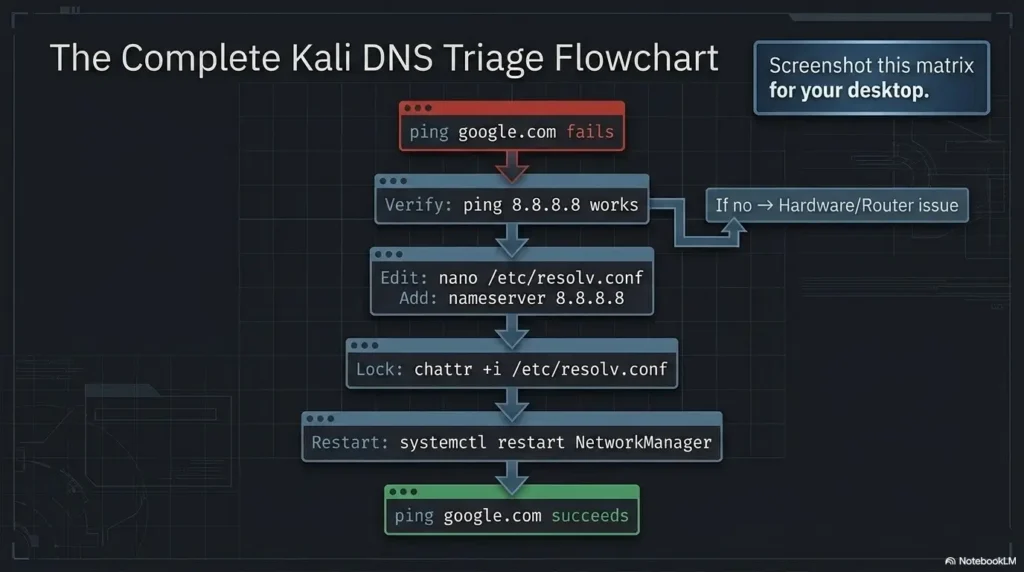
FAQ
Why does Kali say “Temporary failure resolving” during apt update?
It usually means Kali cannot resolve the repository hostname into an IP address. Run the gateway, IP ping, domain ping, /etc/resolv.conf, and nmcli checks before changing mirrors or repositories.
Why does DNS work in my browser but not in the terminal?
Your browser may be using cached results, proxy settings, secure DNS settings, or a different resolution path than terminal tools. Test with terminal commands and check proxy or browser DNS settings if the behavior differs.
Why does /etc/resolv.conf keep changing after reboot?
It may be generated by NetworkManager, DHCP, a local resolver service, or VPN software. Inspect it with ls -l /etc/resolv.conf and configure the managing service rather than repeatedly hand-editing the file.
Should I use Google DNS, Cloudflare DNS, or my router’s DNS on Kali?
For a simple home network, router DNS or reputable public DNS can both work. For VPNs, lab platforms, school networks, company networks, or local hostnames, public DNS may break required private resolution. Choose based on the network, not habit.
Why does Kali DNS break inside VirtualBox or VMware?
The VM network mode may change how Kali receives DNS. NAT, bridged, and host-only modes behave differently. If host internet works but Kali does not, check the VM adapter mode and DHCP state before editing Kali files.
Can a VPN cause Kali DNS problems?
Yes. VPNs can push DNS servers, routes, and search domains. Public websites may work while private lab hostnames fail, or vice versa. Compare DNS settings before and after connecting to the VPN.
Is changing Kali mirrors the same as fixing DNS?
No. DNS failure means Kali cannot resolve a hostname. Mirror or repository issues involve reaching the host but failing because of path, metadata, signature, certificate, or source configuration problems.
Do I need to reinstall Kali if DNS is broken?
Usually no. Most DNS issues are connection profile, DHCP, VM adapter, VPN, or resolver configuration problems. Reinstalling may recreate the same issue if the underlying network setup is unchanged.
Run the Three-Test DNS Snapshot Before Your Next Fix
The next time Kali’s browser fails, apt update complains, or your VPN lab names vanish, do not start with edits. Start with a snapshot. Fifteen quiet minutes here can save you from an evening of network origami.
Run this exact set before changing anything:
ip route ping -c 3 1.1.1.1 ping -c 3 kali.org cat /etc/resolv.conf nmcli dev show | grep -i dns
Then save the output in your notes with the date, network type, VM mode, and VPN status. If you change one setting, run the same snapshot again. Your before-and-after notes will tell you whether you fixed the problem or merely moved the furniture.
For a beginner, that habit is more valuable than memorizing one perfect command. Kali troubleshooting gets much easier when every fix leaves a breadcrumb trail instead of a smoke cloud.
15-Minute Action Plan
- Run the five-command DNS snapshot.
- Label the result: no route, no IP reachability, DNS failure, VPN-only issue, or apt/repository issue.
- Make one fix in the matching place: VM adapter, NetworkManager profile, VPN settings, DHCP/router, or official repository config.
- Run the same snapshot again and save the difference.
Last reviewed: 2026-08