Practical case: Park interruptions with a return condition · Editable working note
Sources, review date and section shortcuts
Reviewed: October 19, 2026. Reduce competing tasks by choosing one question and keeping a visible queue for interruptions.
Primary documentation · Related practical guide
Go straight to: Decision check · Main workflow · Further detail
Open the Working note: Park interruptions with a return condition for this guide’s task-specific fields and next action.
Capture a detour without starting it immediately
Write the new idea, why it matters and the evidence that would justify revisiting it. Return to the current task only while its prerequisites and scope remain valid. When attention is insufficient to interpret results, preserve state and stop. This is an organizational exercise, not a diagnosis or treatment for concentration difficulties. Reference and scope.
Mastering Cybersecurity Focus: The Kioptrix Routine for Distracted Learners
Reduce competing tasks by choosing one question and keeping a visible queue for interruptions.
“Better focus is often built, not found. And the architecture matters more than the hype.”
For distracted learners, the real issue is cognitive sprawl: too many tools, too many tabs, and no clear way to re-enter the lab once momentum breaks. This guide transforms Kioptrix into a repeatable lab routine built around focus, snapshots, and interview-ready practice evidence.
Table of Contents
Fast Answer: Kioptrix Level for learners who struggle with focus during practice sessions works best when the lab stops being a long endurance test and becomes a short, repeatable thinking routine. The goal is not to stay locked in for hours. It is to reduce friction, narrow the task, and create enough structure that attention can return before frustration takes over.
Infographic: The 25-Minute Kioptrix Focus Loop
1. Reset
2 minutes
Open notes. Name one objective.
2. Work
15 minutes
One task only: setup, enum, hypothesis, or validation.
3. Decide
5 minutes
What changed? What still feels unclear?
4. Exit
3 minutes
Snapshot, save notes, define the next entry point.
The quiet trick: stop while the path is still visible, not after the path has collapsed into browser confetti.
Focus First: Why Kioptrix Can Help Distracted Learners Better Than Bigger Labs
A smaller legacy lab lowers decision overload before the real work begins
Distracted learners do not always need easier material. They often need less surface area. Kioptrix helps because it is compact. The environment is old enough to feel legible, small enough to revisit, and bounded enough that you are not drowning in ten machines, twenty dashboards, and a motivational crisis wearing a hoodie.
That matters more than people admit. Bigger labs can feel impressive, but they often turn concentration into logistics. You are not practicing inference anymore. You are managing clutter. With Kioptrix, a beginner can still practice the full loop of observation, hypothesis, testing, and reflection without getting buried under map size alone. If you are still deciding whether this box is the right starting point, Kioptrix for beginners lays out why a smaller lab can be a surprisingly good first training ground.
Fewer moving parts means your attention can stay on process, not platform chaos
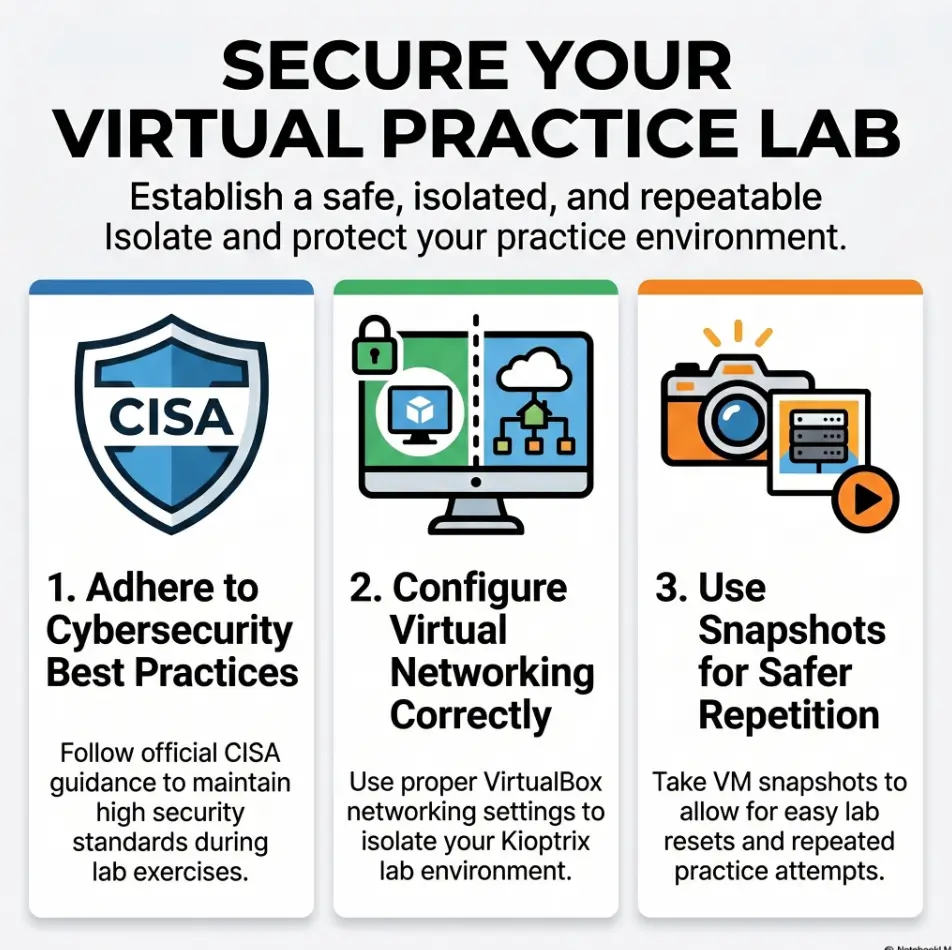
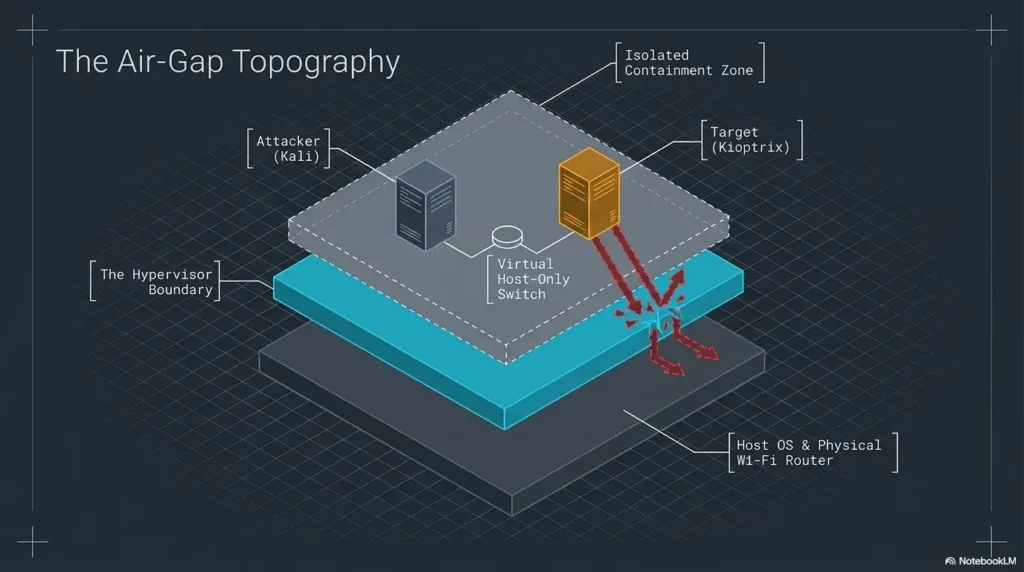
Oracle’s current VirtualBox manual still describes host-only networking as a way to create a network between the host and a set of virtual machines without relying on the physical network. That matters because the simpler your network mental model is, the less cognitive rent you pay before the lab even begins. The tool is not the lesson, but it should stop trying to become the villain.
Why bounded difficulty often teaches more than sprawling challenge rooms
Bounded labs create a humane kind of pressure. There is enough uncertainty to make you think, but not so much that your notes dissolve into frantic tab-hopping. For learners rebuilding focus, that difference is everything. You need a lab that lets you notice a clue and stay with it for another five minutes.
- Small scope reduces decision overload
- Fewer moving parts preserve attention for reasoning
- Bounded labs are easier to revisit and learn from
Apply in 60 seconds: Write one sentence naming why you chose Kioptrix for process practice, not just for “getting a shell.”
Who This Is For and Not For
Best for beginners, career changers, and stop-start learners rebuilding practice stamina
This approach is for people whose study history has a stutter in it. You start strong, drift, restart, feel guilty, disappear, then come back with a brand-new note-taking app as if stationery alone will save you. Many career changers live here. So do beginners with jobs, families, fatigue, and a brain that gets slippery after work.
If your real challenge is not intelligence but returnability, Kioptrix can become a dependable training object. It gives you one machine, one puzzle field, and enough repetition that your attention can develop grooves instead of starting from zero every time. That is especially true for readers navigating a pivot, and Kioptrix for career changers speaks directly to that slower, steadier rebuild.
Useful for people who drift after enumeration or lose momentum after one dead end
A common pattern looks like this: you enumerate, get a few promising clues, then suddenly your energy falls through the floorboards. Now you are opening Burp, Nikto, Nmap options, browser tabs, old writeups, Discord, and perhaps the fridge. The session is not dead because the lab is too hard. It is dead because the branching factor got too high.
Kioptrix is especially useful here because it lets you practice the middle part of offensive thinking: not just discovering information, but deciding what deserves attention next.
Not ideal for learners who currently want speedrunning, leaderboard pressure, or advanced multi-host complexity
If your goal is pure intensity, fast exploit chains, or simulated enterprise sprawl, this is not the main course. Kioptrix is more like good bread than fireworks. That sentence will not sell T-shirts, but it is true. It is a lab for repetition, judgment, and clear note-taking. If you want a spectacle, you may find it too modest.
Eligibility checklist
- Yes: You can focus for 15 to 30 minutes, but not for 2 straight hours
- Yes: You often lose momentum after the first obstacle
- Yes: You want practice evidence you can explain later in interviews
- No: You only value labs that feel new, huge, or highly gamified
- No: You are currently optimizing for advanced multi-machine attack paths
Next step: If you checked mostly “Yes,” design for repeatability first and difficulty second.
Attention Leaks: Where Practice Sessions Usually Fall Apart
Too much time disappears before the first meaningful observation
The first leak is delay. Not difficulty. Delay. You tell yourself you are “starting,” but the first 20 minutes go to booting, checking adapters, rearranging windows, naming folders, and opening tools you might use later. By the time the first real observation arrives, your attention has already paid three tolls and is looking for a way home.
This is why distracted learners often misdiagnose themselves. They think, “I can’t focus.” Sometimes the truer sentence is, “My setup eats my focus before the practice begins.” That is a fixable problem.
Context switching between tools, tabs, notes, and setup quietly drains focus
Attention rarely shatters in one dramatic moment. It thins like worn fabric.
The real failure is often not technical. It is cognitive sprawl
Cognitive sprawl is when your task gets wider faster than your understanding gets deeper. In security practice, that often looks productive. More tools. More scans. More lists. More “coverage.” But coverage without selection is just a prettier form of panic.
Good sessions narrow. They ask, “What does this clue change?” not, “What else can I launch?” Those are two very different mental postures. Only one of them makes you easier to reassemble tomorrow.
Show me the nerdy details
A practical focus metric for labs is not total time spent. It is “minutes to first meaningful observation.” If that number is high, friction is likely upstream of the actual learning task. Reduce setup variance, keep one note page open, and predefine the first command or question before the session begins.
Start Smaller: How to Turn One Kioptrix Session Into a Narrow Win
Give each session one job only: setup, enumeration, hypothesis, or validation
A distracted learner needs a smaller promise. Not “I will work on Kioptrix tonight.” That sentence is too foggy. Instead: “Tonight I will confirm open services and write down what they suggest.” Or: “Tonight I will review one dead end and decide whether it deserves one more test.”
Single-job sessions feel almost suspiciously modest. Good. That is the point. A small promise is easier to keep, and kept promises build more trust than grand plans with theatrical collapse.
Stop chasing root as the only proof that the session counted
If root is the only outcome that feels real, distracted learners will quit too early or push too long. Both are expensive. Plenty of valuable sessions end without a shell. You may leave with a clearer attack surface, a better note trail, or a ruled-out path that saves you 30 minutes next time.
That is not failure. That is map-making. Offensive practice is full of cartography performed by slightly tired people.
Measure progress by clarity gained, not just shells landed
Try a different scorecard:
- What became clearer?
- What assumption got corrected?
- What next step became obvious?
That is the language of sustainable practice. It is also better interview language later, because it describes thinking, not just outcomes. For a practical model of how to turn these small decisions into reusable documentation, see a technical journal approach for Kioptrix practice.
Decision card: What counts as a good session?
| When you think success means… | You usually get… | Better trade-off |
|---|---|---|
| Root or nothing | Long sessions, higher frustration | Count clarity and decisions too |
| One narrow objective | Faster re-entry, better notes | Best for time-poor learners |
Neutral action: Pick your session metric before you launch the VM.
Do Not Do This: The Marathon-Session Trap That Makes You Feel Worse
Long sessions create the illusion of seriousness while degrading observation quality
There is a special kind of self-deception that visits technical learners at night. It whispers that seriousness must look exhausting. So you stay in the chair for three hours, increasingly foggy, because leaving earlier feels like moral weakness. But lab work is not a medieval penance device. After a certain point, more time buys worse judgment.
I have had sessions where minute 25 was sharp, minute 55 was okay, and minute 95 was just me arguing with a command flag as if it had insulted my family. Duration can flatter the ego while quietly starving the brain.
Fatigue invites random guessing, sloppy notes, and copy-paste thinking
Once fatigue arrives, your standards sink. You try things because they are available, not because they make sense. Your notes get thinner. Your curiosity gets louder but less disciplined. This is how learners end up with five commands, three screenshots, and no memory of why any of it happened.
That is also when borrowed steps become tempting. A writeup hovers nearby like a sugar snack. You tell yourself you are “just checking one thing,” and suddenly the session has become imitation with terminal lighting.
Here’s what no one tells you: more time can produce less learning
Short sessions preserve the memory of sequence. You remember what you saw, what you inferred, and what you chose. Long sessions often dissolve that sequence. You still have activity, but not always insight.
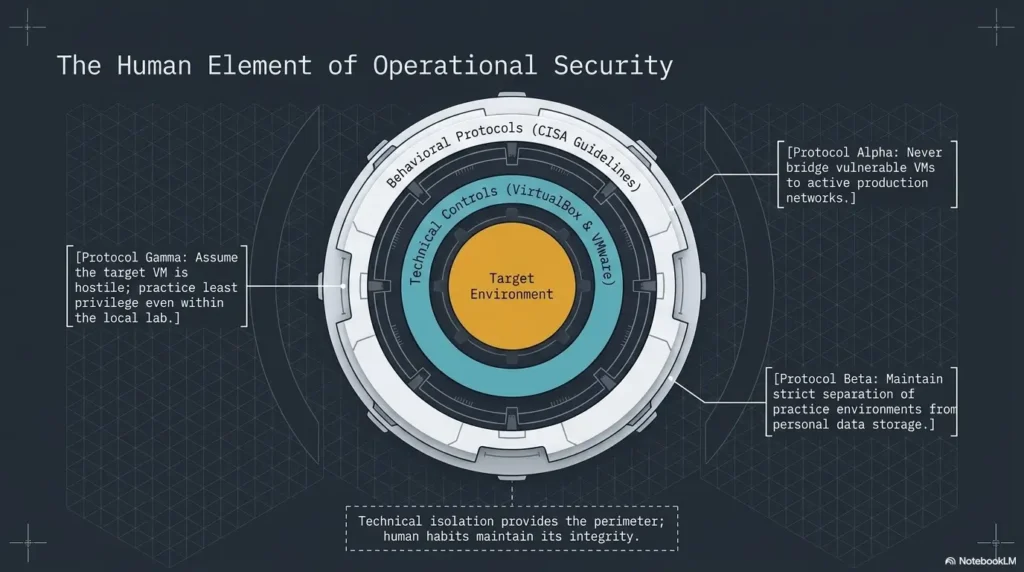
CISA’s public best-practices material leans heavily on routine, consistency, and repeatable basics rather than theatrical complexity. That principle fits lab work beautifully. Durable habits usually beat grand gestures, whether you are securing systems or training your own mind.
- Longer is not automatically better
- Fatigue lowers note quality and hypothesis quality
- Stopping earlier can improve retention and re-entry
Apply in 60 seconds: Set a timer for 25 minutes and treat the stop point as part of the method, not a failure.
Friction Audit: Fix the Setup Problems That Keep Breaking Your Concentration
Snapshot discipline reduces fear and makes re-entry easier next time
Snapshots make experiments easier to reverse. Broadcom’s snapshot best practices apply to VMware vSphere/ESXi: snapshots are not backups, and long chains can affect performance. Do not treat that product-specific guidance as a universal desktop-hypervisor limit. Keep a useful baseline and temporary checkpoints when needed, and back up important files separately.
A simple rhythm works: baseline snapshot, pre-test snapshot when needed, then clean up. Two or three beats, not a symphony. If you want a more deliberate version of that routine, this Kioptrix snapshot strategy fits neatly with the kind of repeatable lab design described here.
Simpler networking beats clever networking when your attention is already thin
For old labs, the right network is often the one you can explain on a sticky note. “Host and VM can talk. The outside world does not matter right now.” That kind of clarity is gold for focus. Oracle’s manual still emphasizes host-only networking as exactly that kind of contained arrangement. When your concentration is fragile, clever infrastructure is usually just chaos in a nicer jacket.
Some learners burn 15 to 20 minutes per session confirming networking they do not fully trust. That distrust becomes its own cognitive tax. Pick the simplest valid model and reuse it. Readers rebuilding a setup from scratch may also want to compare a dedicated Kioptrix network setup guide with a home lab network layout for Kioptrix before they start rearranging cables and adapters like a midnight stage crew.
Build a lab environment that welcomes return visits instead of demanding reorientation
The best lab setup feels like a workshop with tools left where your hand expects them. Same folder. Same note template. Same VM name. Same launch order. Same first command. This is not boring. It is merciful. You are reducing re-entry cost, and re-entry cost is where many good intentions go to disappear.
Quote-prep list: what to gather before comparing lab setups
- Your host OS and version
- Virtualization platform already installed
- Whether host-only networking works reliably today
- How many snapshots you actually need per lab
- Average session length you can sustain
Neutral action: Gather these five items before you change platforms or networking modes.
Show me the nerdy details
A low-friction Kioptrix setup usually benefits from predictable naming and state control: one base VM, one known-good network model, one baseline snapshot, one note file, and one launch checklist of 3 to 5 steps. The goal is not maximum flexibility. The goal is minimum reorientation.
Session Design: A Four-Part Practice Rhythm That Respects Short Attention Spans
Begin with a two-minute reset and one written objective
Before you touch the keyboard, write one sentence. That sentence is the rail your mind holds when it wants to slide sideways. Keep it small. “Confirm services and write one hypothesis.” “Review the web surface and identify one next test.” Two minutes is enough.
It sounds almost too simple, which is often a clue that it works. Distracted brains do not need another sprawling system. They need a door with a handle.
Work in one bounded block with a visible stopping point
Run one block of focused work. Usually 15 to 20 minutes is enough. The timer is not there to make you feel watched. It is there to protect the session from shapeless expansion. One block lets you preserve urgency without summoning panic.
In practice, this often means resisting two temptations: opening a second path too early, and “just checking” a new tool because the first one feels slow. Slowness is not always a warning sign. Sometimes it is the sound of actual thinking. If you are still calibrating what “enough time” looks like, this Kioptrix session length guide complements the routine nicely.
End by writing what changed, not everything you touched
Your exit note should answer three things:
- What did I observe?
- What did that change in my understanding?
- What should happen first next time?
This turns the next session into a continuation instead of a cold start. That single habit may save more future attention than any new extension, plugin, or productivity incantation.
The only difference was the session shape. Two minutes to name the objective, 15 minutes to work one path, five minutes to record what changed, then stop. Within two weeks, her notes became sharper than her old 90-minute sessions ever were. The magic was not discipline descending from the heavens with a trumpet. It was architecture. The room had finally been arranged to help her think.
- Start with one written objective
- Use one bounded work block
- Exit with a note that hands the baton to your future self
Apply in 60 seconds: Create a three-line session template and save it where you launch the lab.
Let’s Be Honest: Focus Problems Often Hide Inside Vague Goals
“Work on Kioptrix” is too broad to guide a tired brain
Broad goals are romantic in theory and useless at 9:40 p.m. after a long day. “Work on Kioptrix” sounds responsible, but it offers no traction. It leaves your brain standing in a hallway full of doors, all equally possible, none emotionally affordable.
Specificity is not restrictive. It is relieving. The brain can do surprising things when it knows what “done for tonight” actually means.
Specific prompts create traction when motivation is unreliable
Try prompts like these:
- Which service deserves my next 15 minutes?
- What clue changed the attack surface most?
- What did I assume that the target has not actually confirmed?
- What is the smallest next test that could remove ambiguity?
These prompts are especially useful when motivation is thin, because they replace drama with structure. Motivation is a weather pattern. Prompts are a roof.
A narrow question keeps curiosity alive longer than a giant mission statement
Curiosity thrives on edges. A giant mission statement is too foggy to energize. A narrow question, by contrast, feels bite-sized and alive. You can carry it around the session without dropping it.
I often think of focused lab work the way chamber music works: not louder, just better arranged. A smaller form can carry more feeling than an orchestra warming up in the wrong key.
Common Mistakes That Make Kioptrix Harder Than It Needs to Be
Starting without a note-taking frame
If the first note you take is accidental, the session is already leaning uphill. Notes do not have to be elaborate. They just need fields. Observation. Hypothesis. Next test. That is enough. Without a frame, distracted learners tend to write either too little or everything. Both create future confusion.
Changing tools too quickly when the first clue feels slow
Tool-hopping often masquerades as adaptability. Sometimes it is just impatience in tactical clothing. If one clue feels slow, stay with it a little longer before opening a second front. That extra three or four minutes often separates real reasoning from restless switching.
Treating dead ends as failure instead of signal
A dead end can mean the hypothesis was weak, the timing was wrong, or the clue was less useful than it first appeared. That is valuable information. A distracted learner, though, may interpret it as personal inadequacy and start scrambling. The dead end itself is rarely the session killer. The emotional interpretation often is.
Rebuilding the environment every time because no reset habit exists
If each session begins with rediscovery, your brain will start to resist starting at all. Reset habits matter. Baseline snapshot. Known notes file. Saved folder. Consistent terminal layout. None of this is glamorous. Neither are good running shoes, yet knees everywhere are grateful.
Park interruptions with a return condition
Practice guidance / illustrative examples. No new VM execution or measured outcome is claimed for this section.
Focus is easier to review when a detour has a written reason. Keep the current question and save a new lead without immediately starting it. An invented re-entry-time example is not a measured learning result.
Illustrative queue: current task is confirming the hostname required by the lab web app. A scanner also reports another service. Record that service, its raw evidence and ‘revisit after the hostname baseline is understood, or sooner if new evidence makes it relevant.’ This preserves the lead without expanding the active task.
Before switching, save the current observation and what remains unknown. When returning later, recheck any conditions that may have changed, including target identity and session state. Review whether each switch answered a different question or merely repeated the same uncertainty with another tool. Adjust the next session's scope from that record, not from a universal limit on tabs or hypotheses.
Dead Ends Matter: How to Recover Focus After You Get Stuck
Pause long enough to name what you know versus what you assumed
When you get stuck, do not immediately escalate complexity. First separate evidence from story. What do you actually know? Which assumption is doing the loudest work? This is a small move, but it can rescue a session from spiraling outward.
Use one fallback question to restart momentum instead of opening five new paths
Choose one fallback question in advance. Mine is usually: What is the smallest next observation that could reduce uncertainty? Yours can be different, but it should be singular. One question. One rope back to the path.
Five new paths feel energizing for about ninety seconds. Then they become a pinball machine in your skull.
Let’s be honest… most spirals begin after an unexamined guess
Many focus collapses start when a learner quietly upgrades a guess into a fact. From there, every next action bends around that hidden assumption. The result is not just wasted time. It is a shaky narrative of the target. Recovery begins when you demote the guess back to what it is.
This is also why short exit notes matter. They preserve what was actually observed so that tomorrow’s session does not inherit yesterday’s fiction.
- Separate evidence from interpretation
- Use one fallback question
- Do not let one guess become the architecture of the whole session
Apply in 60 seconds: Add two labels to your notes now: “Observed” and “Assumed.”
Proof Over Performance: Why Reflective Notes Beat Terminal Theater
Strong learners can explain why they tried something next
Anyone can produce a dramatic command history after enough copying, chaos, and caffeine. What makes a learner stand out is the ability to explain the choice sequence. Why this path? Why now? Why not that other service? Those answers reveal judgment, and judgment is what survives beyond one lab.
Notes should capture observations, decisions, and revisions
A good note trail has three layers:
- Observation: what the target actually revealed
- Decision: what you chose to test next
- Revision: what changed after the result
This keeps notes from becoming either a chaotic transcript or a vague diary. You want reasoning with bones.
Reflection turns a distracted session into reusable evidence of growth
That may not look glamorous on social media. It looks much better inside a real learning life. A simple Kioptrix recon log template or even a cleaner lab report structure can make that growth easier to see in plain daylight.
Show me the nerdy details
Reflective notes improve transfer because they encode not just outcomes, but decision logic. This matters for interviews and for later labs because the reusable part of your skill is rarely the exact exploit chain. It is the pattern of choosing, testing, and revising under uncertainty.
Build the Repeat Loop: How Kioptrix Becomes a Weekly Focus-Training System
Repetition makes the lab more familiar and your thinking more visible
Repeating Kioptrix is not laziness. It is instrumentation. When the lab becomes familiar, your own thinking becomes easier to see. You notice whether your enumeration is sharper, whether your notes are cleaner, whether your dead-end recovery is faster. That is hard to measure when every week is a completely new arena.
Familiar labs remove novelty as camouflage. You get to see your actual habits in daylight. Learners who want to stretch that habit beyond one article can use a broader Kioptrix learning path to keep the repetition purposeful instead of random.
Short recurring practice beats occasional heroic effort
Two or three short contacts each week are usually better than one giant Saturday collapse. Frequency keeps the lab psychologically warm. You do not have to reintroduce yourself to it each time. The task remains alive in memory, which lowers the cost of starting again.
Many learners underestimate this. They plan as if their future self will arrive carrying fresh energy, ideal weather, and the patience of a monastery librarian. Usually, future self arrives tired and wants instructions.
The point is not intensity. It is returnability
Returnability is the hidden metric. Can you come back without dread? Can you resume without rebuilding the universe? Can your notes lead you in by the hand? If yes, you have built a real practice system.
This is where Kioptrix shines. It is not just vulnerable. It is revisit-able. And for learners who struggle with focus, revisit-ability is often the bridge between aspiration and actual skill.
Coverage tier map: how weekly Kioptrix practice can evolve
| Tier | What changes | Time cost |
|---|---|---|
| 1 | Consistent startup and notes | 15 to 20 min |
| 2 | Cleaner enumeration and hypothesis selection | 20 to 25 min |
| 3 | Better dead-end recovery and reflection | 25 min |
| 4 | Interview-ready story building | 10 extra min weekly |
Neutral action: Identify your current tier and build only the next one, not all four at once.
FAQ
Is Kioptrix good for beginners who cannot focus for long?
Yes, often surprisingly so. Its value is not that it is “easy,” but that it is contained. A contained lab gives beginners fewer moving parts to manage, which leaves more attention for observation and reasoning.
How long should a Kioptrix practice session be?
For many distracted learners, 20 to 30 minutes works better than 90. A good starting structure is 2 minutes to reset, 15 to 20 minutes to work one path, and 3 to 5 minutes to write the exit note.
Do I need to finish the box in one sitting?
No. In fact, forcing one-sitting completion often makes focus worse. Treat the lab as a series of connected sessions rather than a single heroic event.
What should I do when I lose focus during enumeration?
Pause and name what changed. Did the task branch too widely? Did the output become noisy? Did you start chasing a guess? Then reduce the scope to one service, one clue, or one next test.
How do I take notes without breaking concentration?
Use a tiny note frame: observation, hypothesis, next test. That keeps notes useful without turning them into a second job. The goal is not beautiful documentation. It is clean handoff to your future self.
Is it better to repeat the same Kioptrix level or move to a new lab?
If focus is the skill you are training, repeating the same level can be excellent. Familiarity reduces novelty load and makes your own thinking habits easier to see.
Can short sessions still help with cybersecurity interview stories?
Absolutely. Short sessions often produce better stories because you remember the decision sequence more clearly. Interviewers usually care more about why you chose a path than about hearing a long list of tools.
What is the best way to restart after a frustrating session?
Read your last three lines of notes, restore the known state, and begin with the smallest next observation that could reduce uncertainty. Do not restart by opening five tabs and hoping mood will do the rest.
Next Step: Run One 25-Minute Kioptrix Session With a Single Objective
Pick one narrow target such as service discovery, web enumeration, or note cleanup
Not five things. One. Service discovery is enough. Reviewing the web surface is enough. Cleaning and clarifying your notes is also enough. Some of the best next sessions are “boring” in a way that ends up being wildly useful.
Write one sentence before you begin and three sentences before you stop
Before: “Tonight I am checking X because it will clarify Y.”
After:
- What I observed
- What changed in my understanding
- What happens first next time
This tiny writing ritual closes the curiosity loop from the beginning of the article. The problem was never simply attention. It was shape. Give the session a shape, and attention has somewhere to land.
Judge the session by whether your thinking became clearer, not whether you reached root
That is the honest next step within 15 minutes: prepare one 25-minute session with a single objective and a clean exit. If that works twice in one week, you are no longer waiting for better focus to arrive. You are building it.
- One objective beats vague ambition
- A short exit note protects the next session
- Clarity is valid progress even without root
Apply in 60 seconds: Put a 25-minute block on your calendar and name its single objective right now.
Review a Parked Lead Before Resuming It
A new idea belongs in the queue until you can explain why it addresses the current question. Reopening every tab is not a completion requirement. Use the existing evidence and return condition to decide what merits another permitted check.
What evidence makes the lead relevant?
- Name the observation that originally raised the question.
- Record what the proposed check could distinguish.
- Mark a missing prerequisite or uncertain target explicitly.
What conditions permit you to resume?
- Confirm that the intended task, target and permissions still apply.
- Choose one bounded action and a stopping condition.
- Keep the lead parked when it does not answer the current question or its prerequisites remain unresolved.
At closure, leave the last known state, original artifact reference and next question. If you need a broader reflection on a specific skill, use the self-assessment guide. The working note below keeps the lead and its return condition together.
Original review: 2026-04.
Technical guidance updated: 2026-10-13. Clarified the product scope of VMware snapshot guidance and the distinction between checkpoints and backups.
Working note: Park interruptions with a return condition
Replace the prompts with your own authorized lab evidence. Select the completed text and copy it to a local note before leaving. This field is not submitted or saved; reload clears edits. Do not enter passwords, tokens or personal data.
Related task: Continue with the related practical guide.