

Mastering Kioptrix: Signal Over Fog
The box usually feels easier the moment you stop treating it like a timed performance and start treating it like a sequence of small decisions.
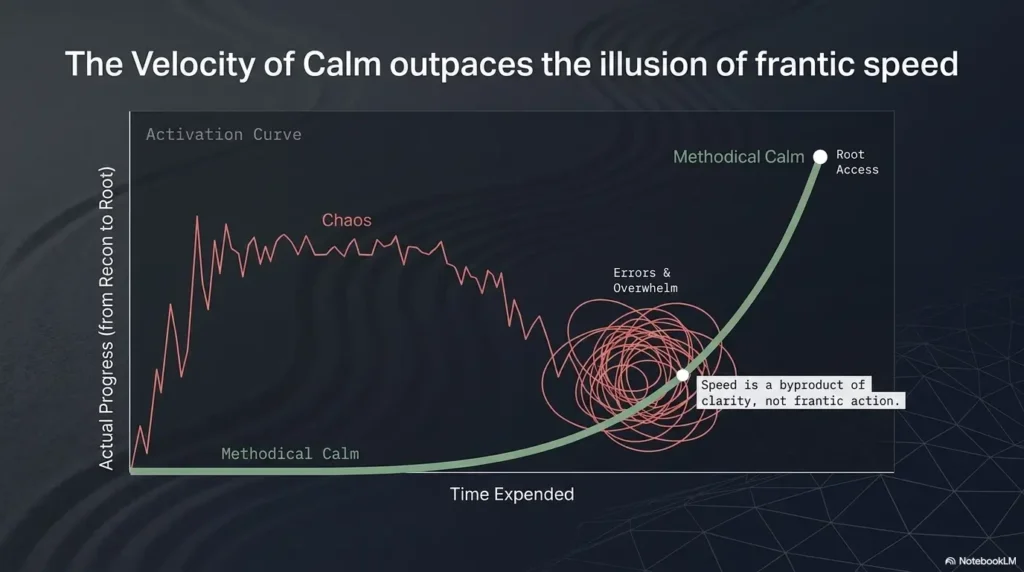
Kioptrix Level gets called “beginner-friendly” so often that many learners waste their first 30 minutes thinking the problem is their skill, when the real problem is their pace. Speed creates noise long before it creates progress.
A calmer Kioptrix workflow helps you enumerate more cleanly, rank clues more intelligently, and build a repeatable method. The result is not merely a smoother solve. It is better judgment and better stories for your next interview.
The Shift
- • Not more tools.
- • Not more panic.
- • More signal, less fog.
The Outcome
- • Hypothesis-driven testing
- • Focused sessions
- • Reduced repeat mistakes
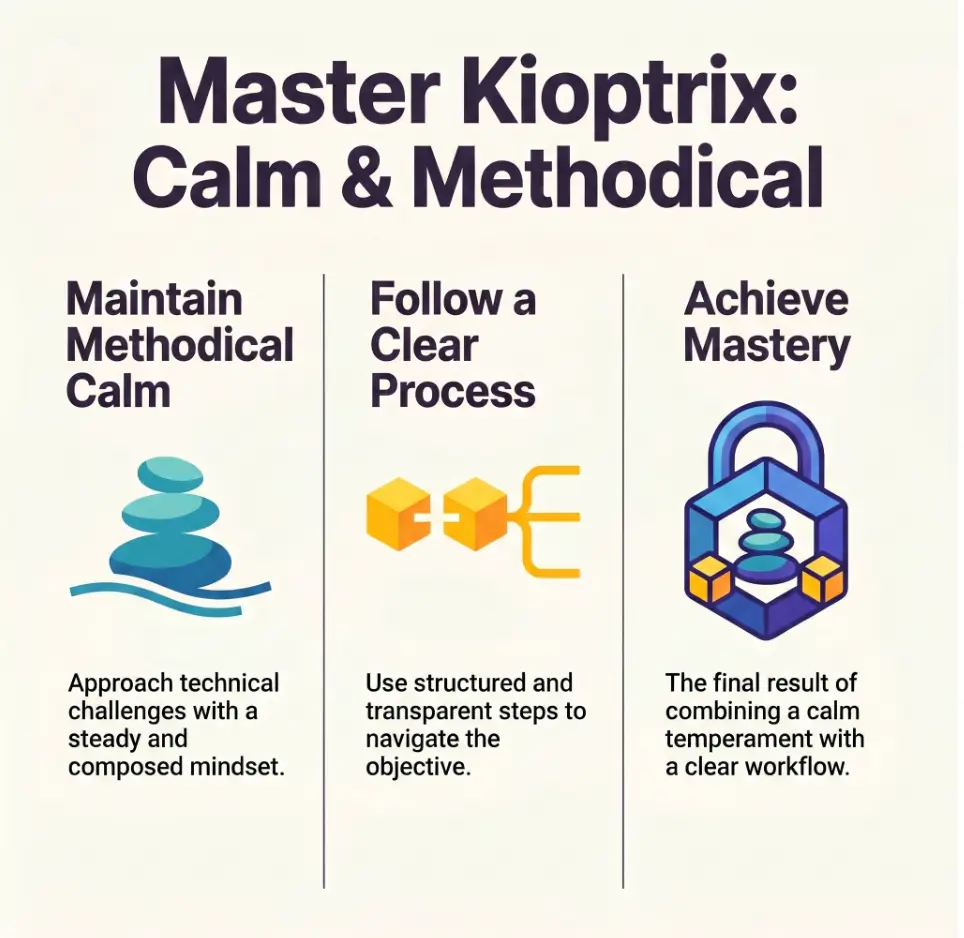
Fast Answer: Kioptrix Level usually feels easier once you stop measuring progress by speed. The box rewards careful enumeration, note-taking, and small decisions much more than frantic scanning or exploit-hunting. When you slow the session down, reduce tool hopping, and follow one clue at a time, the lab often becomes clearer, calmer, and more useful for long-term learning.
Table of Contents
Kioptrix Level Feels Harder When You Turn It Into a Stopwatch Problem
Speed creates noise before it creates progress
Beginners often assume that faster work means better work. In a lab, that instinct can betray you. The moment the clock becomes the main character, every open port starts to look urgent, every banner becomes a possible shortcut, and every delay feels like failure. What you lose first is not skill. It is signal.
That is why Kioptrix can feel strangely harder than people promised. It is old, often described as beginner-friendly, and surrounded by walkthrough culture. So learners arrive expecting a brisk, neat, cinematic victory. Instead, they hit ambiguity. The box is not being cruel. It is revealing that unstructured speed creates fog.
Why rushed enumeration makes simple clues look invisible
Rushed enumeration has a peculiar effect. It does not only cause missed details. It makes details look unimportant. A version string that should trigger curiosity gets skimmed. A service that should be revisited later is mentally filed under “probably nothing.” A small response difference vanishes because the learner is already sprinting toward the next command.
In practice, this is where many sessions drift off course. Not because the learner lacks intelligence, but because their pace makes the environment unreadable. One learner may spend 20 minutes collecting structured notes and walk away with three useful hypotheses. Another may spend the same 20 minutes blasting large tools and come away with a terminal full of text and no idea what matters. Same time. Very different cognitive weather.
The lab is not punishing you, it is exposing your pace
There is a quiet mercy in that. Kioptrix reveals where your process is brittle while the stakes are low. No customer impact. No midnight pager. No teammate waiting on your fix. Just a small lab acting like a mirror.
I often think of this as the “library test.” The learner who behaves as if the room is on fire usually learns less than the learner who behaves as if they are reading a difficult map. One creates heat. The other creates direction.
- Speed pressure makes small clues disappear
- Noise grows faster than understanding
- Old labs still punish sloppy sequencing
Apply in 60 seconds: Before your next session, write one rule at the top of your notes: “No new tool until I can explain what problem I am solving.”
Stop Racing, Start Reading the Box for What It Is Actually Saying
Enumeration gets easier when you let one clue lead to the next
Good enumeration is less like throwing darts and more like following thread through cloth. You pull lightly, then see what moves. Kioptrix becomes easier when each action earns the next one. A discovered service leads to a more targeted check. A response leads to a narrower question. A narrow question leads to a smaller, cleaner test.
This sounds almost too modest to be useful, which is exactly why people skip it. The brain likes drama. “Maybe I found the exploit” is a thrilling sentence. “Maybe I should confirm what this service is doing first” is less glamorous. Yet the second sentence usually produces better outcomes.
Small signals matter more than dramatic breakthroughs
Many learners imagine progress as a series of fireworks. In reality, lab progress is often a row of tiny lamps turning on one by one. A banner. A directory clue. An odd behavior. A version hint. A login surface that does not look important until you see it in context. The box becomes legible through accumulation.
That is why note-taking matters so much. Notes let weak signals gather into something stronger. Without notes, each clue has to shout. Most of them will not. If you need a simple structure, a Kioptrix recon log template can make the early phase feel much less slippery.
Here’s what no one tells you: the “easy” box still expects discipline
“Beginner-friendly” does not mean “mindless.” It usually means the lab contains a learnable chain of decisions. Kioptrix does not ask for wizardry. It asks for steadiness. That can be frustrating for learners who expected immediate momentum, especially if they are coming from tutorial videos where the path looks smooth, obvious, and strangely well-lit. For a broader primer, Kioptrix for beginners helps frame what “beginner-friendly” really means in practice.
But edited success is not the same thing as real-time learning. In real time, there are pauses, revisions, and moments where the most useful action is simply to look again.
Decision Card: What should drive your next move?
| When you see… | Choose… | Trade-off |
|---|---|---|
| A vague scan result | Targeted verification | Slower now, less drift later |
| Three tempting attack paths | Rank by evidence | Less excitement, more traction |
| A long stretch of uncertainty | Re-read your notes first | Feels boring, often saves 15 minutes |
Neutral action: Pick one clue and write the single most reasonable follow-up question it suggests.
The Real Shift Is Mental, Not Technical
From command collecting to decision making
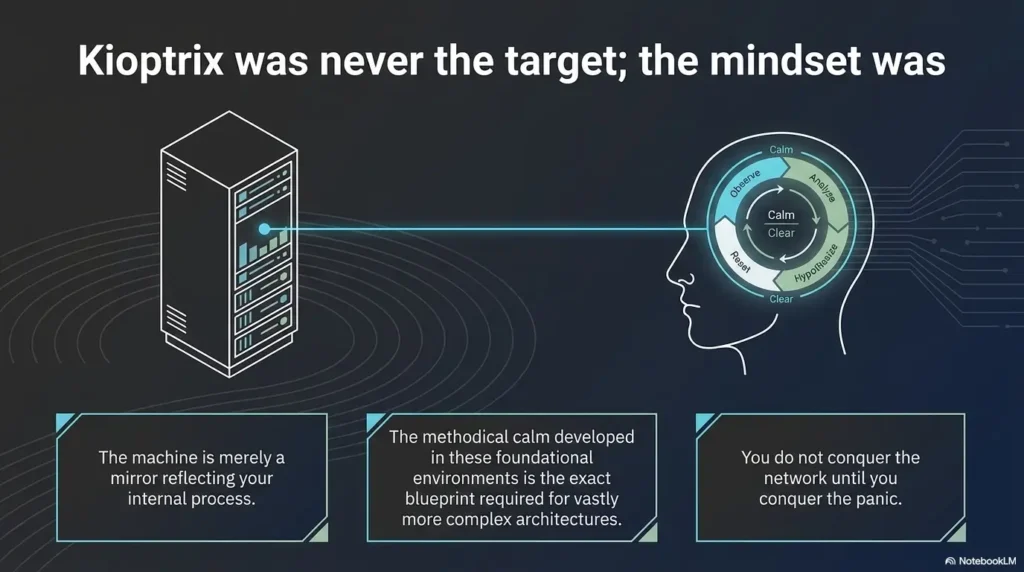
A surprising number of stalled sessions are not technical failures at all. They are decision failures disguised as productivity. The learner knows commands, knows tools, maybe even knows the right tools. What they do not yet have is a sequence for choosing among them.
This is where Kioptrix becomes more valuable than it first appears. It exposes the gap between having tools and using judgment. That is an important distinction for career changers and self-taught learners. In interviews, people rarely impress others by reciting a grocery list of tools. They stand out when they can explain why they chose one action before another. That is also why many learners later turn these sessions into better Kioptrix interview stories instead of mere solve receipts.
Why “what should I try next?” beats “what exploit should I run?”
That shift matters because it changes the shape of the session. “What exploit should I run?” assumes the goal is immediate breakthrough. “What should I try next?” keeps the learner inside the process. It preserves curiosity. It also keeps mistakes smaller.
There is a practical humility to this. Smaller decisions are easier to review, easier to document, and easier to repeat. They also age better. Tool syntax changes. Interfaces drift. Vendor logos change clothes like theater actors. But the habit of forming a hypothesis and testing it cleanly remains useful.
Let’s be honest: panic-searching tools feels productive until it doesn’t
Many learners know this feeling. The session goes flat, so they open another tab, search for a bigger scan, download a louder script, or reach for a framework because silence feels unbearable. It is understandable. It is also usually where the session starts spending energy instead of earning information.
In training environments, panic often wears a technical costume. It looks busy. It sounds busy. Terminal output scrolls like a waterfall. Yet underneath, the learner has stopped making decisions and started hoping the machine will rescue them. If that habit sounds familiar, the piece on why copy-paste commands fail in Kioptrix is a useful companion.
Show me the nerdy details
One useful mental model is to separate actions into three buckets: discovery, verification, and exploitation. If you are stuck, ask which bucket your last three commands belonged to. Many stalled learners accidentally loop discovery commands without moving into targeted verification.
A quiet session is not a failed session. Sometimes it is the first honest one.
Slower Enumeration Often Produces Faster Results
Careful service discovery reduces random detours
There is a small irony at the center of lab work: slow thinking often speeds up the whole session. When you identify what is actually running, confirm what matters, and keep your scope tidy, you avoid the classic sinkholes. Random detours shrink. Duplicate checks disappear. You stop circling the same ground in slightly different shoes.
That is why experienced learners often look calm rather than dramatic. Their pace is not lazy. It is selective. They spend fewer cycles chasing low-quality leads. A deliberate Kioptrix recon routine usually does more for progress than a louder stack of tools.
A clean note-taking trail shortens repeat work
Notes are not academic decoration. They are memory externalized. In Kioptrix, that matters because old labs often present a chain of clues that only becomes visible once you compare a few observations side by side. Version strings, service behavior, potential entry points, rejected paths, credentials tested, responses seen. The notes do not merely record the session. They shape it.
A useful note trail also protects your future self. Return the next day, and you are not squinting into the dark trying to reconstruct your own thinking. You have a map. Not a perfect map, but enough to move without re-paying the entrance fee in confusion. If you want a dedicated workflow, a technical journal for Kioptrix sessions can make that return far smoother.
Why fewer guesses can mean fewer dead ends
Guessing has a tax. Every random guess adds work: interpreting output, checking side effects, deciding whether the result mattered, and unwinding mental clutter. That cost compounds quickly. Learners often think the problem is “I need more ideas.” Sometimes the truer sentence is “I need fewer unearned ideas.”
OWASP’s testing guidance has long emphasized methodology over theatrical cleverness, and Nmap’s own documentation reflects the same spirit: gather what the target is telling you before you try to outsmart it. In other words, the elegant move is often the patient one.
Mini Calculator: How much time did rushing really cost?
Use this simple estimate:
Unproductive repeat attempts × minutes per repeat = estimated avoidable rework
Example: 4 repeats that add no new information × 8 minutes each = 32 minutes of avoidable rework. A failed hypothesis that produces useful evidence still counts as learning, not lost time.
Neutral action: Count your last three detours and estimate what one better note might have saved.
What Changes Once You Stop Trying to Finish in One Sitting
Short sessions protect attention and pattern recognition
One of the quietest upgrades a learner can make is to stop treating every lab as a one-sitting event. The urge is understandable. You want closure. You want the satisfying click of a solved box before life interrupts. But fatigue is a sneaky editor. It deletes nuance first.
Shorter sessions, often in the 30 to 45 minute range, tend to preserve what matters most in beginner labs: observation, emotional steadiness, and the ability to notice when a clue deserves a second look. Once those go, the session may continue, but the quality drops. You are still typing. You are no longer seeing. If you have been wondering about the sweet spot, this guide on Kioptrix session length digs deeper into that rhythm.
Why fatigue turns solvable steps into messy loops
Fatigue makes people impulsive. It turns “I should verify this” into “I’ll just try one more thing.” Then another. Then three more things that resemble the first one wearing fake moustaches. Before long, the lab is not difficult because the target is complex. It is difficult because your brain is crowded.
Many learners misread this moment. They think the difficulty proves they are not good at labs. Usually it proves something simpler: the session went stale. That is not a moral failure. It is a scheduling problem.
The box gets clearer when your brain is less crowded
A rested return often feels almost suspicious. The same target that felt dense at night suddenly looks orderly in the morning. That is not magic. It is reduced cognitive noise. When you bring cleaner attention, the box gives cleaner answers.
I have seen people spend 90 minutes trapped in a knot, then solve the next meaningful step in 7 minutes the following day. The difference was not talent arriving on horseback. It was mental freshness.
- Short sessions preserve pattern recognition
- Fatigue inflates uncertainty
- Stopping early can be a strategic move
Apply in 60 seconds: Set a hard stop for your next lab session before you begin, even if you feel “close.”
Who This Is For, and Who It Is Not For
Best for learners who want structure, not adrenaline
This calmer approach works especially well for learners who care about transfer. They do not just want to solve one box. They want to build a way of working they can repeat on the next lab, the next interview prompt, the next unfamiliar service. They are not allergic to excitement. They just do not want excitement running the meeting.
It is also useful for learners with limited time. A parent studying after work, a career changer doing 40 minutes before bed, a student trying to practice without turning every evening into a five-hour vortex. These people do not need more hype. They need a method that survives ordinary life.
Good for career changers building repeatable practice habits
Career changers often gain the most from this mindset because they are not just learning tools. They are learning how to narrate their thinking. A structured Kioptrix session can become an interview story about observation, prioritization, and learning from dead ends. That is much stronger than saying, “I used Tool A, Tool B, and then something worked.” For that audience, Kioptrix for career changers and Kioptrix for help desk workers both fit naturally beside this approach.
Not ideal for people chasing only speed or instant wins
If your only goal is finishing as fast as possible, this approach may feel too restrained. That is fine. Every training method has a personality. This one is more workshop than fireworks. It is built for skill retention, not scoreboard theatrics.
Eligibility Checklist: Will the “no-rush” approach help you?
- Yes: You often forget what you already tested
- Yes: You jump between tools when a session stalls
- Yes: You want better interview stories, not just faster solves
- No: You only care about speed-run style completion
- No: You refuse to write notes under any circumstances
Neutral action: If you answered “Yes” to two or more lines, try one Kioptrix session with a fixed note template.
Common Mistakes That Make Kioptrix Level Feel Needlessly Hard
Treating every open port like an urgent emergency
Not everything visible is equally important. One of the beginner traps in Kioptrix is confusing visibility with priority. An open port is an invitation to investigate, not a command to panic. When everything becomes urgent, nothing gets ranked, and the session loses its spine. If you need a calmer way to sort early findings, what service to investigate first in Kioptrix is worth bookmarking.
Running big tools before forming small hypotheses
Big tools can be useful. They can also become a hiding place. Learners sometimes deploy them before they know what question they are asking, hoping that output volume will compensate for uncertainty. Usually it does the opposite. It creates a warehouse of details with no shelves.
Skipping notes because “I’ll remember this part”
This line has betrayed more learners than any target ever has. You will remember some of it, certainly. You will also forget just enough to waste 12 minutes tomorrow. Then you will half-remember enough to trust the wrong detail. Memory in lab work is a charming liar.
Confusing motion with method
Motion feels good because it relieves discomfort. Method feels slower because it asks you to sit inside uncertainty for a moment. But method compounds, while motion evaporates. One builds understanding. The other merely burns keyboard oil.
Tools like Kali Linux, Burp Suite, Metasploit, or VMware snapshots can support excellent practice. They cannot create discipline for you. That still has to happen in the space between one clue and your next choice. For readers weighing convenience against learning value, the comparison between Metasploit and manual Kioptrix practice adds useful nuance.
Show me the nerdy details
A practical workflow is to label each note with one of four tags: confirmed, suspected, tested, rejected. That tiny taxonomy prevents the common beginner mistake of treating every observation as equally trustworthy.
Don’t Do This: The Habits That Quietly Break Your Momentum
Don’t restart the lab every time you feel uncertain
Restarting can feel cleansing. It can also become ritualized avoidance. Sometimes the learner is not resetting because the environment is broken. They are resetting because uncertainty feels itchy. A clean boot becomes emotional Febreze.
There are moments when a restart makes sense, especially if your state is genuinely messy or you need to validate reproducibility. But using it as a reflex can quietly destroy continuity. You lose the trail of what you observed, what you tested, and what the target already taught you. A light snapshot strategy for Kioptrix is often a better answer than constant emotional resets.
Don’t copy commands you cannot explain
This one matters more than it seems. Copying commands without understanding them trains the wrong muscles. It may get you past one step, but it leaves you unable to judge whether the output is meaningful, risky, or irrelevant. In other words, it borrows confidence and charges interest later.
Don’t mistake frustration for proof that you are stuck
Frustration is information, not a verdict. Sometimes it means the path is thin. Sometimes it means your session is tired. Sometimes it means you found the edge of your current method and need to tighten it. The emotional weather matters, but it is not the map.
Short Story: A learner once spent an evening certain they were trapped. They had scans, notes, a half-dozen browser tabs, and the special brand of despair that arrives around minute 73. Nothing felt coherent. The next day, instead of running more tools, they read their own notes line by line and highlighted only confirmed facts.
Two things stood out immediately: one service they had mentally demoted too early, and one assumption they had never actually tested. Within 15 minutes, the whole box felt different. Not easy, exactly. But navigable. The breakthrough was not a secret exploit descending from the clouds. It was a quieter correction. They stopped arguing with uncertainty and started sequencing it. That is often how Kioptrix opens its door: not with fireworks, but with a small hinge finally moving.
- Unnecessary restarts reset useful context
- Blind copying blocks real learning
- Frustration can signal method drift, not failure
Apply in 60 seconds: Add a “Why this command?” line beneath every new action in your notes.
Why Kioptrix Level Rewards Process More Than Raw Talent
The learner who observes well often outperforms the learner who rushes
Natural technical confidence can help, of course. But in a lab like Kioptrix, observation quality often beats swagger. The learner who notices one relevant behavior and follows it carefully may outperform the learner who knows more commands but cannot sequence them under ambiguity.
This is good news for beginners. It means progress is not reserved for the naturally dazzling. It is available to the patient, the methodical, and the humble enough to write things down.
Patience is not passive in a lab, it is active filtering
People sometimes talk about patience as if it means sitting there nobly while nothing happens. In lab work, patience is active. It filters. It ranks. It protects you from turning possibility into clutter. It is less a rocking chair than a sieve. That is the core idea behind why Kioptrix Level rewards patience, and it shows up again and again once you start watching your own habits closely.
What looks like “intuition” is often just better sequencing
When experienced learners seem intuitive, what you are often seeing is compressed judgment. They are not necessarily guessing better. They have simply practiced the order of operations enough that their choices look smooth. That is trainable. And Kioptrix is a useful place to train it because the environment is small enough for your process to remain visible.
Coverage Tier Map: What changes as your process matures?
| Tier | Typical behavior | What improves next |
|---|---|---|
| Tier 1 | Tool hopping | Basic note discipline |
| Tier 2 | Scan first, think later | Hypothesis before action |
| Tier 3 | Targeted verification | Better ranking of leads |
| Tier 4 | Reproducible workflow | Cleaner storytelling |
| Tier 5 | Calm sequencing under uncertainty | Transfer to new labs and interviews |
Neutral action: Circle the tier that sounds most like your current habit, then choose one upgrade instead of five.
When the Box Finally Clicks, It Usually Happens Quietly
Progress often arrives as narrowing, not revelation
This is one of the most encouraging truths in lab work. The click often does not sound like triumph. It sounds like reduction. Fewer possibilities. Sharper direction. One service now matters more than the others. One path deserves your next 10 minutes. Confusion shrinks from fog to corridor.
That is why learners sometimes miss their own progress. They are waiting for certainty to arrive in a gold cape. Instead, progress shows up like a good editor, crossing out half the page.
One useful note can unlock the next three decisions
A single confirmed detail can reorganize the whole session. This is another reason calm note-taking matters. Good notes do not just preserve facts. They amplify them. One clear line can suddenly connect a version hint, a behavior you observed earlier, and a next step that now feels obvious rather than mystical.
The moment of clarity usually begins long before exploitation
Exploitation may be the visible climax, but comprehension usually begins earlier. It begins when the target stops feeling like a pile of surfaces and starts feeling like a sequence. That is the real click. Once that happens, the box often feels easier not because it became easier, but because you became more readable to yourself.
Infographic: The Calm Kioptrix Loop
Gather signal
Keep only facts
Ask one question
Reduce noise
Choose next best move
Rule: If you cannot explain step 4, return to step 2. The loop is not glamorous. It is effective.
Next Step: Run One Session With a “No Rush” Rule
Set a 30 to 45 minute limit and stop before fatigue takes over
Here is the simplest next step. Run one Kioptrix session with an explicit no-rush rule. Give yourself 30 to 45 minutes. That is enough time to collect signal and form direction without letting attention curdle into chaos. Stop while your notes are still useful and your judgment is still awake.
Write down every clue before choosing your next action
Keep the note format embarrassingly simple if needed. Service. Version. Behavior. Question. Next action. You are not trying to win a stationery award. You are trying to keep your future self from wandering into the same hedge twice. A focused Kioptrix note-taking tool or even a plain template can carry more weight than people expect.
End the session by summarizing one decision you made and why it was reasonable
This final step matters more than it looks. It trains explanation, which reinforces learning. It also produces the raw material for interview stories, blog notes, and future review. By the end of the session, you should be able to say, in plain language, “I chose this next step because these clues made it the most reasonable option.”
That is the curiosity loop from the introduction, now closed. Kioptrix feels easier once you stop racing because the box was never asking for panic. It was asking for sequence. The old lab becomes teachable the moment you stop demanding a sprint from what is really a careful walk. If you want to turn that walk into a repeatable framework, the best-practice path for Kioptrix Level is a natural next read.
In the next 15 minutes, you do not need to solve the whole box. Build the first calm session instead. Create a note template, choose a time limit, scan lightly, and end by writing one decision sentence. That small discipline is where many learners first stop feeling behind and start feeling in control. If you are still in the earliest stage, your first Kioptrix lab and first-lab anxiety both make good next steps.
Original review: 2026-04.
FAQ
Why does Kioptrix Level feel harder than people say it is?
Because many descriptions flatten the real experience. People often call it beginner-friendly, which is true in the sense that the path is learnable. But that does not mean the lab tolerates rushed thinking. It still expects careful enumeration, patience, and note discipline. If you arrive expecting a quick victory lap, the gap between expectation and reality can make the box feel harsher than it is.
Is it normal to spend most of the session just enumerating?
Yes. In fact, that is often a sign of healthier practice. Enumeration is where direction is built. A long enumeration phase is not wasted time if it produces a clearer hypothesis and fewer random detours later. Many useful sessions end with better understanding rather than full compromise, especially for beginners. Readers who want a deeper dive can continue with Kioptrix enumeration.
How long should one Kioptrix practice session be?
For many learners, 30 to 45 minutes is a strong starting range. It is long enough to gather meaningful signal and short enough to protect attention. Some people can go longer, but once fatigue starts turning your notes fuzzy and your choices impulsive, the session quality usually drops. Stopping early is often smarter than dragging the lab into a low-quality second hour.
Should beginners use walkthroughs right away or only after trying first?
A useful middle path is to try first with a clear time boundary, then check a walkthrough only after you can name what confused you. That keeps the walkthrough from becoming a substitute for thinking. It turns it into a feedback tool instead. The goal is not purity theater. The goal is to learn without outsourcing every decision. If you do reach for one, a Kioptrix Level walkthrough is most helpful after an honest first pass.
What should I write down while working through the lab?
At minimum, record confirmed services, versions or behaviors that seem meaningful, hypotheses you formed, actions you took, and paths you rejected. It also helps to note why you chose an action. That tiny line of reasoning becomes very valuable when you return later or need to explain your thinking to someone else.
How do I know whether I am learning method instead of memorizing steps?
Ask whether you can explain your next move before you take it. If you can say, in plain language, what evidence led you there, you are probably learning method. If your process depends on copying sequences that make sense only in that exact box, you may be memorizing more than you realize. Transfer is the clue. Can the habit survive a different target?
Does moving slowly mean I am bad at labs?
No. Slow can mean careful, selective, and honest. In many cases, learners who move more deliberately build stronger long-term skill because they notice patterns, keep cleaner notes, and avoid false urgency. Slowness becomes a problem only when it comes from paralysis rather than purposeful observation. The answer is not panic. It is better structure.
Can Kioptrix still help with interview storytelling and job prep?
Absolutely. Kioptrix is useful not only as a technical lab but as a training ground for decision stories. It lets you practice describing how you gathered information, ranked possibilities, handled dead ends, and learned from uncertainty. Those are exactly the kinds of details that make an interview answer sound thoughtful instead of scripted. If you want a more reflective checkpoint, a Kioptrix self-assessment is a strong follow-up after a few sessions.
Technical guidance updated: 2026-10-13. Corrected the rework calculator so useful failed tests are not counted as wasted practice.