Cybersecurity career decision guide
OSCP vs CEH vs PNPT:
Which Certification Pays Off?
Picking a cybersecurity certification can feel strangely expensive before it feels educational. One browser tab says OSCP is the badge with gravity. Another says CEH gets past HR. A third whispers that PNPT teaches the work more honestly. Meanwhile, your calendar, wallet, and résumé are all looking at you with tiny clipboards.
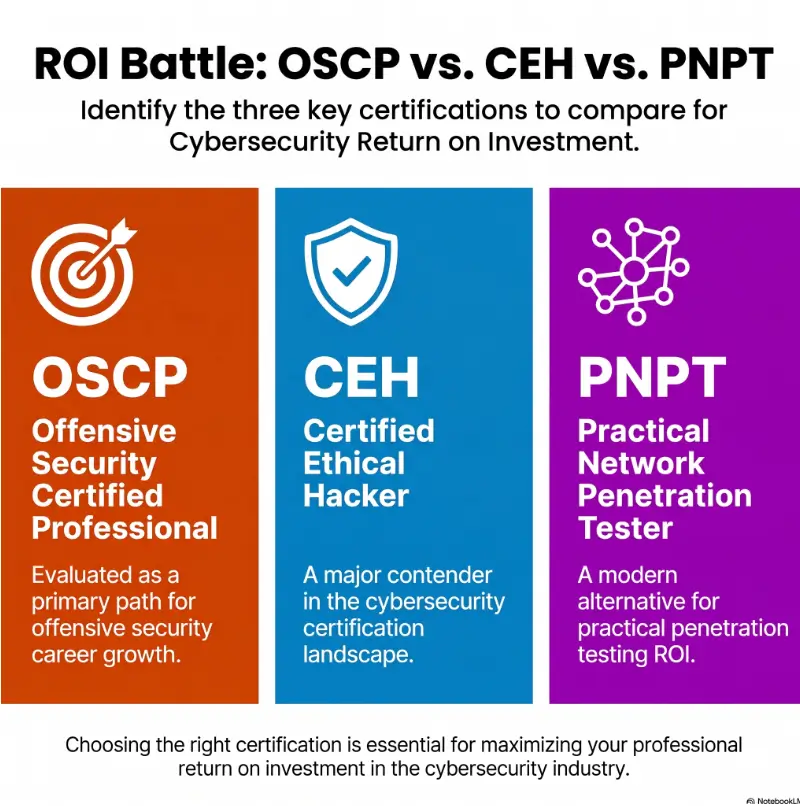
This guide compares OSCP, CEH, and PNPT by what actually matters: employer recognition, practical skill value, cost, study burden, beginner readiness, portfolio impact, and the job descriptions you are likely to face in the US and UK market. The goal is not to crown one shiny winner for everyone. It is to help you avoid buying the wrong hill to climb.
If you are in help desk, SOC, IT support, college, military transition, or self-taught lab mode, this article will help you choose the certification that fits your next move instead of someone else’s LinkedIn mythology.
Compare ROI
See which badge helps with interviews, learning, HR filters, and career timing.
Avoid wrong costs
Account for prep time, retakes, lab access, training, and opportunity cost.
Pick a next step
Use a 30-job-post test before paying for any exam voucher.
A good certification should make your next interview easier to earn, not your bank account easier to empty. 🧭
Snapshot
This article is for early-career IT workers, SOC analysts, help desk professionals, students, and aspiring penetration testers comparing OSCP, CEH, and PNPT. You will learn which certification fits different goals, how to avoid wasting money, and how to run a simple job-posting test before choosing your path.
Table of Contents
Fast Answer: OSCP, CEH, Or PNPT?
For most US penetration-testing career paths, OSCP usually pays off best for employer recognition, PNPT pays off best for practical training value, and CEH pays off best when a job description, HR filter, government contractor, or compliance-heavy employer specifically asks for it.
The practical answer is not “which certification is best?” It is “which certification helps the job I am actually trying to get?” OSCP has the strongest résumé gravity for many pentest roles. PNPT is unusually useful for learning how a client-style engagement works. CEH can still matter when the employer’s checklist says CEH, especially in more formal or compliance-driven hiring pipelines.
Key takeaway
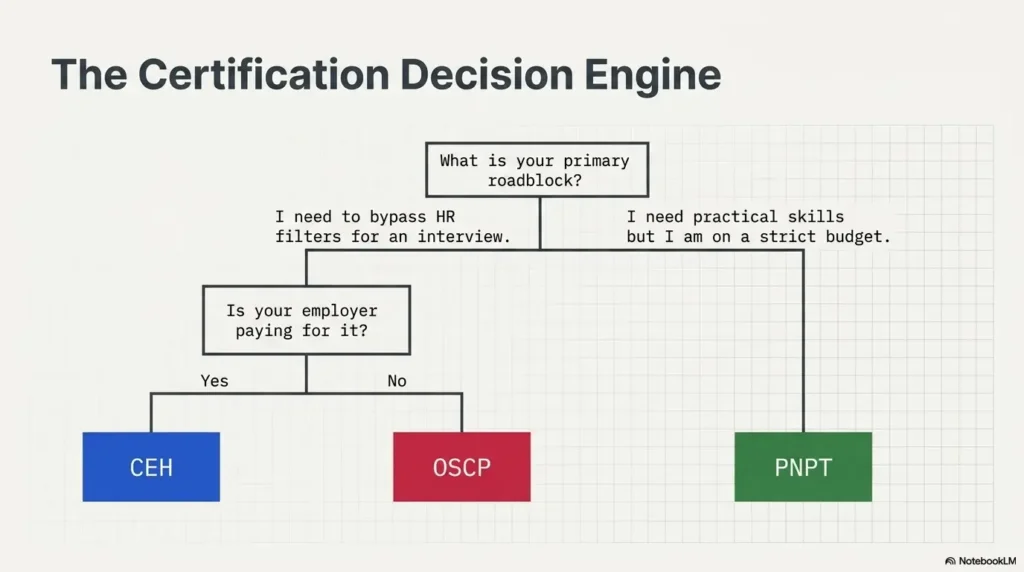
If you want one clean rule: choose OSCP for signal, PNPT for practical skill-building, and CEH only when your target job postings repeatedly name it.
As of the last review of this article, OffSec’s official pricing page listed the PEN-200 Course + Cert Bundle at $1,749 and Learn One at $2,749 per year. TCM Security listed PNPT at $499 for an exam voucher plus training. EC-Council pricing may vary by delivery method, region, eligibility, training format, and partner provider, so always verify current cost before budgeting.
Before You Pay: A Cert Is Not A Career Contract
This article is career education, not hiring, legal, financial, or professional cybersecurity advice. Certification requirements change. Prices change. Job descriptions change. Employer preferences can vary wildly by country, city, industry, clearance requirements, consulting model, and whether the hiring manager is technical or not.
Also, cybersecurity practice must stay inside authorized environments. Labs, CTFs, your own machines, employer-approved systems, and signed scopes are the safe playgrounds. Random public targets are not “practice.” They are a trapdoor painted like a shortcut.
Before you act checklist
- Check at least 30 real job posts before buying an exam voucher.
- Confirm current pricing on the official certification provider page.
- Budget for retakes, lab time, books, courses, and lost weekends.
- Do not assume a certification will replace experience, documentation, or fundamentals.
- Practice only in legal, authorized labs and environments.
For official details, use the certification providers and labor data sources directly. Blog posts, forum comments, and viral study plans are helpful for texture, but official pages are where your wallet should look before it jumps.
Why “Pays Off” Is Not One Number
A certification pays off in several currencies. Salary is the loudest one, naturally. But there are quieter currencies too: recruiter searches, HR keyword filters, interview confidence, technical vocabulary, report-writing skill, and the ability to tell a clear story about how you solve security problems.
That is why OSCP vs CEH vs PNPT is not a simple boxing match. OSCP may help you get noticed faster for certain pentest roles. PNPT may help you explain an assessment better. CEH may unlock an HR screen that would otherwise ignore you. Each has a different shape in the hiring machine.
The real ROI formula: salary signal + job filter + skill proof
Think of certification ROI as three stacked signals. The first is salary signal: does this credential make employers believe you can do higher-value work? The second is job filter: does it appear in real job descriptions? The third is skill proof: does the process leave you with usable ability, not just a badge?
OSCP tends to score well on recognition. PNPT tends to score well on job-shaped practice. CEH can score well on HR matching when the job post says CEH. The mistake is pretending these are the same kind of value.
Cost is visible. Opportunity cost hides in the walls.
Sticker price is only the first invoice. A $499 exam can become expensive if it sends you down the wrong path for six months. A $1,749 course can be worth it if it helps you land interviews you were not getting before. A cheaper badge can be costly if it does not move your target job market at all.
Opportunity cost includes study hours, retake stress, lab subscriptions, books, courses, missed family weekends, and the emotional tax of grinding without a plan. That tax does not appear at checkout, but it collects interest.
The uncomfortable truth: a cert can help you get seen, not hired
A certification can put your résumé into a better pile. It cannot answer interview questions for you. It cannot write your report. It cannot make your lab notes coherent. It cannot explain why a vulnerability matters to a business owner who does not care about the tool name.
The strongest candidates combine certification with visible proof: write-ups, lab reports, clean screenshots, simple methodology, and stories that show judgment. For a beginner, a tiny portfolio often does more than a lonely credential sitting on a résumé like a postage stamp on an unopened letter.
| ROI factor | What it means | Best practical question |
|---|---|---|
| Employer recognition | Recruiters and hiring managers recognize the badge quickly. | Does this cert appear in my target job postings? |
| Skill-building value | The training and exam improve real working ability. | Will I become better at assessment, reporting, and reasoning? |
| HR keyword value | The credential helps pass automated or nontechnical screens. | Does the job description explicitly name it? |
| Cost control | Total cost stays realistic after prep, retakes, and tools. | Can I afford the full path, not just the first payment? |
| Timing fit | The cert matches your current skill base and next role. | Am I ready, or am I buying pressure before preparation? |
OSCP First: The Name Recruiters Recognize
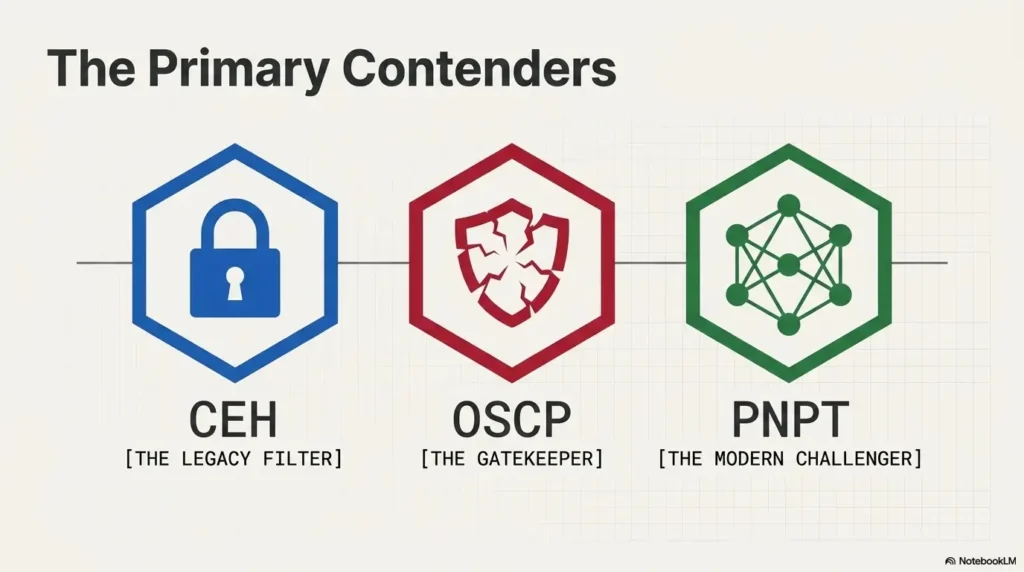
OSCP has long carried unusual weight in penetration-testing hiring circles. It is not magic. It is not a personality transplant. But it is a badge many security teams understand without needing a long explanation.
For junior pentest, security consultant, red-team-adjacent, and offensive security roles, OSCP often functions as a strong signal that you can work through hard technical problems under pressure. That does not mean every hiring manager requires it. It means the name often gets attention.
Why OSCP still carries résumé gravity
The OSCP reputation comes partly from its hands-on nature and partly from the culture around it. People who pass usually have stories: stuck boxes, stubborn enumeration, rabbit holes, pivot points, proof screenshots, late-night notes, and that strange moment when a clue finally clicks.
Employers like signals that reduce uncertainty. OSCP is imperfect, but it can suggest persistence, process, basic offensive methodology, Linux comfort, web exploitation exposure, and exam pressure tolerance. In a crowded résumé stack, that matters.
The exam tells employers you can suffer productively
That phrase sounds dramatic, but the idea is simple. Penetration testing often requires calm frustration management. You need to keep notes, retest assumptions, avoid panic-scanning, and explain what happened after your brain has been cooked to medium-well.
OSCP’s value is not only technical. It is also behavioral. It hints that you can sit with ambiguity and keep moving. In consulting, that matters because clients pay for outcomes, not tool confetti.
Where OSCP shines: pentest roles, red-team tracks, consulting firms
Choose OSCP when your target job titles include penetration tester, security consultant, offensive security consultant, application security tester, junior red teamer, or vulnerability assessment consultant. It is especially relevant if your target employers already mention OSCP in postings.
OSCP can also pair nicely with practical lab write-ups. If you are building a portfolio around Kioptrix, Hack The Box, Proving Grounds, or internal labs, you can strengthen your story with documentation. A guide such as OSCP time management planning or an initial access checklist can help turn scattered practice into a repeatable system.
Where OSCP disappoints: beginners without lab discipline
OSCP can be a poor first purchase for someone with weak networking, Linux, web basics, note-taking habits, and troubleshooting instincts. If every port scan feels mysterious and every shell error feels personal, OSCP may become expensive fog.
That does not mean you are not capable. It means the timing may be wrong. A few months of structured lab work can turn the same course from punishment into progress.
Key takeaway
OSCP is often the strongest choice when your target role is clearly offensive security and your fundamentals are already sturdy enough to benefit from a hard lab path.
CEH Next: The HR Door, Not The Hacker Throne
CEH is probably the most misunderstood certification in this comparison. Some people treat it as useless. Others treat it as a golden ticket. Neither view is careful enough.
CEH can be useful when a job description, government contractor, HR filter, training requirement, or employer policy specifically asks for it. It is less persuasive when the goal is to prove hands-on penetration-testing skill to a technical hiring panel.
CEH works when the job post says CEH
If you are targeting roles that explicitly list CEH, the value is obvious: it can help you match the requirement. This is especially true in larger organizations where the first screen may be handled by HR staff or applicant tracking software before a technical person ever sees your résumé.
That does not mean CEH is the best technical education for every aspiring pentester. It means CEH can be a practical key for certain doors. Keys are useful when they fit the lock. They are less impressive when waved in the air.
Why hiring managers may respect it less than HR systems do
Many technical hiring managers care more about practical ability than the CEH label alone. They may ask how you enumerate services, validate findings, communicate risk, avoid false positives, or write remediation guidance. If your answer is only “I studied the exam,” the room may become very quiet.
CEH can help with recognition, especially outside deeply technical pentest teams. But you still need proof that you can do the work. Pair it with labs, reports, and concrete examples.
The federal-contracting angle: boring, but not useless
Some cybersecurity career paths are shaped by compliance, contract language, and personnel requirements. In those environments, a credential can matter because the contract says it matters. This may not feel romantic, but romance has rarely approved a purchase order.
If your target employers include defense contractors, public-sector vendors, or compliance-heavy organizations, do not dismiss CEH without checking the job postings first. The point is not cultural prestige. The point is whether it helps you pass the gate you are actually facing.
Don’t buy CEH for street cred alone
If your goal is technical respect in offensive security circles, CEH alone is unlikely to carry the same weight as OSCP. If your goal is practical pentest workflow, PNPT may feel more work-shaped. CEH makes the most sense when your market asks for it by name.
| CEH may be worth considering when… | CEH may be the wrong first choice when… |
|---|---|
| Your target job posts repeatedly mention CEH. | You want a hands-on pentest signal above all else. |
| Your employer reimburses it or requires it. | You are paying out of pocket without job-post evidence. |
| You work near government, contractor, or compliance hiring. | You expect it to replace labs, reports, and practical practice. |
| You need an HR-friendly cybersecurity credential. | You want street-level recognition from offensive security teams. |
PNPT Quietly Wins The Practical-Value Round
PNPT has a different flavor. It is less about being the most searched keyword in recruiter databases and more about learning how a penetration test feels as a client engagement. That distinction matters.
The PNPT exam format includes assessment work, a professional report, and a debrief. That makes it unusually relevant to how real security consulting often works. You do not just find issues. You explain them.
The exam feels closer to a client engagement
Real penetration testing is not only exploitation. It is scoping, enumeration, evidence, prioritization, cleanup, report writing, retesting, and sometimes explaining a risk to someone who thinks “SMB signing” sounds like a small business choir.
PNPT’s client-style structure helps students practice the full arc. That is valuable for people who want to move from tool usage into professional assessment habits.
Reporting and debriefing make PNPT unusually job-shaped
Many beginners focus on exploitation because it feels exciting. Hiring managers often care just as much about whether you can document what happened. A finding without context is just a spark in a jar.
PNPT’s emphasis on reporting and debriefing can help you build interview stories. You can talk about methodology, evidence, risk, and remediation. That is more valuable than saying, “I ran a tool and something green appeared.”
Why PNPT may teach more than it signals
The catch is recognition. Fewer recruiters may search for PNPT by name compared with OSCP or CEH. A technical manager may appreciate it. A nontechnical HR screen may not know what to do with it.
This creates a strange but important split: PNPT can be excellent learning value while having weaker keyword value. That does not make it bad. It means you need to support it with a clear résumé, portfolio, and interview narrative.
When PNPT is especially smart
PNPT can be a strong choice if you want a practical ramp before OSCP, you prefer structured learning, you need confidence with reporting, or you want a lower-cost way to test whether penetration testing truly fits your brain.
If you are using Kioptrix-style labs before PNPT, a resource such as what to practice before PNPT can help you build the muscles that make the certification path less chaotic.
Key takeaway
PNPT is often the best learning-value choice for people who want realistic assessment, reporting, and debrief practice, but it may need more explanation on a résumé.
Who Should Choose What, And Who Should Pause?
The right certification depends less on your dream job title and more on your next realistic step. A help desk worker trying to pivot into SOC has a different problem than a SOC analyst trying to move into pentesting. A college student with time but no experience has a different risk profile than a working parent with two hours per night and a coffee budget that already squeaks.
Choose OSCP if you want pentest interviews
Choose OSCP if your target role is clearly offensive security and your job postings repeatedly mention OSCP, penetration testing, web exploitation, Active Directory basics, Linux, Windows privilege escalation, reporting, and client-facing security work.
OSCP is also a better fit if you already know how to learn from failure without needing constant hand-holding. That is not a character judgment. It is a study-design reality.
Choose PNPT if you need practical confidence before interviews
Choose PNPT if you want a structured, realistic, lower-cost route into practical penetration-testing habits. It can be especially useful if you need report-writing practice, debrief experience, and a clearer sense of how technical findings become business risk.
PNPT can also work well as a bridge before OSCP. If OSCP feels like a mountain in bad weather, PNPT can be the training hike where you learn to pack properly.
Choose CEH if your target employers explicitly request it
Choose CEH when your job-post analysis shows it is repeatedly requested in your target market. That is the cleanest argument. Not Reddit debates. Not vibes. Not a course vendor’s fireworks. Real postings.
If an employer pays for CEH, the math changes too. A credential with moderate technical prestige can still be worth doing when it costs you little and helps meet an employer requirement.
Pause if you have no networking, Linux, or Windows fundamentals
If you cannot explain basic TCP/IP, common ports, DNS, HTTP, Linux permissions, Windows services, command-line navigation, or how to document evidence, pause before buying any of the three.
That pause is not failure. It is strategy. Build a small public portfolio first. Write one clean lab report. Finish one beginner lab without copy-pasting your way through the entire thing. Learn how to take notes that Future You will not curse at.
| Your current situation | Best first move | Why |
|---|---|---|
| Help desk with weak Linux skills | Build fundamentals before OSCP, CEH, or PNPT | You need troubleshooting muscle before exam pressure. |
| SOC analyst wanting pentest work | PNPT or OSCP, based on job postings | You likely have security context but need offensive workflow proof. |
| Student with time and lab interest | Portfolio plus PNPT or OSCP prep | Visible practice can compensate for thin experience. |
| Government contractor applicant | Check CEH requirements carefully | Credential requirements may be shaped by contracts. |
| Self-taught lab learner | PNPT for structure, OSCP for signal later | This can turn practice into a cleaner career story. |
The Salary Question: What Certs Can And Cannot Promise
Cybersecurity pay can be strong, but certifications do not print money. They are multipliers. A multiplier only helps when there is something to multiply: skill, experience, portfolio proof, communication, location fit, employer demand, and timing.
The US Bureau of Labor Statistics reported a May 2024 median annual wage of $124,910 for information security analysts and projected strong employment growth for the occupation from 2024 to 2034. That is encouraging, but it does not mean every beginner with a fresh badge walks into a six-figure job.
Entry-level security roles are not entry-level life rafts
Many “entry-level” cybersecurity jobs ask for experience because security teams often need people who can be trusted with sensitive systems. That can be frustrating, but it is understandable. A company does not want someone learning production risk by tapping the big red button labeled “interesting.”
If you are coming from help desk, systems administration, networking, QA, military IT, or software support, your existing experience matters. A cert can help reposition that experience. Without any adjacent experience, you may need a longer runway.
A cert is a multiplier, not a rescue boat
OSCP can multiply a strong offensive-security portfolio. PNPT can multiply practical report-writing and engagement confidence. CEH can multiply job-filter alignment in certain organizations. None of them can rescue a résumé that shows no troubleshooting, no writing, no project history, and no evidence of learning.
If you want career ROI, build the badge and the proof together. That is where the salary story becomes more believable.
Good, better, best salary-positioning plan
| Approach | What you do | Best fit | Risk |
|---|---|---|---|
| Good | Earn one relevant cert and update your résumé. | Employer reimbursement or clear job-post match. | Too thin if there is no portfolio proof. |
| Better | Earn a cert plus publish 2 to 3 polished lab write-ups. | Career changers and junior applicants. | Requires time and careful writing. |
| Best | Match cert, portfolio, job postings, and interview stories. | Serious pentest or security consultant candidates. | Harder, but far more persuasive. |
Mistakes That Waste Money Before They Build Skill
The wrong certification choice usually starts with a reasonable feeling: “I need momentum.” That feeling is not wrong. The problem comes when momentum becomes checkout-button therapy.
Mistake #1: Buying the hardest cert too early
OSCP without fundamentals can become a fog machine with a receipt. If you are still shaky on basic enumeration, Linux navigation, file permissions, HTTP behavior, or Windows service concepts, buying OSCP may add pressure before it adds clarity.
A better path is to build proof before buying pressure. Finish beginner labs. Keep a clean recon log. Practice explaining one vulnerability clearly. Use resources such as a recon log template to turn practice into something repeatable.
Mistake #2: Choosing CEH because it sounds official
Official-sounding does not always mean best-fit. CEH may be useful for job filters, but if your target roles prefer OSCP, practical reports, or real pentest experience, CEH might be a detour.
Before buying, search jobs in your target city, remote market, or employer type. Count mentions. If CEH appears repeatedly, consider it. If it does not, be careful.
Mistake #3: Studying tools without learning methodology
Tools are useful. Methodology is what keeps you from wandering around a target like a raccoon in a server closet. A good learner knows how to form hypotheses, test them, document evidence, and explain impact.
If your notes are only command dumps, you are missing the career value. Add why you ran the command, what you expected, what changed, what failed, and what you tried next.
Mistake #4: Passing silently
Passing a certification and telling no story is a missed opportunity. You do not need to reveal exam content or violate rules. You can still publish ethical reflections, lab reports, methodology notes, tool comparisons, and lessons learned from legal practice environments.
A guide such as how to write a technical write-up can help you turn private learning into public proof without oversharing sensitive details.
Cost-control checklist
- Confirm exam voucher expiration before purchase.
- Check retake cost and waiting period.
- Budget for lab access beyond the official course if needed.
- Decide your weekly study hours before buying.
- Set a stop-loss date: if fundamentals are too weak, pause and rebuild.
- Track job-post demand before committing to a credential.
The Hidden ROI: Reports, GitHub, Labs, And Interview Stories
The most underpriced career asset is not another badge. It is a clean explanation of how you think. Hiring managers remember candidates who can reason clearly under uncertainty.
A certification says, “I completed a recognized challenge.” A portfolio says, “Here is how I approach messy problems.” Together, they are stronger than either alone.
Your write-up may matter more than the badge
A strong write-up shows your process. It explains scope, enumeration, assumptions, evidence, impact, remediation, and lessons learned. It also shows whether you can communicate without drowning the reader in acronyms.
For pentest roles, report writing is not decoration. It is the deliverable. A beautiful exploit with a terrible report is like a violin solo performed inside a locked refrigerator.
Real-world example
Imagine two junior candidates. Candidate A has CEH, OSCP, and a résumé full of tool names, but no project links and no clear examples. Candidate B has PNPT, two careful lab reports, a small GitHub notes repository, and a one-page explanation of how they triage findings.
Candidate A may win the keyword search. Candidate B may win the technical conversation. The strongest version is Candidate C: a recognized credential, targeted job-post alignment, clean reports, and interview stories that sound grounded rather than rehearsed.
Build interview stories, not just study logs
The best certification story is not “I passed.” It is “I found the weakness, explained the business risk, documented the fix, and defended my reasoning.”
That sentence is the bridge between lab skill and employer value. Build your projects around that bridge.
Show me the nerdy details
A strong certification ROI model can be scored from 1 to 5 across five factors: target job frequency, employer recognition, practical skill transfer, total cost control, and portfolio compatibility.
For example, OSCP may score high on recognition and job frequency for pentest roles, but lower on beginner readiness. PNPT may score high on practical transfer and cost control, but lower on recruiter keyword frequency. CEH may score high on HR matching in some markets, but lower on technical prestige for hands-on pentesting.
The smart move is not to copy someone else’s score. Build your own based on real postings, your current skills, and your budget.
Certification Decision Flow
1. Count jobs
Search 30 postings. Count OSCP, CEH, PNPT, experience, and degree mentions.
2. Check skills
If Linux, networking, and notes are weak, pause and build fundamentals.
3. Match value
OSCP for signal, PNPT for practice, CEH for explicit HR requirements.
4. Add proof
Publish ethical write-ups, reports, templates, and interview-ready stories.
Side-By-Side Decision Matrix
Here is the clean comparison. Use it as a map, not a commandment carved into stone tablets by a very caffeinated sysadmin.
| Category | OSCP | CEH | PNPT |
|---|---|---|---|
| Best for | Pentest interviews and offensive security signal | HR filters, employer requirements, compliance-heavy roles | Practical learning, reporting, client-style assessment |
| Recognition | High in many pentest circles | High name recognition, mixed technical prestige | Growing, but less common in recruiter searches |
| Practical skill value | Strong, especially with disciplined lab practice | Varies by training path and learner effort | Strong, especially for reporting and debriefing |
| Beginner friendliness | Low to moderate | Moderate, depending on background | Moderate, especially with structured prep |
| Cost profile | Higher official course bundle cost | Variable by exam, training, region, and provider | Lower listed voucher plus training cost |
| Main risk | Buying too early without fundamentals | Buying for prestige when jobs do not ask for it | Learning value may exceed recruiter keyword value |
| Best support asset | Portfolio reports, proof screenshots, methodology notes | Job-post match and employer requirement evidence | Professional report samples and debrief stories |
Best for employer recognition: OSCP
If the job title says penetration tester, security consultant, or offensive security, OSCP is often the strongest recognition play. It is not always required, but it is widely understood.
Best for HR keyword matching: CEH
If the job post names CEH, do not argue with the filter. Count the postings. If CEH appears repeatedly in your target lane, it belongs on your shortlist.
Best for practical learning value: PNPT
If you want to feel closer to real client work, PNPT has a strong practical argument. The reporting and debrief elements are especially useful for candidates who need more than tool familiarity.
Best for beginners: usually none of the three first
A true beginner may be better served by networking basics, Linux practice, Windows fundamentals, simple labs, and technical writing before buying any of these. A small public portfolio can become the quiet engine under the badge.
Readiness scorecard
- You can explain TCP, UDP, DNS, HTTP, SMB, SSH, and common ports without notes.
- You can navigate Linux comfortably and understand permissions.
- You can keep structured notes for a lab from start to finish.
- You can write a short vulnerability finding with impact and remediation.
- You can troubleshoot failed commands instead of blindly trying another tool.
- You have reviewed at least 30 target job posts.
If you cannot check at least four items, build fundamentals before buying a premium exam path.
FAQ
Is OSCP better than CEH for penetration testing?
For many hands-on penetration-testing roles, OSCP is usually a stronger technical signal than CEH. CEH can still be useful when a job post or employer requirement specifically asks for it.
Is PNPT respected by employers in the US?
PNPT is respected by many technical people who value practical assessment, reporting, and debriefing. It may be less recognized by nontechnical recruiters than OSCP or CEH, so support it with clear portfolio proof.
Should beginners take CEH before OSCP?
Not automatically. Beginners should first check target job postings and assess their fundamentals. CEH may help in some HR-driven markets, but it is not a required stepping stone before OSCP for everyone.
Is PNPT harder than CEH?
They test different things. CEH is more associated with broad knowledge and exam preparation. PNPT is more client-engagement shaped, with practical assessment, reporting, and debriefing. Difficulty depends on your background.
Which certification is best for government cybersecurity jobs?
Check the exact job posting and contract context. CEH may appear in some government or contractor environments, while OSCP may matter more for hands-on offensive roles. Do not guess. Count real postings.
Can OSCP get me a job with no experience?
OSCP can help you get noticed, but it does not guarantee employment. Candidates with no experience should pair it with labs, reports, GitHub notes, networking, and strong interview stories.
Is CEH still worth it in 2026?
CEH can still be worth it when your target employers explicitly request it, when your employer pays for it, or when it helps pass an HR requirement. It is less compelling if you are buying it only because it sounds official.
What should I do before paying for any of these certs?
Run the 30-job-post test, confirm current official pricing, estimate total study cost, assess your fundamentals, and write one public lab report. If those steps feel impossible, fix that before purchasing.
Run The 30-Job-Post Test Before Buying Anything
Here is the simplest way to make this decision less emotional. Before buying OSCP, CEH, or PNPT, collect 30 real job postings. Use the market you actually want, not a fantasy market assembled from motivational screenshots.
Choose 10 entry-level security roles, 10 junior pentest or security consultant roles, and 10 adjacent roles such as SOC analyst, vulnerability analyst, application security associate, or IT security specialist. Then count what they ask for.
15-minute certification decision worksheet
- Open a spreadsheet with columns for job title, company type, location, OSCP, CEH, PNPT, Security+, degree, experience, and notes.
- Find 30 postings in your real target market.
- Mark every certification mention with a simple yes or no.
- Highlight repeated patterns, not one-off wish lists.
- Pick the certification that appears in the jobs you actually want and matches your current readiness.
If OSCP appears repeatedly in your desired pentest lane, it belongs high on the shortlist. If CEH appears across the employers you want, treat it seriously. If PNPT rarely appears but your weakness is practical confidence and reporting, it may still be the right learning investment.
Then add one more column: “portfolio proof.” For each job, write one artifact that would make you more credible. A lab report. A methodology note. A sanitized finding template. A small tool. A write-up. A pentest report template. This is where your certification stops being a badge and becomes a story.
The certification that pays off is the one that helps you cross your next real bridge. Not the loudest one. Not the most expensive one. Not the one someone with a different background swears by in a comment thread at 1:17 a.m.
Open the spreadsheet. Count the evidence. Choose the badge that matches the work you want to do, then build the proof that makes the badge believable.
Last reviewed: 2026-08