Open the practical working record to connect this guide to your scope, evidence and next decision.
2026 Small-Business Security Budget Guide
Penetration Testing Cost for Small Businesses: Know What the Quote Really Buys
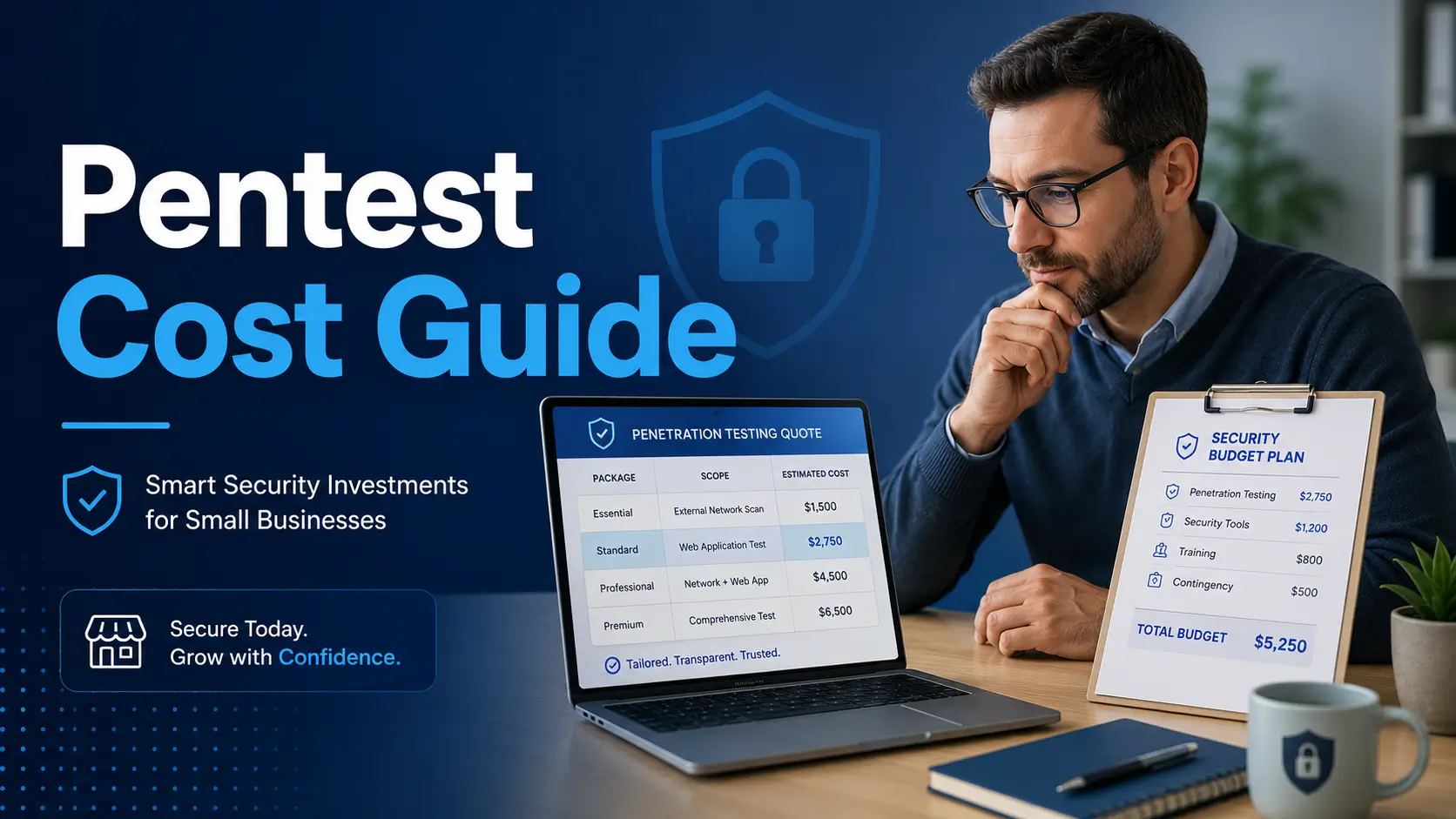
Hypothetical quote comparison: imagine one vendor pricing a web application at $4,500 and another at $14,000. These are invented inputs, not collected quotes. Compare the defined systems, identities, workflows, testing effort and exclusions before attributing a difference to value.
Build the budget from named assets, authenticated roles, testing depth, tester effort and deliverables. This guide does not establish market price bands. Add APIs, cloud paths, internal access, compliance evidence or repeat validation only when they are actually in the scope, then obtain comparable written proposals.
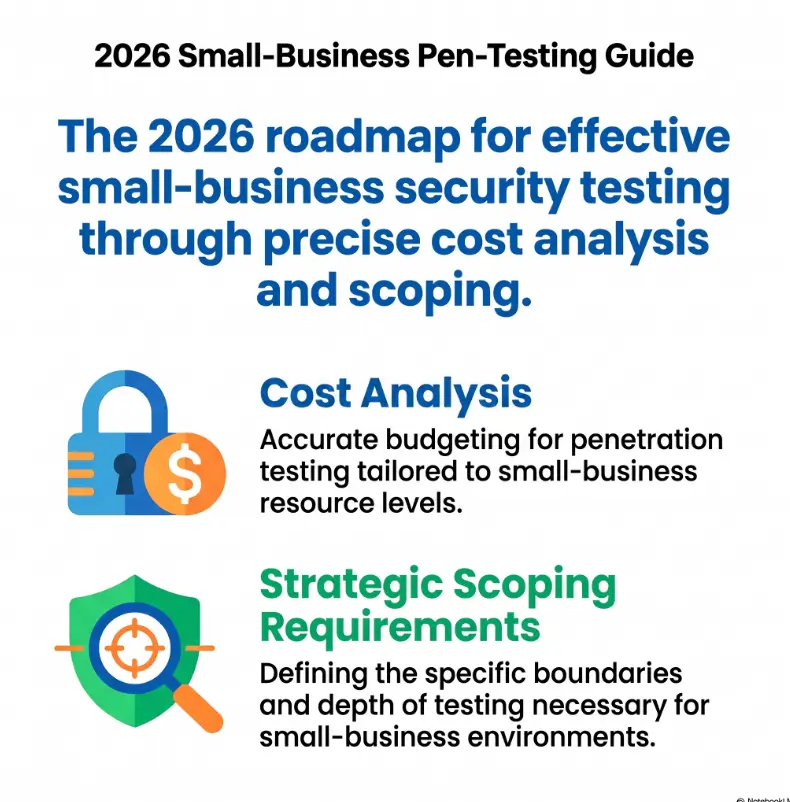
This guide turns that fog into a shopping list. You will learn which technical details move the price, what low quotes often omit, how to create a one-page scope brief, and how to compare vendors without accidentally buying three scanners in a trench coat.
Budget with context
Match quoted work and deliverables to the assets and testing depth you actually need.
Expose exclusions
Spot missing APIs, user roles, evidence, retesting, and reporting support before signing.
Compare identical scopes
Turn three incompatible proposals into one clean, decision-ready quote matrix.
The practical promise: spend fifteen minutes defining the scope now, and you may prevent weeks of change orders, retest disputes, and unusable reports later. 🔐
Snapshot
This article is for small-business owners, SaaS founders, IT managers, and compliance leads preparing to request or review penetration-testing quotes. It explains what drives cost, when scanning may be enough, what to demand in the report, and how to send vendors a scope brief that produces comparable proposals.
Table of Contents
Before You Act
This guide provides general budgeting and vendor-selection information. It cannot determine whether a particular test satisfies your contract, insurer, auditor, regulator, or customer. Confirm the required scope, testing method, evidence, tester qualifications, authorization language, data-handling terms, and delivery date with the relevant professional or requesting party before purchasing an engagement.
Who This Cost Guide Helps, and Who Can Wait
A strong fit for businesses facing real security pressure
A paid penetration test becomes easier to justify when an outside party, major release, or credible threat has turned security from a general concern into a defined business requirement.
Typical buyers include SaaS companies completing enterprise security questionnaires, online businesses storing sensitive customer data, merchants operating payment systems, and small organizations renewing cyber insurance. A test may also be appropriate before an acquisition, infrastructure migration, major application launch, or customer contract that explicitly requests independent security testing.
- A customer has requested a recent penetration-test report or attestation.
- Your application has multiple account types, integrations, or sensitive workflows.
- You recently changed authentication, cloud architecture, payment flows, or network boundaries.
- Your organization has never had human-led testing of its internet-facing systems.
- A prior incident exposed uncertainty about privilege escalation, segmentation, or data access.
- An insurer, auditor, lender, or board has supplied specific testing language.
Who may not need a full penetration test yet
A penetration test is not a substitute for basic security maintenance. Paying specialists to discover an unpatched server, an abandoned administrator account, or a public storage bucket can feel like hiring a concert pianist to test whether the piano is plugged in.
A very small business may get better immediate value from asset inventory, patching, multifactor authentication, secure backups, vulnerability scanning, configuration review, logging, and basic incident-response preparation. These controls do not replace a future pentest, but they reduce the chance that expensive testing time is consumed by obvious housekeeping failures.
Teams still building their foundation can use a broader security testing strategy to decide which questions should be answered by scanning, code review, cloud configuration checks, tabletop exercises, or human-led penetration testing.
Scan, assessment, or pentest?
| Service | What it usually does | Best use | Common limitation |
|---|---|---|---|
| Automated vulnerability scan | Checks systems against known signatures, versions, configurations, and common weaknesses | Routine hygiene, broad coverage, patch prioritization | Can produce false positives and rarely tests business logic |
| Security assessment | Reviews architecture, controls, configurations, processes, or code against a defined standard | Readiness reviews, control gaps, design decisions | May not attempt exploitation or attack chaining |
| Penetration test | Adds human validation, controlled exploitation, privilege testing, attack chaining, and impact analysis | Customer assurance, high-risk systems, realistic attack paths | Point-in-time coverage within an agreed scope |
Key takeaway
Buy a penetration test when you need human proof about realistic attack paths. Buy scanning when you need broad, repeatable detection of known issues. Many healthy security programs use both.
Build a Scope-Based Budget Before Comparing Prices
Penetration-testing cost is a proposal for work under defined assumptions. Ask what assets, roles, environments, methods, reporting and follow-up each vendor priced. Similar labels do not establish equivalent coverage.
Use the scope categories below to structure requests. They are not price tiers: the written proposal must explain effort, inclusions, exclusions and change triggers for your environment.
| Scope to price | Assumptions to resolve |
|---|---|
| Narrow external validation | Live hosts, services, manual validation and exclusions |
| One application or API | Roles, tenants, endpoints, workflows and accounts |
| Multiple attack surfaces | Separate network, cloud, application and internal work |
| Specialist or complex scope | Technology, safety, data handling, reporting and added effort |
Narrow scope produces narrow answers
A low-cost engagement can be useful when the target is genuinely small. Examples include a handful of public IP addresses, one simple brochure-style site with a login, or a limited validation exercise after internal remediation.
A narrow external test can be useful for a genuinely small target, but it may say little about authenticated workflows, internal access, cloud permissions, mobile clients or third-party integrations. Specify the question it must answer instead of inferring coverage from the fee.
A focused application needs an explicit effort estimate
For a focused application or API, define manual validation, authorization and workflow coverage, test accounts, reporting, meetings and retesting. A manageable endpoint count does not remove complex roles or tenant boundaries.
Request a written estimate of tester effort with the assumptions behind it. Ask how setup delays, missing accounts, newly discovered endpoints or expanded report requirements affect that estimate.
Price multiple attack surfaces separately
Costs rise when the test becomes a small program rather than a single target. One customer portal, one administrative console, a public API, an internal corporate network, and a cloud account may each require different credentials, tools, expertise, evidence, and safety controls.
Complex authentication, cross-tenant authorization, payment logic, mobile clients, containers, identity permissions, and Active Directory can also demand specialist testers. These engagements may include several testing phases, multiple reports, executive briefings, developer workshops, and more than one retest cycle.
Budget rule
Reserve money for remediation, not only testing. A polished report can create developer work, network changes, cloud-permission cleanup, emergency patching, and follow-up validation.
Why Two Similar Apps Receive Wildly Different Quotes
Login roles multiply the testing paths
A public website and a customer portal may look equally simple from the home page. Behind the login, however, the portal may contain administrators, employees, customers, resellers, support agents, and read-only users.
Each role creates authorization questions. Can a customer view another tenant’s records? Can a support agent become an administrator? Can an ordinary user call an administrative API directly? Does disabling a user also revoke active tokens? Testing those paths takes time because permissions must be compared horizontally and vertically across accounts.
APIs hide a second application behind the first
A polished interface may call dozens or hundreds of endpoints. Some are documented. Others were built for mobile clients, integrations, internal dashboards, legacy workflows, or features that have quietly retired without fully disappearing.
API testing may include token handling, object-level authorization, rate limits, mass assignment, data exposure, replay behavior, input validation, and workflow abuse. The number of visible screens is therefore a poor estimate of testing effort. For more context, review the practical distinctions in this guide to API authentication and authorization for SaaS.
Business logic resists automation
Scanners are good at recognizing familiar patterns. They are far less capable of understanding whether a coupon can be reused indefinitely, whether a refund can be approved by its requester, or whether a user can manipulate a multi-step process to bypass payment.
Human testers spend time learning how the business works, then asking impolite but valuable questions. Can a reseller see another reseller’s customers? Can a trial account consume paid resources? Can an invitation link be transferred? Can a deleted workspace still be accessed through an old API token?
Let us be honest: employee count is a weak pricing signal
A 15-person SaaS company can operate a complicated multi-tenant platform with several APIs and cloud accounts. A 150-person professional-services firm may expose only a small website, email, VPN, and a modest internal network.
Technical scope, attack surface, architecture, user roles, test depth, and reporting needs usually predict cost better than headcount. Employee count matters mainly when it changes the size of the internal environment, the number of offices, identity systems, endpoints, or social-engineering targets.
Illustrative example: one app, two very different prices
Imagine two project-management applications. Both have roughly 25 visible screens.
App A has one user role, no public API, no payment flow, and a separate staging environment. The vendor receives a test account, architecture notes, and a clear list of functions. A focused assessment may fit comfortably within a modest number of tester days.
App B has five roles, enterprise single sign-on, a mobile client, public and private APIs, file sharing, billing, audit logs, tenant administration, and integrations with cloud storage. Testing must compare permissions across roles and tenants, inspect token behavior, examine uploaded content, and follow data through several connected systems.
The screen count is similar. The attack-path count is not. The higher quote is buying time to investigate those branches rather than stopping at the front door.
Test Type Changes the Price Before Testing Starts
External network penetration testing
External testing focuses on systems reachable from the internet. Targets may include public IP addresses, firewalls, VPN gateways, remote-access services, mail systems, DNS, web servers, and administrative interfaces.
Pricing often depends on the number of live hosts and exposed services rather than the raw size of an IP range. A range containing four active systems is different from one containing dozens of web portals, appliances, and remote-management services.
Internal network penetration testing
Internal testing usually begins from an assumed-breach position. The tester may receive access equivalent to a compromised employee device, an office network connection, a standard user account, or a controlled foothold.
The engagement may examine Active Directory, password and credential exposure, privilege escalation, lateral movement, network segmentation, sensitive file access, administrative pathways, and detection controls. Larger identity environments and multiple sites can increase both testing time and coordination effort.
Web application and API penetration testing
Application testing is driven by functionality. Authentication, account recovery, file handling, search, administrative features, payments, integrations, data exports, and custom workflows each create test cases.
Ask vendors how they estimate application complexity. Some use endpoint counts, page counts, role counts, feature inventories, or tester-day ranges. None is perfect, but a transparent method is better than a mysterious flat fee.
Cloud configuration and cloud-native attack paths
A cloud test may include identity permissions, exposed storage, secrets, public services, serverless functions, containers, logging gaps, trust relationships, and pathways between accounts or subscriptions.
Clarify whether the vendor is testing only configuration against best practices or actively exploring attack paths with authorized credentials. Those services overlap, but they are not identical. A configuration review may identify excessive permissions, while a cloud penetration test may attempt to show how those permissions could be combined to reach sensitive resources.
| Knowledge model | Tester receives | Useful for | Pricing effect |
|---|---|---|---|
| Black box | Little information beyond public targets | Testing external discovery and unauthenticated exposure | May spend more time discovering systems and less time examining deep authenticated logic |
| Gray box | Selected credentials, documentation, or architecture context | Efficient testing of realistic authenticated attacks | Often provides a strong balance of depth, time, and cost |
| White box | Broader credentials, architecture details, configuration context, or source-assisted access | Deep coverage and efficient investigation of complex systems | Can increase preparation and specialist effort while reducing blind discovery time |
The four-step buying flow
01
Define assets
List applications, APIs, IPs, roles, environments, cloud accounts, and exclusions.
02
Choose the test
Separate network, web, API, cloud, mobile, internal, and social-engineering work.
03
Agree the evidence
Specify report format, proof, attestation, workshops, retesting, and distribution rights.
04
Compare total cost
Include optional days, remediation support, retests, rush fees, and internal labor.
What the Cheapest Quote Quietly Leaves Out
Automated scanning dressed as manual testing
Automation belongs in a penetration test. Testers use scanners, scripts, proxies, discovery tools, and custom utilities to work efficiently. The problem begins when automated output becomes nearly the whole service while the proposal suggests deep human investigation.
Ask how the vendor validates scanner findings, tests authorization, examines business logic, chains weaknesses, and documents unsuccessful attack paths. A mature answer should describe human judgment, not merely a branded tool stack.
Retesting sold as a second engagement
Retest terms are contract-specific. A 30-, 60- or 90-day window, limits on findings and hourly or fixed charges are possible comparison inputs, not surveyed typical terms. Confirm the actual fee, expiry and deliverable in writing.
Confirm whether the retest produces an updated report, a separate closure letter, or only an email stating that selected issues were reviewed. Also ask what happens when a fix changes the application and creates a new issue. Validation of the original finding may be included, while testing the redesigned workflow may require additional scope.
Compliance-ready evidence
A report intended for engineers can differ from one intended for an auditor, customer, insurer, or board. Useful deliverables may include screenshots, request and response evidence, affected assets, risk ratings, reproduction steps, remediation guidance, an executive summary, methodology, limitations, and confirmation of tester independence.
Some customers want a sanitized report. Others accept an attestation letter or executive summary. Determine what the recipient will accept before the engagement, not after the final PDF arrives wearing the wrong clothes.
Here is what no one tells you: the report is part of the product
A technically competent test can still create poor business value if the report is vague, repetitive, or difficult to act upon. Developers need enough evidence to reproduce the issue. Managers need a clear explanation of impact. Customers and auditors need an understandable statement of scope, timing, methodology, and limitations.
Before signing, request a sanitized sample report and compare it with the guidance in how to read a penetration-test report. Look for specific assets, realistic impact, practical remediation, clear severity reasoning, and a visible distinction between validated findings and automated observations.
| Quote item | Good | Better | Best for higher-assurance needs |
|---|---|---|---|
| Scope | Lists the main target | Lists assets, roles, environments, APIs, and exclusions | Adds feature inventory, endpoint assumptions, and change-control terms |
| Testing method | Mentions manual testing | Explains manual validation, authorization testing, and attack chaining | Maps methods to recognized standards and target-specific risks |
| Report | Technical findings | Technical report plus executive summary and remediation guidance | Adds compliance mapping, attestation, workshop, and distribution-ready summary |
| Retest | Available for a fee | One defined retest included | Time-limited validation, updated status, and closure documentation included |
| Communication | Email contact | Kickoff, urgent-findings process, and results call | Named tester access, daily status, developer workshop, and executive briefing |
Show me the nerdy details
Tester-day estimates are only useful when the assumptions are visible. Eight tester days could mean six days of active testing plus two days for reporting, or it could mean eight days total including kickoff, setup, scanning, meetings, and retesting.
Ask whether the estimate includes project management, quality review, report revisions, urgent-finding communication, customer questionnaires, and evidence packaging. Also confirm whether multiple testers work in parallel. A five-day calendar window may contain five tester days or ten.
For application work, request the assumed number of roles, workflows, endpoints, and environments. For network work, request the assumed number of live hosts, identity domains, offices, and network segments. Those variables are the gears behind the price tag.
Do Not Buy a Pentest Before You Define This One Page
List the exact assets in scope
Begin with concrete nouns. “Our platform” is not a scope. A useful list names the customer web application, administrative portal, public API, mobile API, production cloud account, corporate VPN, public IP addresses, and any offices or wireless networks.
Include supporting systems only when they are authorized and relevant. Third-party services, managed platforms, payment processors, content-delivery networks, and customer-owned environments may require separate permission or may be excluded entirely.
Count accounts, roles, and environments
Specify whether testing will be unauthenticated, authenticated, or both. List each meaningful role and state whether the vendor should test differences between tenants, departments, organizations, or permission levels.
State whether the target is production, staging, a dedicated test environment, or a combination. Staging can reduce operational risk but may not reproduce production permissions, integrations, data flows, protective controls, or deployment settings.
State the required deliverables
- Technical report with evidence and reproduction steps
- Executive summary written for nontechnical stakeholders
- Methodology and testing limitations
- Risk ratings and prioritization logic
- Practical remediation guidance
- Compliance or contractual mapping, when specifically required
- Customer-facing attestation or sanitized summary
- Developer review meeting or remediation workshop
- One retest and written closure status
Set safe testing boundaries and written authorization
Document permitted testing dates, time zones, emergency contacts, source IP addresses, production restrictions, blackout periods, data-handling rules, prohibited techniques, notification thresholds, and the emergency-stop process.
Written authorization protects both parties by defining what the tester may examine and under which conditions. The agreement should also address third-party systems, denial-of-service testing, social engineering, persistence, destructive techniques, sensitive-data access, evidence storage, and deletion.
One-page scope checklist
- Business reason, recipient, and required completion date
- Applications, APIs, IPs, networks, cloud accounts, and environments
- User roles, tenant models, authentication methods, and integrations
- Permitted techniques, exclusions, testing windows, and emergency contacts
- Report, evidence, attestation, workshop, and retest requirements
- Required standards, qualifications, insurance, and data-handling terms
Normalize the retest before declaring a quote cheaper
Hypothetical proposals for the same accepted scope: A charges $7,200 plus $1,200 for the required retest, totaling $8,400. B charges $7,900 with that retest included. A looks $700 cheaper initially but costs $500 more for the specified purchase.
If both require ten internal coordination hours valued at $80, their modeled economic totals become $9,200 and $8,700. Internal time is shown separately from the vendor cash expense. These invented fees are not market benchmarks.
The comparison works only if the retest covers the same findings, deadline, validation effort and written update, and the base tests have equivalent scope and quality. Keep remediation engineering, taxes, travel and extra testing separate unless a proposal includes them. Record that equality before comparing totals.
Common Pricing Mistakes That Drain the Security Budget
Mistake 1: requesting “a full pentest” without defining full
Vague language produces incomparable proposals. One vendor may interpret “full” as external network testing. Another may include a web application. A third may exclude APIs, cloud services, authenticated testing, and retesting while keeping the headline pleasantly small.
Replace broad adjectives with counts, names, roles, environments, and deliverables. Precision is not bureaucratic decoration. It is a cost-control mechanism.
Mistake 2: combining unrelated systems into one quote
A web application, internal network, cloud account, mobile application, and social-engineering exercise require different assumptions. Bundling everything into one total makes it difficult to see where money is being spent or which component can be delayed.
Request separate line items. You may discover that the customer-facing application is urgent, while the mobile app can wait until its next major release. Itemization creates room for sensible sequencing.
Mistake 3: choosing the lowest number before reading exclusions
Place exclusions beside prices in your comparison sheet. Look specifically for APIs, authenticated roles, cloud services, mobile components, source-code review, social engineering, denial-of-service techniques, report revisions, meetings, travel, expedited delivery, and retesting.
A lower quote may remain the best choice. The decision becomes safer once you know whether it is cheaper because the vendor is efficient or because half the kitchen is missing.
Mistake 4: testing before obvious vulnerabilities are fixed
Complete a basic readiness pass before the engagement. Patch known critical issues, remove abandoned assets, review privileged accounts, confirm backups, check public storage, verify multifactor authentication, and run routine scans.
This does not mean hiding weaknesses from the tester. It means preserving expensive human attention for the problems your ordinary controls did not already identify.
Mistake 5: forgetting remediation and report acceptance
The testing fee may be only the first invoice. Findings can create developer effort, architecture changes, emergency patches, access reviews, customer communication, and retesting.
There is also a second acceptance risk: the report may not satisfy the party requesting it. Before buying, send the proposed scope and deliverables to the customer, auditor, insurer, or internal owner who will review the result. A short confirmation email can prevent an expensive encore.
Costly mistake to avoid
Do not assume that “compliance-ready,” “manual,” “comprehensive,” or “unlimited” has a shared meaning. Ask the vendor to translate every important adjective into a specific deliverable, quantity, time allowance, or inclusion.
The Compliance Clause That Quietly Expands the Scope
SOC 2 customer expectations versus formal scope
SOC 2 conversations often mix three separate questions: what the auditor expects, what the company’s controls state, and what an enterprise customer demands during procurement. Those questions can produce different answers.
Do not purchase an assumed “SOC 2 pentest package” without confirming the actual need. Ask whether the recipient wants an annual test, a particular attack surface, an independent provider, specific methodology, remediation evidence, or only proof that testing occurs. Related planning resources include a SOC 2 budget calculator and practical guidance on SOC 2 policies for startups.
PCI DSS payment environments
Businesses handling payment account data should confirm the applicable PCI DSS scope before requesting quotes. Penetration-testing provisions sit within Requirement 11.4 of PCI DSS v4.x, but the precise systems, segmentation tests, frequency, and evidence depend on the organization’s environment and obligations.
Give vendors a diagram of the cardholder data environment, connected systems, segmentation controls, service providers, and data flows. A quote based only on “we accept credit cards” is likely to be either overbroad or incomplete.
HIPAA and sensitive healthcare systems
Healthcare-related testing may require stricter handling of sensitive data, tighter production controls, approved evidence storage, and careful coordination with third-party platforms. The vendor may need to avoid accessing real records or use specially prepared test data.
Confirm contractual, privacy, breach-notification, and business-associate requirements with qualified professionals. A technically useful scope can still be operationally unsuitable if evidence collection or data retention is poorly controlled.
Cyber insurance and enterprise contracts
Obtain the exact wording from the policy, application, questionnaire, or contract. “Regular testing,” “annual assessment,” “independent penetration test,” and “vulnerability management” are not interchangeable phrases.
Ask whether the test must cover all internet-facing systems, a particular application, internal networks, cloud infrastructure, or a defined environment. The broader cyber-insurance guide for small businesses can help you identify related control and evidence questions before renewal.
One-Off Pentest or Ongoing PTaaS?
Choose a one-time test for a defined milestone
A project-based penetration test works well when the target and deadline are clear. Common triggers include a major release, first enterprise contract, annual compliance checkpoint, acquisition, infrastructure migration, or first independent security assessment.
One-off testing also makes cost comparison easier because the scope can be fixed. The tradeoff is that the report begins aging as soon as the application, cloud environment, or network changes.
Choose recurring testing for fast-changing systems
Recurring testing or penetration testing as a service, often shortened to PTaaS, may suit teams releasing frequently, adding APIs, changing cloud infrastructure, or responding to repeated customer deadlines.
The value depends on access to actual testers and the ability to direct effort toward meaningful changes. A portal full of scanner alerts is not automatically continuous penetration testing.
Watch the subscription arithmetic
| Factor | One-off engagement | Recurring PTaaS |
|---|---|---|
| Best fit | Defined milestone or stable annual scope | Frequent releases and changing attack surfaces |
| Cost structure | Project fee plus options and retesting | Subscription, testing credits, hours, or annual allowance |
| Tester access | Usually concentrated during the project | May include ongoing chat, triage, or scheduled testing windows |
| Retesting | Defined round or separate fee | May be included, credit-based, or limited by plan |
| Main risk | Report ages after major changes | Paying recurring fees for mostly automated activity |
Before subscribing, compare annual fees, included testing hours, credit expiration, rollover rules, emergency testing, tester response times, supported technologies, report formats, retest limits, and cancellation terms.
Ask for a twelve-month usage example based on your release schedule. A service that looks inexpensive per month can become costly when every meaningful test consumes extra credits or requires a premium testing window.
Key takeaway
A one-time test buys a detailed snapshot. PTaaS buys access over time. Compare the amount of human testing delivered during a year, not the smoothness of the dashboard.
FAQ: Quick Answers Before Requesting Quotes
What is a typical pentest budget for a 10-person company?
Headcount alone cannot determine a typical price. Inventory assets, roles, environments, integrations, depth and required deliverables, then ask vendors to price the same scope. This guide does not assign a standard allowance to a ten-person business.
Build the estimate from assets, roles, environments, integrations, testing depth, and deliverables rather than employee count.
What is the difference between vulnerability scanning and penetration testing?
Vulnerability scanning automatically checks for known weaknesses and configuration issues across many systems. Penetration testing adds human validation, controlled exploitation, authorization testing, attack chaining, business-logic review, false-positive analysis, and an explanation of realistic impact.
How often should a small business get a penetration test?
Annual testing is a common starting point, but frequency should also respond to major application releases, significant infrastructure changes, new sensitive workflows, contractual deadlines, changes in compliance scope, acquisitions, and security incidents.
A stable professional-services firm and a SaaS company deploying several times per day may reasonably choose different schedules.
Can production systems be tested safely?
Production testing can provide realistic coverage, but it requires careful planning. Confirm backups, monitoring, emergency contacts, testing windows, blackout periods, data-handling rules, excluded techniques, rate limits, and a stop procedure.
Staging may reduce risk but can miss production-only controls, permissions, integrations, data patterns, and deployment differences. Some engagements test deeply in staging and perform a narrower validation in production.
Is retesting normally included?
Sometimes. Common models include one free retest within a stated period, a limited number of verification hours, validation of only high-severity findings, per-finding pricing, or a separate engagement.
Confirm the time limit, findings covered, evidence produced, and whether an updated report or closure letter is included.
How long does a small-business pentest take?
A narrow test may require several active testing days, while broader work may take multiple weeks. Calendar duration also includes scoping, account setup, authorization, active testing, quality review, report writing, clarification, remediation, and retesting.
Ask for both active tester days and expected calendar dates. They answer different planning questions.
Does a penetration test guarantee security?
No. A penetration test is a point-in-time assessment of defined systems under agreed conditions. It cannot prove that every vulnerability has been discovered, predict every future change, or replace secure development, monitoring, patching, access control, backups, and incident response.
What parts of a pentest can be shared with customers?
Organizations often share an executive summary, attestation letter, sanitized report, remediation status, or selected evidence under a nondisclosure agreement. Full reports may contain sensitive technical details and distribution restrictions.
Agree on customer-facing deliverables and sharing rights before the test begins. Confirm that the final documents identify the scope, testing dates, provider, status, and limitations clearly enough for the intended recipient.
Next Step: Send a Five-Line Scope Brief Today
The fastest way to improve a penetration-testing quote is not to negotiate harder. It is to remove ambiguity before the vendor estimates the work.
Open a blank document and write the five lines below. The exercise should take less than fifteen minutes, yet it will expose most of the assumptions that cause pricing gaps.
Five-line vendor brief
- Systems: Name every application, API, IP range, network, cloud account, environment, and meaningful user role.
- Reason: State the business trigger, intended recipient, and firm completion date.
- Depth: Specify unauthenticated and authenticated testing, production or staging, and any required attack scenarios.
- Deliverables: Request the technical report, executive summary, evidence, attestation, workshop, compliance mapping, and sharing rights you need.
- Follow-through: State whether remediation guidance and one documented retest must be included in the quoted price.
Request three itemized proposals
Ask each vendor to separate base testing, optional assets, additional tester days, compliance documentation, expedited delivery, remediation support, travel, and retesting. Request a sanitized sample report and the qualifications of the testers likely to perform the work.
Review contractual terms alongside technical scope, including confidentiality, data handling, evidence retention, authorization, liability, third-party systems, and cancellation. This guide to penetration-test limitation-of-liability clauses can help you prepare questions for qualified legal review.
Compare scope before price
| Comparison field | Vendor A | Vendor B | Vendor C |
|---|---|---|---|
| Assets and environments included | Record exact scope | Record exact scope | Record exact scope |
| User roles and API coverage | Record counts and exclusions | Record counts and exclusions | Record counts and exclusions |
| Estimated manual tester days | Record assumption | Record assumption | Record assumption |
| Report and customer-facing evidence | Record deliverables | Record deliverables | Record deliverables |
| Retest model | Record limit and timing | Record limit and timing | Record limit and timing |
| Optional and likely extra fees | Record total exposure | Record total exposure | Record total exposure |
| Total expected cost | Calculate | Calculate | Calculate |
The right penetration-test budget is not necessarily the lowest number or the largest package. It is the smallest well-defined engagement that answers the security question your business genuinely needs answered.
Once every vendor is pricing the same assets, roles, depth, evidence, and retest terms, the decision becomes quieter. The numbers stop shouting, the exclusions step into the light, and you can choose with something better than hope.
Last reviewed: 2026-10-13
Technical guidance updated: 2026-10-13. Clarified that dollar bands are hypothetical planning assumptions rather than established market prices, and repaired section navigation.
Editorial review: October 16, 2026. Updated the decision guidance and removed misleading illustrations where identified. Worked examples are hypothetical; they do not describe testing performed by Kioptrix, actual quotes, claim decisions or guaranteed outcomes.
Small-business pentest quote brief
Use this when: you are a buyer comparing authorized testing proposals for the same business question. Copy these fields into your notes and replace each prompt with a dated response. Keep assumptions and unresolved questions visible.
| Field | What to record | Your evidence / owner / next check |
|---|---|---|
| Testing boundary | List assets, roles, workflows, environments and excluded activities. | To complete |
| Method and effort | Ask how the provider will investigate the priority question. | To complete |
| Usable evidence | Define findings, validation, limitations and report acceptance. | To complete |
| Retest and extras | Record retest scope, scheduling, customer work and additional charges. | To complete |
Next action: Send the same testing brief to each bidder before comparing totals. Mark the relevant row confirmed, provisional or unresolved. Keep the supporting record, responsible person and next check beside it so another reader can continue the work without treating an assumption as a result.
This is an editorial working aid. Complete it with your own scope, source records and accountable reviewers. Filling the table does not by itself establish coverage, compliance or acceptance.
Worksheet change record — October 20, 2026
Added this small-business pentest quote brief with four article-specific fields and an evidence-based next action. Existing source notes retain their own review dates. This addition is not a fresh verification of every statement or a newly executed test.