
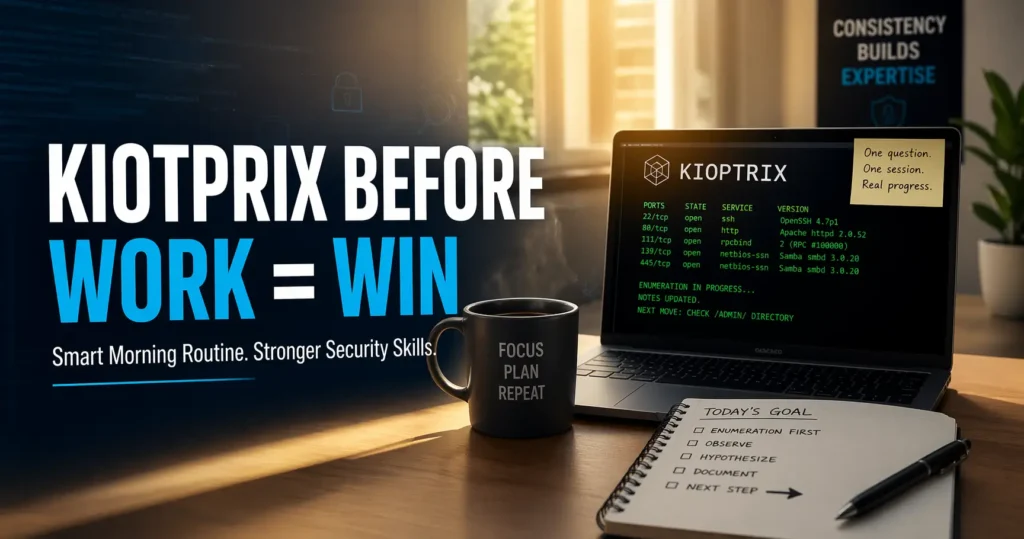
Mastering Kioptrix: Why Your Morning Routine is the Ultimate Security Skill
Late-night lab practice has a talent for looking productive while quietly wrecking retention. Kioptrix Level before work flips that script by giving your sharpest brain to the part that matters most: noticing clues, narrowing hypotheses, and leaving notes your future self can actually use.
The real frustration is rarely lack of effort. It is opening a vulnerable machine when you are already mentally cooked, then mistaking tab-count, scan noise, and half-finished ideas for progress. For busy IT, help desk, and early-career security learners, that pattern turns cybersecurity study into a fatigue ritual instead of a skill-building system.
Keep training that way, and you do not just lose time. You lose continuity.
A better morning routine makes Kioptrix practice cleaner, calmer, and more repeatable. Instead of trying to root the box before coffee gets cold, you learn how to use short sessions for enumeration, hypothesis testing, note quality, and steady technical judgment that compounds across the week.
This approach is grounded in the body of real security work: observation first, exploitation later, with structure strong enough to survive ordinary adult life.
Here is the useful part:
- ▹ What a 25-to-40-minute session should actually do.
- ▹ What to prepare the night before.
- ▹ How to measure progress before the shell ever arrives.
Table of Contents
Fast Answer: Kioptrix Level for people studying before work instead of late at night can be a smarter, cleaner way to build real security skills. Morning practice often improves focus, note quality, and decision-making because your brain is less fried and your sessions stay tighter. The goal is not to finish the box before breakfast. It is to build a repeatable lab rhythm that trains method, memory, and calm technical judgment.
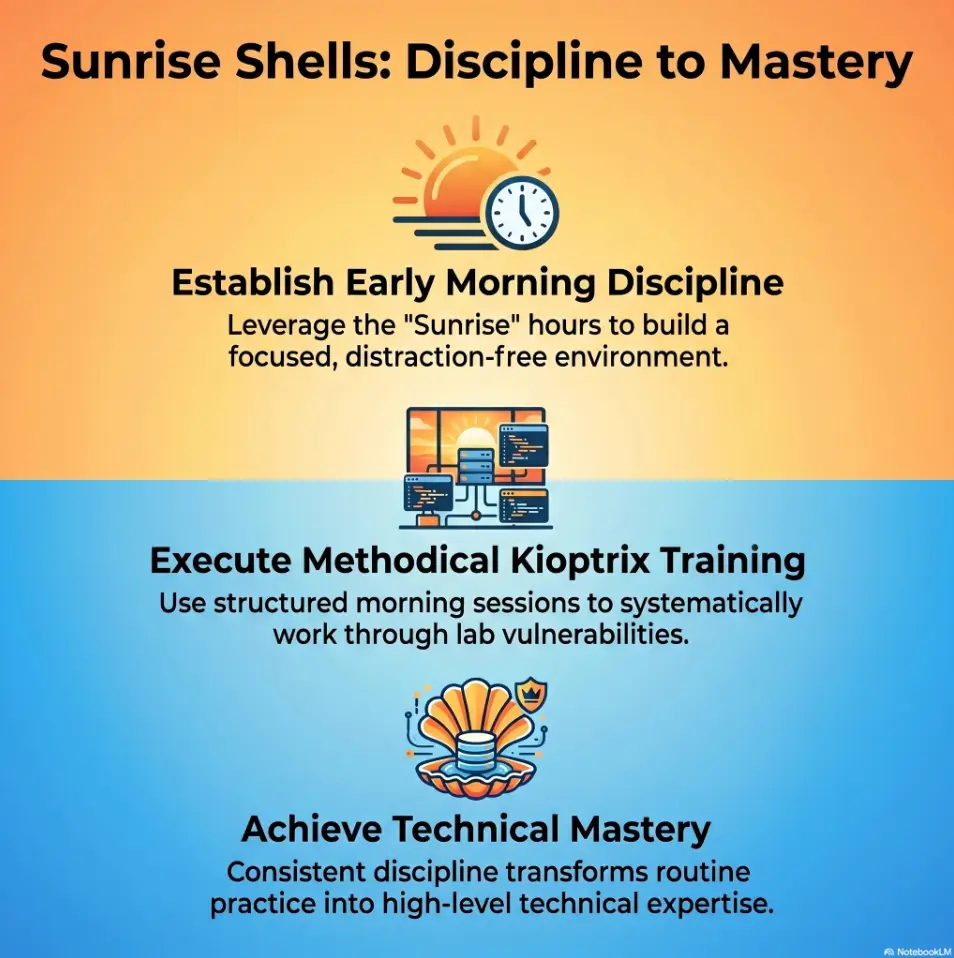
Why Morning Wins: Kioptrix Before Work Changes the Whole Training Mood
Early sessions often produce better judgment than tired late-night clicking
There is a particular kind of false confidence that appears late at night. It sounds productive. It wears the costume of effort. It opens three scans, five writeups, two exploit pages, and somehow remembers none of them by morning. Before work, the mood is different. Your brain has not yet been sandblasted by meetings, tickets, messages, errands, and that strange modern ritual known as pretending to be calm while fifty small fires burn.
With Kioptrix, that matters. This is not a lab where you win by dramatic flourish. You win by observing service behavior, noticing version clues, recognizing weak assumptions, and recording what changed after each test. Morning attention often favors these quieter skills. A fresh brain does not make you brilliant. It simply makes you less likely to confuse motion with progress.
Morning energy favors enumeration, pattern recognition, and cleaner notes
Enumeration is not glamorous, which is precisely why it benefits from daylight. It asks for patience instead of adrenaline. You are looking for the ordinary things that become extraordinary once they line up: open ports, default pages, directory hints, error messages, old software fingerprints, behavior that feels one inch off. Morning study gives these details a chance to speak before noise barges in wearing steel-toed boots.
I learned this the annoying way. For a while, I treated night practice like a moral virtue. If I stayed up long enough, surely I was serious. What I actually produced was a graveyard of half-usable notes, screenshots with no captions, and a heroic quantity of confusion. In the morning, I did less. The embarrassing part is that less worked better.
Why less time can still create better practice quality before the workday begins
A 25-minute session has edges. That is its charm. Long sessions tempt you into drift. Short sessions ask you to choose. When the clock is honest, your thinking often becomes honest too. You stop pretending you will enumerate, exploit, pivot, document, and write a crisp retrospective before your toast cools. You accept a smaller task. You finish more of it. You remember more of it later.
- Fresh attention helps you notice small clues
- Short sessions reduce random tool-hopping
- Cleaner notes make tomorrow easier
Apply in 60 seconds: Write one sentence in your notes: “Tomorrow morning, I am only trying to answer this one question.”
Start Smaller, Learn Faster: What a Before-Work Kioptrix Session Should Actually Do
A 20-to-40-minute session should solve one problem, not the whole machine
Morning practice fails when the mission statement is ridiculous. “Root the box before work” has the same energy as “rebuild my life before 8:15.” It is cinematic. It is also a bad plan. A before-work session should answer one bounded question. Which services are exposed? Is this web app leaking version clues? Does this form handle input strangely? Is that 404 page merely dull, or is it trying to tell me something?
One solved question compounds. A solved question becomes a better next step, and a better next step becomes a habit loop. Soon you are not starting from zero each morning. You are stepping onto a small stone bridge you built yesterday.
The real goal is momentum, not a dramatic breakthrough before coffee cools
In short sessions, momentum is not motivational wallpaper. It is architecture. It keeps your practice from collapsing between weekdays. If you leave each session with one confirmed fact and one deliberate next move, you are building continuity. That continuity matters more than the occasional lucky leap.
People often underrate the value of “I now know what not to try next.” In real security work, dead ends are not always failures. They are part of the map. The trick is to label them clearly so they do not keep charging you rent three mornings in a row.
Let’s be honest: most stalled learners are not under-skilled, they are over-ambitious at 6:30 a.m.
Ambition is excellent until it becomes theatrical. Many learners do not stall because they lack technical ability. They stall because the size of the morning task quietly terrifies them. A task that is too large triggers avoidance, and avoidance gets dressed up as “I’ll do a proper session tonight.” Night arrives. Life arrives harder. Practice disappears again.
So make the task smaller than your ego prefers. That is not laziness. That is design. A modest morning target is more trustworthy than a noble fantasy. If you need help sizing that target honestly, a guide on choosing the right Kioptrix session length can keep your weekday plan from turning theatrical.
Decision Card: What should a pre-work session try to do?
| If you have… | Do this | Why it works |
|---|---|---|
| 20 minutes | Run one enumeration pass and record 3 clues | High signal, low chaos |
| 30 minutes | Test one hypothesis from yesterday’s notes | Builds continuity instead of restarting |
| 40 minutes | Enumerate, test one path, write next move | Still bounded enough to survive weekdays |
Neutral next step: pick the smallest row you can repeat five days in a row.
Build the Right Morning Loop: Enumeration First, Exploitation Later
Start with service discovery, version clues, and web paths before touching exploits
When people say they want to get better at labs, they often imagine exploitation skill first. But before exploitation comes recognition. Before recognition comes observation. Morning sessions are ideal for this order because they keep you from sprinting past the obvious. Start with service discovery. Identify what is exposed. Note banners, HTTP behavior, page titles, robots paths, directory hints, login prompts, and anything suspiciously old-fashioned in the software stack.
That order does not just protect beginners. It protects intermediates too. Once you get even a little comfortable, it becomes weirdly easy to skip the plain clues because they feel too plain. Meanwhile, the box keeps whispering the answer in a small accent and you keep shouting over it with tools. This is why a repeatable Kioptrix methodology matters more than the thrill of the next exploit tab.
Use one hypothesis per session so your thinking stays sharp instead of scattered
A morning session should have a single working theory. Not ten. One. “This web app may expose an outdated component.” “This login flow may leak useful behavior with malformed input.” “This service stack suggests a path worth confirming.” One hypothesis gives your mind a rail to hold.
Without that rail, short sessions dissolve into sampling. Sampling feels active. It is the tapas menu of confusion. Delicious-looking. Nutritionally uncertain. By the end, you have touched six things and understood none of them deeply enough to continue tomorrow.
A short pre-work lab works best when each step has a clear stopping point
Stopping points matter because work is coming. You cannot let curiosity yank you into a tunnel five minutes before you need to function as a normal adult human. Define your finish line before you begin. “Stop after the scan completes and summarize the results.” “Stop after testing one path.” “Stop after updating the notes with three facts, two guesses, one next action.”
This does something subtle: it teaches your brain that the lab is safe to begin. You are no longer opening a trapdoor to an endless session. You are entering a room with a known exit.
Show me the nerdy details
For pre-work labs, a practical sequence is: snapshot ready, target confirmed, one enumeration command or one manual review pass, note what changed, capture one screenshot only if it proves something, then write the next question in plain English. That sequence reduces context-switching cost and preserves state across days better than tool-heavy improvisation.
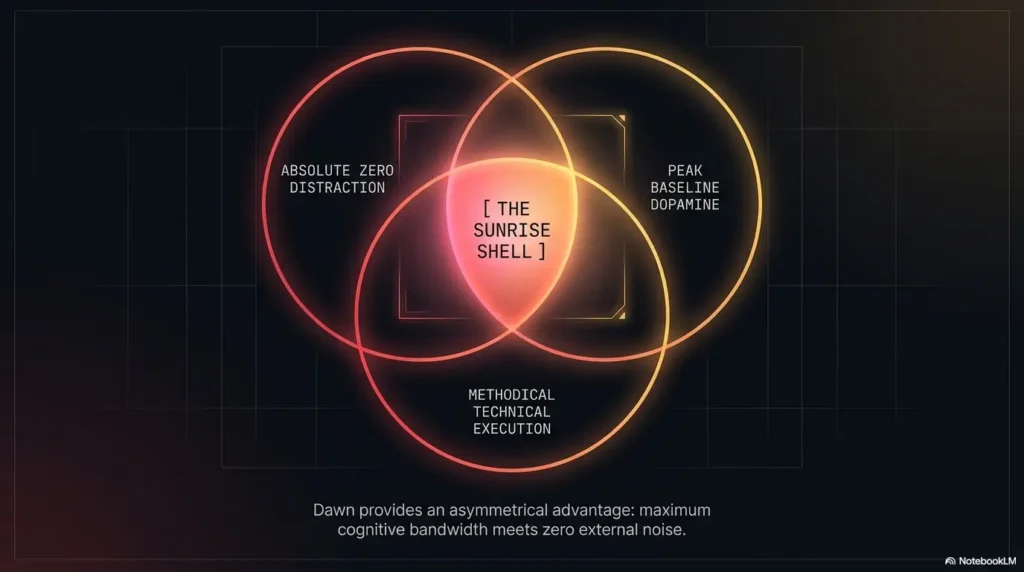
Do Not Burn Your Best Brain Too Early: The Mistake of Turning Morning Study Into Chaos
Jumping into attacks too fast can wreck the whole value of an early session
Your morning attention is expensive. Spend it badly and the cost spreads. If you launch straight into exploit attempts without context, you use your clearest minutes on guesswork. Guesswork has its place, but not at the top of the day and not as your default posture. The morning version of impatience wears nicer clothes than the late-night version. It looks disciplined. It says, “I only have 30 minutes, so I need to move fast.” What it actually means is, “I am about to skip the evidence and call it efficiency.”
Too many tabs, too many tools, too little recall: this is how morning focus gets wasted
Chaos is not only noisy. It is adhesive. It clings to the rest of your day. The learner who starts with twelve tabs often spends office hours half-haunted by unfinished possibilities. You do not want that. Before-work practice should energize you, not trail behind you like a shopping bag of unresolved guesses.
I once began a morning session by opening so many references that I looked less like a student and more like a person losing an argument with a browser. By the time I left for work, I had gathered evidence for one thing only: I was very capable of confusing myself at high speed.
Here’s what no one tells you: tired people over-click at night, but rushed people over-scan in the morning
Late-night learners often click too much because fatigue lowers resistance. Morning learners often scan too fast because urgency lowers depth. The fix is not identical. If night practice needs friction, morning practice needs pace control. Read one result twice. Confirm one clue before chasing the next. Copy exact strings into your notes. Make yourself a little slower than your anxiety wants. If that tendency sounds familiar, a piece on common Kioptrix recon mistakes pairs well with this section.
- Do not spend fresh focus on blind exploit attempts
- Limit tools before the session starts
- Use a stopping rule so urgency does not swallow judgment
Apply in 60 seconds: Before tomorrow’s session, write a “not today” list with two tools or paths you will not open unless the evidence justifies them.
Who This Is For, and Who It Is Not For
This is for learners who want steady security reps before work without killing the rest of the day
If you are time-poor, mentally busy, and trying to build a security habit that can live beside a job, this model fits beautifully. It respects limits. It assumes you have responsibilities. It refuses the fantasy that real progress only counts if it arrives drenched in six uninterrupted hours.
This is especially useful for people who like structure more than adrenaline. If you enjoy noticing patterns, keeping notes, and building method over time, pre-work Kioptrix can feel less like a dramatic performance and more like a craft bench.
This is for help desk, IT support, and early-career security learners building method, not speed
For help desk and IT support professionals, this matters even more. Much of security work overlaps with habits you already know: careful triage, documentation, signal extraction, and clear escalation logic. A morning lab turns those instincts toward security tasks. You are not pretending to be a movie hacker before sunrise. You are strengthening a workflow mind. If that transition is your lane, Kioptrix for help desk workers and Kioptrix for IT generalists both extend this idea well.
The NICE Framework from NIST is useful here because it treats cybersecurity as a family of roles built from knowledge, skills, and tasks, not just flashy exploits. That is good news for the person who is trying to grow through disciplined repetitions rather than theatrical intensity.
This is not for people expecting full-box completion every morning before their commute
If your idea of success requires daily dramatic breakthroughs, morning practice may feel too modest. That is not a flaw in the method. It is a mismatch of expectations. A pre-work session is more garden than fireworks. It rewards regular tending. It rarely bursts into applause.
This is not for learners who still need a full beginner setup before touching a practice box
If you do not yet have a working lab environment, a notes system, or basic command familiarity, your first step is not the box. It is setup. Trying to begin Kioptrix while also learning virtualization, networking, note structure, and tooling all at once before 8 a.m. is a charming recipe for resentment. In that case, start with a beginner-friendly Kioptrix foundation or even your first Kioptrix lab before demanding weekday dawn heroics.
Eligibility checklist: Is before-work Kioptrix a good fit right now?
- Yes/No: I can protect 20 to 40 minutes at least 3 mornings a week
- Yes/No: My VM and notes setup already work
- Yes/No: I am willing to measure progress by clarity, not just shells
- Yes/No: I can stop on time without resentment
Neutral next step: if you answered “no” to two or more items, fix setup before increasing ambition.
Your Pre-Work Setup Matters More Than Motivation
Save your VM state, notes template, and tool shortlist the night before
Morning discipline is often just evening kindness in disguise. The best pre-work session begins the night before with very small mercies: save the VM state, open the notes file, list the one or two tools you expect to use, and write the exact question you want to answer. That work takes maybe 5 minutes. It can save 15 minutes of friction, which in a short session is nearly the entire kingdom.
Motivation is unreliable at 6:40 a.m. Setup is dependable. Setup asks for no mood. It simply waits for you.
Remove friction so your brain starts learning before your excuses wake up
Friction is sneaky. It hides in missing snapshots, confusing folder names, cluttered desktops, expired terminals, and that one note file you swear exists somewhere. Each tiny obstacle looks harmless. Together they become a moat. Morning practice succeeds when the drawbridge is already down.
I like a near-ridiculous degree of readiness here. VM named clearly. Target noted. Timer visible. Notes template waiting. Water nearby. One browser window, not a digital flea market. It is not glamorous, but neither is spending 12 minutes remembering where you saved yesterday’s screenshot. A smart snapshot strategy and a clean Kioptrix note-taking setup do more work here than raw motivation ever will.
The best morning session often begins the previous evening with a five-minute reset
A reset can be simple:
- Close old tabs
- Save your current state
- Write one sentence about tomorrow’s goal
- Leave one clear first action
That final action matters. “Open the target page and inspect the response behavior” is much better than “work on Kioptrix.” One is a starting point. The other is a vibe.
Security training is full of people trying to outmotivate systems problems. Usually the system wins. Fix the system first.
Pre-session prep list: what to gather before comparing good and bad mornings
- Working VM snapshot
- One notes template with headings already made
- One primary objective in plain English
- One fallback task if the main path stalls
Neutral next step: gather these tonight and compare tomorrow’s session quality against your usual routine.
Common Mistakes That Make Before-Work Kioptrix Practice Fail
Mistake one: choosing a session goal that is too large for the clock
The clock is not your enemy, but it will not negotiate. If the task requires open-ended exploration, it may belong to a weekend block, not a weekday morning. A good morning goal fits inside the actual time, not the time you wish adulthood would grant you.
Mistake two: treating enumeration notes like disposable scratch work
Disposable notes create expensive mornings. If your notes are vague, tomorrow’s first ten minutes become archaeology. Good notes do not need to be pretty. They need to be legible, specific, and structured enough that tired future-you can re-enter the problem without performing a séance. A recon log template or even a fuller technical journal approach can rescue a lot of wasted restarts.
Mistake three: switching techniques too quickly because progress feels slow
Slow does not always mean wrong. Sometimes it means you are finally looking. New learners often abandon a promising path because it fails to produce immediate drama. They start another technique, then another, then another. By the end, the session contains plenty of variety and almost no continuity.
Mistake four: ending the session without writing the next logical move
This is the quiet killer. You stop because you must go to work, but you leave no breadcrumb. Tomorrow arrives and the path is gone. Momentum leaks out through the tiny hole you forgot to seal.
One of my own ugliest habits used to be ending sessions with the noble thought, “I’ll remember this.” Reader, no. I did not remember this. I remembered the mood of this, which is not the same thing and rarely useful.
Common failure pattern: vague goal, messy notes, too many pivots, no next step. Fix those four and morning study becomes dramatically more stable. If you want a companion piece for this section, practice sessions without burnout gets at the same problem from a stamina angle.
Show me the nerdy details
A strong session-ending note includes four fields: confirmed fact, discarded path, current hypothesis, and exact next action. That structure shrinks restart time and prevents duplicate work. In practical terms, it also makes weekend deep dives far more productive because the weekday breadcrumbs are clean.
Not Every Win Looks Exciting: How to Measure Progress in Morning Sessions
Good progress can mean cleaner notes, narrower hypotheses, and fewer repeated mistakes
There is a seductive scoreboard in labs: shell, no shell. Root, no root. Flag, no flag. That scoreboard is not useless, but it is crude. It misses the growth that actually predicts later competence. Morning practice becomes sustainable when you notice quieter wins: fewer duplicated tests, faster re-entry into the problem, better recognition of dead ends, and sharper distinction between facts and guesses.
A narrow hypothesis is progress. A better-labeled mistake is progress. A more precise question is progress. None of these will make your heart sing in the shower. All of them make you more dangerous in the gentle, professional sense of the word.
A single confirmed clue can be more valuable than an hour of random exploit attempts
One clue that meaningfully changes your model of the target often outweighs a string of blind attempts. Morning sessions are built for this kind of value. They are not built for spectacle. This is a difficult truth if you have absorbed the internet’s preference for flashy outcomes. The internet likes screenshots of shells. It is less emotionally available for the sentence “I confirmed the app behavior and ruled out two bad paths.” Yet that sentence may be the better investment.
Do not judge a morning session only by shells gained or flags captured
Judge it by what tomorrow inherits. Does tomorrow start with clarity? Does the next session know where to begin? Does your note history show a mind becoming more organized? If yes, the session worked. That same logic sits underneath a good Kioptrix self-assessment routine: not just what you got, but how well you can explain what changed.
Infographic: What counts as progress in a before-work Kioptrix routine?
I touched the lab.
I captured 3 usable facts.
I ruled out 1 bad path.
I left 1 precise next move.
I can restart tomorrow in under 2 minutes.
- Clearer notes count
- Narrower hypotheses count
- Ruled-out paths count
Apply in 60 seconds: Add one line to your template: “What will tomorrow inherit from this session?”
Make the Notes Do the Heavy Lifting: Memory Support for Sleepy Brains and Busy Schedules
Use a fixed note structure so tomorrow-you can restart without friction
The best notes are not beautiful. They are generous. They spare your future self the pain of reconstructing context from scraps. A fixed structure helps because it turns recall into pattern instead of effort. You do not need to invent a new system each time. You need a sturdy little tray with the same compartments every day.
A simple structure works well:
- Facts: what you observed directly
- Guesses: what you suspect but have not confirmed
- Dead ends: what you tried that did not help
- Next move: the first action for tomorrow
Separate facts, guesses, dead ends, and next moves so sessions reconnect cleanly
This separation matters more than people think. When facts and guesses mingle, your notes become gossip. When dead ends are not labeled, you repeat yourself with tragic sincerity. When the next move is missing, the morning begins in fog. Structure sounds dry until you remember how much energy fog steals.
I once found an old note that said only, “Check login weirdness maybe???” That is not a note. That is a cry from a swamp.
Morning practice becomes sustainable when your notes carry context across days
Context transfer is the secret engine. It keeps the practice alive across workdays, interruptions, and ordinary human forgetfulness. Notes are not a school chore here. They are part of the learning machinery itself. If your notes are good, a missed day does not become a ruined week. If you want examples of how documentation sharpens learning, this is where a technical write-up mindset quietly begins.
Short Story: A friend once told me that his best study routine was not the one with the longest sessions. It was the one that could survive a terrible Tuesday. He kept a plain text file with four headings and wrote in it before dawn while the house was still gray and half-silent. Some mornings he found a clue. Some mornings he mostly found better questions.
Then his child got sick, work exploded, and three days vanished. Old him would have lost the thread entirely. This time he opened the file, read four short entries, and was back in the lab in under two minutes. No heroic mood. No guilt opera. Just continuity. That small return changed the whole story. The breakthrough came later, but the real win was earlier: he built a routine that survived real life.
Mini calculator: how much lab time do short mornings actually create?
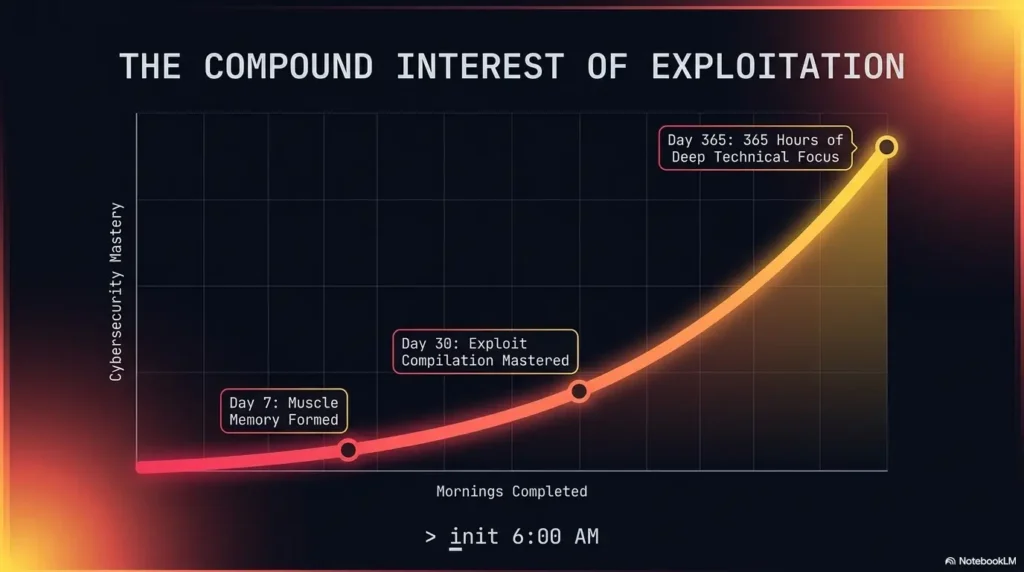
If you study 25 minutes per morning for 4 days, that is 100 minutes a week. Over 4 weeks, that becomes 400 minutes, or about 6 hours 40 minutes.
Neutral next step: calculate your monthly total before dismissing short sessions as “too small.”
Night Owl Advice Does Not Always Apply: Why Late-Night Study Logic Can Mislead You
Late-night learners often optimize for long immersion, but morning learners need tight precision
Much productivity advice around labs assumes long immersion blocks. That advice is not wrong. It is just clock-specific. At night, you might allow exploration to sprawl a bit because the next hard stop is sleep. In the morning, the hard stop is not sleep. It is the rest of your life, already wearing shoes.
That means your strategy must change. Morning learners benefit from precision, pre-selection, bounded scope, and strong note discipline. What works at 11:40 p.m. may be clumsy at 7:00 a.m. Same target, different cognitive weather.
What feels productive at 11:40 p.m. may feel sloppy and expensive at 7:00 a.m.
Late-night momentum can create a feeling of depth. Sometimes it is real. Sometimes it is just duration wearing a nice hat. Morning sessions expose that illusion because they force a sharper question: what exactly am I trying to learn right now? If you cannot answer that quickly, the session starts to bleed.
Different clock, different strategy: same lab, different cognitive weather
The useful shift is psychological as much as technical. Stop borrowing expectations from learners with different lives, different energy patterns, and different schedules. Build the lab around the clock you actually inhabit. There is no medal for copying someone else’s optimal conditions. There is only whether your own system works next Tuesday when you are busy and somewhat grumpy. In practice, that usually means building a Kioptrix practice routine and then turning it into a weekly habit rather than waiting for the perfect mood.
CISA’s general cyber guidance often emphasizes repeatable fundamentals over flashy complexity, and that spirit fits here. Security maturity grows through dependable habits. Before-work Kioptrix is one way to make that principle concrete on an ordinary weekday.
FAQ
Is Kioptrix Level good for studying before work if I only have 30 minutes?
Yes, if you define success correctly. A 30-minute session is enough for focused enumeration, one hypothesis test, and a clean note update. It is usually not enough for full-box completion, and expecting that will make the routine feel broken when it is actually working.
Should I do enumeration every morning or pick up where I left off?
Do both, but in proportion. Start by briefly re-grounding yourself in yesterday’s evidence, then continue with the next logical step. Re-running small confirmation checks is fine. Restarting the entire lab from scratch every day is rarely efficient unless your notes are unusable or your previous path was poorly supported.
Is morning cybersecurity study better than late-night practice for retention?
For many people, morning study improves retention because note quality and decision quality improve when fatigue is lower. But there is no universal winner. The better option is the one you can repeat consistently while staying mentally usable for the rest of your day.
How much progress should I expect from Kioptrix before work each day?
Expect small, meaningful gains. Think in terms of clues gathered, bad paths ruled out, hypotheses refined, and restart friction reduced. Some mornings will feel modest. Over a month, modest often becomes substantial.
What should I prepare the night before a morning lab session?
Save your VM state, open your notes template, decide your first action, and define one session question. If possible, leave a visible breadcrumb such as a command, URL, or screenshot label so your morning self does not waste precious attention reassembling context.
Can beginners use Kioptrix in short morning sessions without feeling lost?
Yes, but only if their environment already works and their scope stays small. If a beginner still needs to set up virtualization, networking, note structure, and tool basics, morning Kioptrix may feel frustrating. In that case, spend a few sessions stabilizing the setup first.
What is the best note-taking method for pre-work hacking practice?
A fixed template with four parts works extremely well: facts, guesses, dead ends, and next move. The point is not aesthetic perfection. The point is fast re-entry and low confusion.
Should I exploit during morning sessions or save that for weekends?
Use the evidence to decide. If the path is already well-supported, a morning exploitation step can be fine. If the path is still murky, morning time is usually better spent on enumeration and clarification. Many learners use weekdays for high-signal groundwork and weekends for longer execution windows.
Next Step: Set Up Tomorrow’s First 25-Minute Session Tonight
Save your VM snapshot, open your notes file, choose one enumeration target, and define one question to answer in the morning
The hook at the beginning of this article was simple: maybe your best intentions keep arriving too late and too tired. The answer is not to become a different person by force. The answer is to give your clearest minutes a smaller, better job. Before-work Kioptrix works when the session is bounded, the setup is ready, and the notes are strong enough to carry the story forward.
Tonight, set up one 25-minute session. Not a lifestyle overhaul. Not a cinematic rebirth. Just one session. Save the VM snapshot. Open the note file. Pick one enumeration target. Write one question. If you do that, tomorrow morning will not begin as a negotiation. It will begin as a continuation.
Make the first session embarrassingly small so you can repeat it again the next day
That is the real trick. Small enough to start. Clear enough to finish. Useful enough to want again. The first session should almost feel too easy. Good. Easy repeats. Repeats accumulate. Accumulation becomes evidence that you are not drifting anymore. You are building something. For readers mapping this into a broader arc, a simple Kioptrix learning path can help your tiny mornings point somewhere larger without bloating them.
- Protect your freshest attention
- Choose one bounded question
- Leave tomorrow a clean runway
Apply in 60 seconds: Create a note titled “Tomorrow 25-Minute Kioptrix Session” and write the first command or first page to inspect.
Last reviewed: 2026-04.