Open the practical working record to connect this guide to your scope, evidence and next decision.
Make each answer reviewable
For every claim, identify the responsible owner, applicable product or environment, supporting artifact and review date. Distinguish implemented controls from plans and partial coverage. A template maps questions to evidence; it does not certify the organization or make unsupported yes answers acceptable. Reference and scope.
Practical SaaS Vendor Risk Assessment
Vendor Security Questionnaire Template for SaaS Decisions You Can Defend
Evaluate the actual vendor service and scope, using dated evidence, review owners and explicit exceptions.
The useful questions begin with context: what data the service receives, which systems it can reach, how difficult it would be to replace, and what happens if the vendor is compromised or unavailable. Only then should the review expand into identity, encryption, development practices, incident response, recovery, privacy, and subprocessors.
This guide gives buyers a risk-based structure, evidence fields, scoring logic, escalation rules, and a five-tab workbook design. It also helps SaaS vendors prepare cleaner responses without making claims that outrun the product actually being sold.
Tier the review
Match questionnaire depth to data, access, integrations, criticality, and failure impact.
Request useful proof
Capture evidence, product scope, control ownership, exceptions, and review dates.
Make a decision
Separate manageable findings from issues that require remediation, contract terms, or rejection.
The goal is not a perfect vendor. It is a visible risk, a supported decision, and no nasty surprises hiding after signature. 🔍
Snapshot
This article is for SaaS buyers, founders, procurement teams, security reviewers, and vendors preparing enterprise responses. It solves the twin problems of oversized questionnaires and shallow yes-or-no answers. By the end, you can scope a review, organize evidence, score material gaps, and build a usable first version without purchasing a large third-party risk platform.
Table of Contents
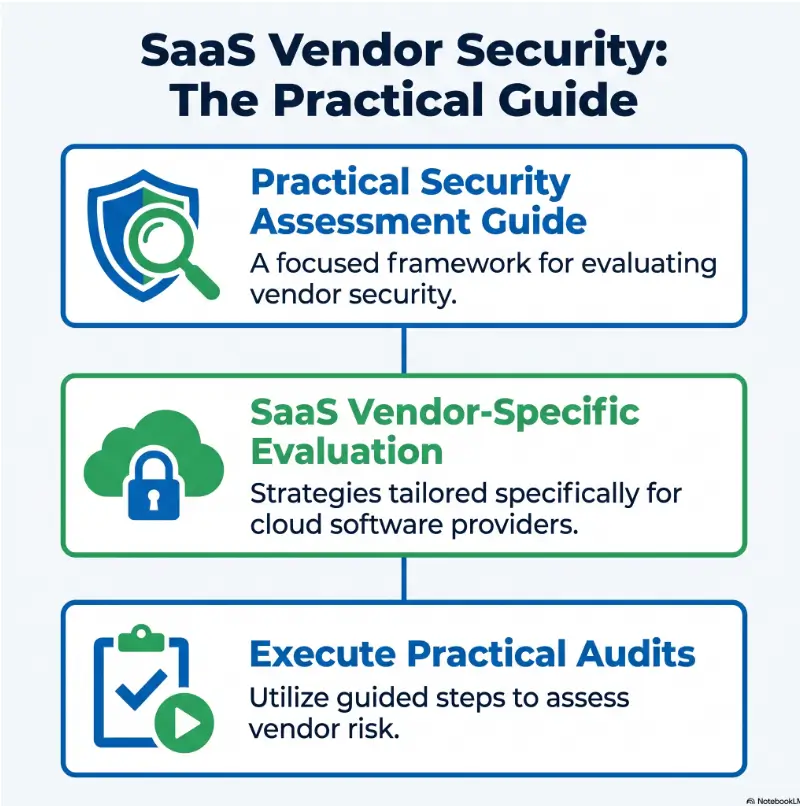
Before You Send It: Set the Boundary of the Review
A SaaS vendor security questionnaire records what a vendor says about its controls. It can expose gaps, contradictions, and areas that need evidence, but it does not independently prove that every control exists or operates effectively.
That distinction matters. A beautifully completed questionnaire may still describe a corporate policy that does not cover the product you are buying, a control that is optional, or an assurance report with an old review period.
Before You Act
This template supports general security and procurement due diligence. It is not legal advice, a regulatory audit, a penetration test, or a guarantee that a vendor will prevent every incident. Confirm material privacy, contractual, regulatory, insurance, and technical decisions with the appropriate qualified reviewers. Active incidents and suspected compromises require a separate response process.
Who this template fits
- Companies evaluating software that stores, processes, transmits, or accesses business information
- Procurement teams that need a repeatable vendor-review workflow
- Security teams replacing improvised spreadsheets with structured questions
- Startups creating a first third-party risk management process
- SaaS vendors preparing a reusable customer evidence packet
When the template is not enough
A questionnaire alone is rarely sufficient for a highly specialized medical platform, payment processor, banking system, defense supplier, critical infrastructure service, or deeply privileged network integration. Those reviews may require legal counsel, a privacy impact assessment, architecture review, independent testing, on-site assessment, or regulatory expertise.
It is also the wrong tool for investigating a known breach. During an active incident, use your incident-response procedures, preserve evidence, involve appropriate specialists, and follow notification obligations rather than trying to turn a procurement form into a forensic instrument.
Key takeaway
A questionnaire is a decision aid, not a security certificate. Its value comes from the scope, evidence, follow-up, and actions attached to each answer.
Risk Tier First: Decide How Deep the Review Should Go
Sending every vendor the same 300-question workbook feels consistent, but it usually creates expensive noise. A public-content scheduling tool and a production database platform should not consume the same review effort.
Begin with inherent risk, meaning the exposure created by the planned use before you credit the vendor for its controls. Five inputs usually reveal how deep the review needs to go.
The five inputs that set questionnaire depth
- Data sensitivity: Will the service receive public, internal, confidential, personal, financial, health, authentication, or regulated information?
- Access level: Does it have ordinary user access, administrative permissions, production access, mailbox access, source-code access, or privileged tokens?
- Operational importance: Can the business continue if the service is unavailable for an hour, a day, or a week?
- Integration breadth: How many systems, APIs, identity providers, agents, extensions, and data feeds connect to it?
- Failure impact: Could compromise or failure cause fraud, customer harm, regulatory exposure, business interruption, or difficult data recovery?
A simple three-tier SaaS review model
| Tier | Typical use | Recommended review | Typical approval path |
|---|---|---|---|
| Low | Public-content or basic productivity tool with no sensitive data or privileged access | Short intake, core questions, terms review | Business owner plus procurement |
| Medium | Business application processing internal, employee, or customer information | Core questionnaire, relevant evidence, privacy and security review | Business owner, security, privacy, procurement |
| High | Critical platform, privileged integration, regulated-data processor, or major operational dependency | Expanded modules, evidence examination, contract controls, specialist approval | Security, privacy, legal, resilience, executive risk owner |
The small app that may not be low risk
A browser extension may cost little and have only a handful of users, yet still request permission to read web pages, modify content, access downloads, or observe authentication sessions. A support tool may appear ordinary until it receives administrative access to customer accounts.
Price, company size, and user count are poor substitutes for access analysis. Tiny software can hold very large keys.
Free checklist, structured workflow, or paid platform?
| Approach | Best fit | Advantages | Trade-offs |
|---|---|---|---|
| Good: Spreadsheet template | Small teams with a modest vendor count | Low cost, easy to customize, quick to launch | Manual reminders, version control, evidence tracking, and reporting |
| Better: Forms plus workflow tools | Growing programs with repeatable approvals | Conditional questions, notifications, cleaner ownership | Requires design work and careful permissions |
| Best: Dedicated TPRM platform | Large vendor portfolios or regulated environments | Central evidence, reassessment schedules, dashboards, integrations | Licensing cost, implementation effort, and process complexity |
| Specialist support | High-risk systems or limited internal expertise | Deeper review and independent judgment | Professional fees and the need for precise scope |
Before purchasing software, estimate the full cost of licenses, implementation, evidence storage, analyst time, and renewals. A broader security tool stack cost calculator can help expose expenses that are easy to miss when each tool is considered separately.
1. Scope
Identify data, access, integrations, users, and business purpose.
2. Tier
Set review depth from inherent risk rather than vendor size.
3. Question
Send only core and conditional modules that can affect a decision.
4. Verify
Check product scope, evidence dates, exceptions, and owners.
5. Decide
Approve, remediate, contract around, accept, or reject the risk.
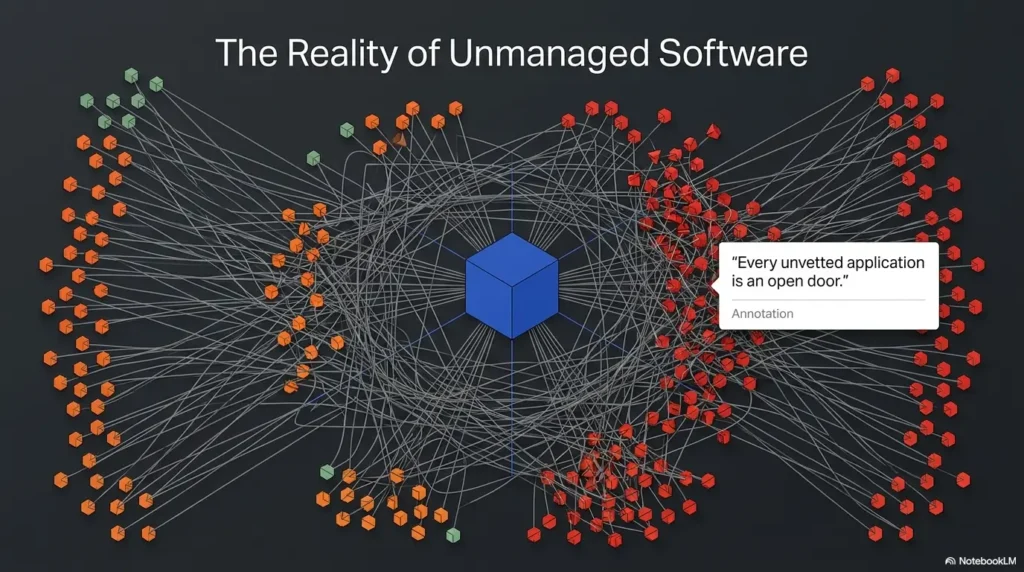
One-Page Intake: Understand the Service Before Scoring It
The intake page is the map legend. Without it, reviewers may spend hours examining controls that do not apply while missing the one integration that changes the entire risk tier.
Ask the business sponsor to complete the internal portion before the questionnaire goes to the vendor. The sponsor often knows why the product is needed, while the vendor knows how the service operates. You need both views.
Vendor and product identity
- Contracting legal entity and exact product name
- Service description and planned business use
- Primary security, privacy, and operational contacts
- Hosting providers, deployment model, and available regions
- Public status page and customer trust-center location
- Relevant certifications, assurance reports, and review periods
- Customer support channels and escalation path
Customer-data scope
Do not settle for “customer data.” Ask what categories are collected, created, inferred, copied into logs, included in support tickets, or retained in backups. A file-sharing platform, for example, may process uploaded content, user identities, activity records, device information, search indexes, and diagnostic logs.
| Intake field | Question to answer |
|---|---|
| Data received | What information enters the service from users, systems, imports, or integrations? |
| Data created | What metadata, analytics, transcripts, summaries, or derived records are produced? |
| Sensitive categories | Does the service handle credentials, financial information, health information, personal data, source code, or confidential business records? |
| Locations | Where is information stored, processed, backed up, and accessed for support? |
| Retention | How long is information kept during use and after account termination? |
| Deletion | What is removed immediately, queued for deletion, or retained until backup expiration? |
Access and integration map
- Authentication method and single sign-on support
- OAuth permissions and token scopes
- Administrative integrations
- APIs, webhooks, service accounts, and secret storage
- Installed agents, browser extensions, desktop clients, or mobile apps
- Inbound and outbound network connectivity
- Data export routes and bulk-download permissions
API access deserves particular attention because an apparently narrow product can become a bridge into several systems. Use an API authentication and authorization review to separate secure login from the equally important question of what each identity is allowed to do.
Subprocessors and fourth-party dependencies
Request the name, purpose, processing location, data access, and change-notification process for material subprocessors. Ask which providers are essential to service delivery and which are optional features.
A long list is not automatically bad. An undisclosed dependency with broad access is more concerning than several well-governed providers with narrow roles.
Key takeaway
The first page should reveal enough context to decide which questions come next. If it cannot change the review path, the intake is collecting trivia.
Identity Is the Hinge: Find Out Who Can Reach What
Identity controls sit between ordinary product use and some of the most damaging failure scenarios. The assessment should cover customer login, vendor workforce access, privileged administration, service accounts, secrets, and emergency access.
Workforce access to production systems
Ask whether production access is role-based, approved, logged, periodically reviewed, and removed promptly when responsibilities change. Determine whether contractors and support personnel follow the same process as employees.
- Is strong multi-factor authentication required for production access?
- Are permissions based on job responsibilities?
- Is access time-limited where practical?
- Can support staff view customer content, or only metadata?
- Are access logs monitored and reviewed?
- How quickly is access removed after termination?
- Who approves emergency access?
Privileged-access controls
Privileged users can change configurations, access sensitive records, create accounts, export data, or bypass ordinary restrictions. Their access should receive deeper scrutiny than a standard user account.
- Separate administrative and ordinary user accounts
- Just-in-time or time-bound privilege elevation
- Privileged access management controls
- Protected break-glass accounts
- Session recording for sensitive administrative work
- Periodic access certification
- Alerts for unusual administrative activity
Customer identity controls
Customer-facing controls should include SAML or OIDC single sign-on where appropriate, configurable multi-factor authentication, role-based permissions, session settings, account recovery controls, and usable administrative logs.
Do not mark “SSO supported” and move on. Confirm whether it is included in the proposed plan, whether local accounts can be disabled, how emergency access works, and whether deprovisioning can be automated. A focused guide to SAML SSO for SaaS can help buyers examine the implementation rather than the brochure checkbox.
Service accounts, secrets, and API keys
Ask how non-human credentials are created, stored, restricted, rotated, monitored, and revoked. Long-lived secrets with broad permissions are quiet risks because they can remain useful to an attacker without attracting the attention that a suspicious user login might receive.
Relevant follow-ups include whether secrets are kept outside source code, whether token scopes are minimized, whether credentials expire, and whether unused credentials are detected. Teams building their own controls can compare these answers with a practical startup secrets management approach.
Key takeaway
Strong customer SSO does not prove strong internal access control. Ask separately about employees, contractors, support staff, production administrators, and machine identities.
Data Lifecycle Map: Follow Information Until It Disappears
“Encrypted and deleted” sounds reassuring, but each word hides several design decisions. Useful reviews trace information from collection through storage, use, sharing, logging, backup, export, termination, and final expiration.
Collection and minimization
Ask which data is required for the service and which data is optional. Determine whether telemetry, diagnostic content, session replay, support access, or product analytics can be limited.
Minimization is not merely a privacy phrase. Data that was never collected cannot be leaked from a forgotten log bucket three years later.
Encryption and key management
- Encryption for data in transit
- Encryption for active storage and backups
- Key creation, storage, access, and rotation
- Separation of keys from encrypted information
- Customer-managed or customer-held key options
- Processes for compromised or retired keys
- Coverage of exports, replicas, indexes, and temporary files
“Industry-standard encryption” is an opening statement, not a complete answer. Ask what is covered, what is excluded, and who can cause decryption.
Retention is not deletion
One delete command rarely reaches every copy at once. Distinguish active database removal from log expiration, cache removal, search-index deletion, backup expiration, analytics retention, and subprocessor deletion.
| Data location | Question to ask | Evidence or explanation |
|---|---|---|
| Primary application | How soon is customer content removed after deletion? | Product documentation or deletion workflow |
| Logs | Can logs contain identifiers, message content, tokens, or file names? | Logging standard and retention settings |
| Caches and indexes | How are derived copies expired or rebuilt? | Architecture explanation |
| Backups | When do deleted records age out of protected backups? | Backup schedule and retention policy |
| Subprocessors | How is deletion communicated and confirmed? | Contractual or procedural description |
| Account termination | Is there an export window before deletion begins? | Termination procedure and customer guidance |
AI, analytics, and secondary data use
Ask whether customer content, prompts, attachments, metadata, support tickets, and usage records may be used to train models, improve shared systems, create benchmarks, develop new features, generate aggregated analytics, or support profiling.
“We do not sell personal data” does not answer whether information is shared with service providers, used to improve a common model, reviewed by support staff, incorporated into analytics, or retained after an account closes.
Fast data-use follow-up
Ask the vendor to complete this sentence: “Customer information may be accessed or reused for the following purposes, by the following parties, in the following locations, for the following retention periods.” Fog tends to retreat when a sentence has to end.
Build and Defend: Test the SaaS Security Engineering Story
A vendor does not need to expose proprietary code or hand over every internal document. It should, however, be able to explain how security requirements enter development, how weaknesses are discovered, and how urgent findings are handled.
Secure development lifecycle
- Security requirements for new features and material changes
- Threat modeling for sensitive systems and workflows
- Peer review and protected source-code repositories
- Testing before release
- Dependency, container, and infrastructure scanning
- Separation of development, test, and production
- Change approval and emergency-change procedures
- Security training relevant to developer responsibilities
For smaller vendors, maturity may be uneven. A lightweight but consistently followed process can be more informative than a polished policy nobody uses. Buyers can compare early-stage practices with an MVP threat-modeling process for startups.
Vulnerability discovery and remediation
Ask how vulnerabilities are found, classified, assigned, fixed, retested, and tracked to closure. Include application testing, dependency scanning, cloud configuration review, external reports, and customer disclosures.
- Does the vendor maintain severity definitions?
- Are remediation targets defined by severity?
- Who approves extensions and risk exceptions?
- Are severe findings retested after correction?
- Does the process cover infrastructure and dependencies?
- Can customers report security concerns through a defined channel?
- Are overdue findings visible to management?
A written deadline is useful only when teams monitor missed deadlines and control exceptions. A separate vulnerability remediation SLA guide can help buyers distinguish an operational target from an unsupported promise.
Cloud configuration and tenant isolation
Explore infrastructure-as-code review, configuration monitoring, public-resource detection, network segmentation, storage permissions, workload isolation, and tenant separation. Multi-tenant does not automatically mean unsafe, but the separation method should be understood and tested.
Common errors often come from configuration rather than novel attack techniques. Review the vendor’s answers against known categories of cloud misconfiguration risk, especially public storage, excessive permissions, exposed administrative interfaces, and weak secret handling.
Logging without creating another data leak
Logs should help detect incidents and explain important actions without becoming a second warehouse of credentials and customer content. Ask what is recorded, who can search it, how long it is retained, and how sensitive fields are filtered.
Show me the nerdy details
A good material question can be tested through five dimensions: design, scope, implementation, operation, and evidence. “We scan dependencies” describes a control design. It does not reveal whether all repositories are included, whether scans block releases, whether results are assigned, or whether severe findings are closed on time.
Ask for evidence proportional to risk. A low-risk vendor may provide an approved policy excerpt and a recent review date. A critical vendor may need to provide an independent test summary, sample access review, recovery-test result, architecture explanation, and a documented exception process.
Evidence should be recent enough to support the decision, scoped to the product, protected according to sensitivity, and reviewed by someone who knows what decision it is meant to inform.
The Cloud Security Alliance provides cloud-focused control and questionnaire resources that buyers can use as references when designing product-specific reviews rather than inventing every control category from scratch.
Failure-Day Questions: Incidents, Outages, and Recovery
Prevention questions dominate many assessments because they feel orderly. Failure-day questions reveal whether the vendor can detect trouble, communicate clearly, restore service, and learn without losing the thread.
Incident response before the alarm rings
- Documented incident-response plan
- Defined severity levels and escalation criteria
- Named technical, legal, privacy, communications, and executive roles
- Procedures for evidence preservation
- Contact process for customers and authorities
- Regular exercises or simulations
- Post-incident review and corrective-action tracking
Ask what was learned from the most recent exercise rather than asking only whether exercises occur. A mature answer may include gaps, owners, target dates, and completed improvements. Perfect exercises are often theater wearing a lanyard.
Customer-notification expectations
Capture what qualifies as a reportable incident, when the notification clock begins, which channel is used, what the initial notice includes, how updates are provided, and whether a root-cause report is available.
Questionnaire answers are not always binding. Material notification commitments may need to appear in the agreement, security addendum, data processing terms, or other approved contract document.
Recovery objectives that have actually been tested
| Recovery item | What to request | Why it matters |
|---|---|---|
| RTO | Target time to restore the service | Shows the intended outage duration |
| RPO | Maximum intended data-loss window | Clarifies how much recent work may be lost |
| Backup frequency | Schedule and systems covered | Tests whether the RPO is plausible |
| Backup isolation | Separation, access controls, and protection | Reduces the chance that one incident destroys primary and backup copies |
| Restore testing | Most recent date, scope, result, and findings | Shows whether data can actually be recovered |
| Remediation | Owners and target dates for material findings | Connects testing to improvement |
Availability dependencies hiding below the SLA
Identify single-region designs and critical dependencies such as cloud hosting, DNS, identity providers, communications platforms, payment services, certificate providers, and data pipelines. A contractual availability percentage does not explain how several shared dependencies can fail together.
Illustrative example
A growing company reviewed a customer-support platform that appeared medium risk. It stored support conversations, supported SSO, and provided a current assurance report. The initial score looked comfortable.
During the recovery follow-up, the buyer learned that uploaded attachments were backed up, but the vendor’s regular restore test covered application databases only. Attachment recovery had not been tested for the purchased product.
The buyer did not automatically reject the vendor. Instead, it documented the gap, restricted the use of highly sensitive attachments, added an export procedure, required a recovery-testing commitment, and assigned a business owner to accept the remaining risk.
The lesson was not that the vendor was careless. It was that a broad “backups are tested” answer concealed a product-specific boundary. One calm follow-up changed the decision from hopeful to defensible.
Key takeaway
A disaster-recovery policy is not the same as a successful restoration test. Ask what was restored, when it was tested, what failed, and whether the purchased product was in scope.
Evidence Over Promises: Score What Can Be Supported
A useful scoring model rewards controls that are implemented, relevant to the product, and supported by recent evidence. It should also preserve the difference between a minor documentation issue and a severe exposure.
Add five fields to every material question
| Field | Purpose | Example |
|---|---|---|
| Response | Records the vendor’s stated status | Yes, partial, no, not applicable, planned |
| Explanation | Adds product-specific context | Enabled for production administrators but not contractors |
| Evidence | Supports the statement | Report, screenshot, policy, test result, system record |
| Owner | Identifies accountability | Security operations director |
| Review date | Shows when the answer was last checked | 2026-05-15 |
Use scoring that recognizes partial controls
| Score | Meaning |
|---|---|
| 3 | Implemented, in product scope, and supported by recent evidence |
| 2 | Implemented with limited evidence, narrow exclusions, or minor exceptions |
| 1 | Planned, inconsistent, weakly scoped, or materially incomplete |
| 0 | Absent, contradicted, unsupported, or inappropriate for the risk |
| N/A | Genuinely outside the service scope, with a clear explanation |
Do not average away severe findings. A vendor can score well across dozens of ordinary questions while still lacking a tested recovery process, a notification commitment, or reasonable control over privileged access.
Separate findings from automatic escalation triggers
- Unrestricted or poorly monitored privileged access
- Unsupported end-of-life infrastructure in a material system
- No workable incident-notification commitment
- No tested recovery capability for a critical service
- Unapproved secondary use of customer information
- Unresolved severe vulnerabilities without credible protection
- Refusal to identify material subprocessors
- Assurance evidence that does not cover the product being purchased
Accept compensating controls without hiding the gap
A missing control does not always require rejection. It may be addressed through narrower deployment, reduced permissions, shorter retention, additional monitoring, contract commitments, data minimization, manual review, or a time-bound remediation plan.
- The missing or incomplete control
- The risk created by the gap
- The proposed alternative control
- The person accountable for it
- The remediation or review deadline
- The buyer’s approval and risk-acceptance record
Align with recognized resources without sewing a compliance quilt
NIST SP 1305 explains how Cybersecurity Framework 2.0 can support supply-chain risk management and help organizations define and communicate supplier requirements.
Shared Assessments offers the Standardized Information Gathering approach for structured third-party assessments, including options intended to support different depths of review.
AICPA SOC 2 materials organize relevant controls around security, availability, processing integrity, confidentiality, and privacy. A report can be valuable evidence, but buyers still need to examine scope, dates, exceptions, subservice organizations, and relevance to the product.
When reviewing independent test evidence, concentrate on scope, testing dates, unresolved findings, severity, retesting, and exclusions. This guide to reading a penetration test report explains why an impressive cover page is less useful than the pages describing what was not tested.
Questionnaire Mistakes That Waste Time and Miss Risk
The most expensive questionnaire mistakes are rarely obscure. They are workflow failures that allow teams to collect information without turning it into a decision.
Mistake 1: Sending every vendor the same questionnaire
Use a common intake and core section, then add conditional modules for sensitive data, privileged access, APIs, software agents, regulated information, critical operations, payment functions, or artificial intelligence features.
Mistake 2: Accepting yes-or-no answers without context
A “yes” should trigger product scope, implementation detail, evidence, ownership, and date questions. A “no” should trigger risk, alternative controls, remediation plans, and decision ownership.
Mistake 3: Treating certification as universal coverage
Check the audited entity, product, locations, systems, review period, exceptions, exclusions, subservice organizations, and customer responsibilities. Company-wide capability may not be enabled in the specific plan under consideration.
Mistake 4: Requesting evidence nobody will review
Assign an evaluator and decision purpose before requesting each sensitive document. Unopened reports increase handling risk while producing no assurance.
Mistake 5: Letting an average score hide a critical weakness
Use category thresholds and explicit escalation rules. One unsupported control involving administrator access, model training, breach notification, or recovery may matter more than thirty well-written policy answers.
Mistake 6: Letting questionnaires expire silently
- Scheduled annual or risk-based reassessment
- Major product or architecture change
- New sensitive-data processing
- New privileged integration
- Material subprocessor change
- Acquisition or ownership change
- Security incident or extended outage
- Material control failure or overdue remediation
The product-specific test
Before accepting any answer, ask: “Does this control cover the exact service, plan, region, integration, and support model we intend to use?” This single sentence prevents a surprising amount of questionnaire confetti.
FAQ
How many questions should a SaaS vendor security questionnaire contain?
There is no universal number. It should contain enough questions to address the vendor’s actual risk and remain short enough for every material response to be reviewed. A focused intake plus conditional modules is usually more useful than a fixed questionnaire sent to every provider.
Should every SaaS vendor complete the same questionnaire?
No. Use common intake and baseline questions, then expand according to data sensitivity, access, integrations, operational importance, regulatory exposure, and failure impact.
Is a SOC 2 Type II report enough to approve a vendor?
Not by itself. Review the report’s entity and product scope, examination period, exceptions, relevant criteria, subservice organizations, complementary customer controls, and any gap between the report date and the planned purchase.
Can a startup without SOC 2 pass a security review?
Potentially. A buyer may consider policy excerpts, technical configurations, independent test summaries, access reviews, recovery tests, architecture information, vulnerability records, and a credible remediation plan. The acceptable evidence depends on the service risk and the buyer’s requirements.
Startups considering assurance work should compare readiness, audit scope, internal labor, remediation, and recurring expenses rather than budgeting only for the examination. A SOC 2 budget calculator can help organize those cost categories.
What evidence should buyers request?
Depending on risk, evidence may include independent assurance reports, certification records, penetration-test summaries, policy excerpts, access-review records, recovery-test results, architecture diagrams, secure-development records, vulnerability metrics, and approved exception documentation.
How often should vendor security questionnaires be refreshed?
Use a scheduled frequency based on risk and trigger additional reviews after material product changes, incidents, acquisitions, new subprocessors, expanded data access, privileged integrations, or significant control failures.
Should questionnaire answers be included in the contract?
Material commitments may need to be translated into approved contract language, a security addendum, data processing agreement, service-level terms, or incident-notification obligations. Appropriate counsel should review binding language and remedies.
How should buyers evaluate vendor subprocessors?
Identify what each material subprocessor does, what information it receives, where processing occurs, how the vendor assesses it, what contractual protections apply, and how customers are notified about changes.
Build Your First Version in 15 Minutes
You do not need a massive platform or a perfect control catalog to begin. Open a spreadsheet and create five tabs: Vendor Intake, Core Questions, Risk-Based Follow-Ups, Evidence Register, and Findings and Decisions.
The 15-minute build sequence
- Minutes 1 to 3: Add the five inherent-risk inputs: data, access, criticality, integrations, and failure impact.
- Minutes 4 to 6: Create low, medium, and high review tiers.
- Minutes 7 to 9: Add core questions for identity, data handling, development, incidents, and recovery.
- Minutes 10 to 12: Add Response, Explanation, Evidence, Owner, and Review Date columns.
- Minutes 13 to 15: Define three escalation rules and assign decision owners.
Start with three escalation rules
- The vendor receives sensitive customer, employee, financial, health, authentication, or confidential business information.
- The service receives privileged system access, administrative integration, broad OAuth permissions, or production credentials.
- The service is important enough that a prolonged outage or failed recovery would materially disrupt operations.
Assign decision owners before the questionnaire leaves your inbox
| Decision area | Suggested owner |
|---|---|
| Security findings | Security or technology risk lead |
| Privacy and data use | Privacy lead or qualified counsel |
| Contract commitments | Legal and procurement |
| Business continuity | Service owner and resilience lead |
| Commercial need | Business sponsor |
| Final risk acceptance | Named authority with sufficient accountability |
Pilot the template on three different vendors
Test it against one low-risk tool, one medium-risk business application, and one high-impact platform. Remove questions that never influence a decision. Strengthen questions that repeatedly expose uncertainty, hidden access, secondary data use, missing evidence, or weak recovery.
The questionnaire will improve through use, not admiration. Your first concrete step is simple: create the five tabs, add the three escalation rules, and choose one current SaaS purchase as the pilot. Fifteen minutes from now, you will have something better than a blank page and far more useful than a borrowed 400-row spreadsheet.
Your next move
Select one vendor, write down the data it receives and the access it holds, then assign a risk tier before asking a single control question. Context first. Evidence second. Decision always.
Last reviewed: 2026-08
Technical guidance updated: 2026-10-13. Repaired table-of-contents navigation for risk tiers, identity, data handling, evidence, recovery, and decision workflow.
Calculate the score without hiding uncertainty
Illustrative scoring example: five questions receive 3, 2, 1, 0, and an approved N/A. The four applicable questions earn 6 out of 12 possible points: 6 ÷ (4 × 3) × 100 = 50%. Remove an item from the denominator only after the reviewer agrees it is outside scope. An unanswered or unverified control is not N/A.
Record control status and evidence confidence beside the number. A score of zero because evidence is missing does not establish that the control is absent. Distinguish “not verified” from “confirmed absent,” request the missing evidence, and apply the relevant risk gate. A critical unresolved access or data-protection issue can prevent approval even when the average is high.
This is an editorial scoring convention, not a NIST or AICPA approval threshold. If using weights, document them before comparing vendors and retain the rationale for overrides. The NIST supply-chain risk quick-start guide provides the broader context for defining supplier requirements.
Editorial review: 16 October 2026. Examples are illustrative; this review does not represent an audit or live control test.
Vendor security review decision card
Use this when: you are a buyer evaluating a vendor against the intended service and data use. Copy these fields into your notes and replace each prompt with a dated response. Keep assumptions and unresolved questions visible.
| Field | What to record | Your evidence / owner / next check |
|---|---|---|
| Service risk | Record intended use, data, access and business dependence. | To complete |
| Evidence request | Ask for material that addresses the specific risk question. | To complete |
| Uncertainty | Keep missing, stale or out-of-scope evidence visible. | To complete |
| Acceptance decision | Assign an owner, conditions and a review trigger. | To complete |
Next action: Resolve a material evidence gap before converting questionnaire answers into a pass. Mark the relevant row confirmed, provisional or unresolved. Keep the supporting record, responsible person and next check beside it so another reader can continue the work without treating an assumption as a result.
This is an editorial working aid. Complete it with your own scope, source records and accountable reviewers. Filling the table does not by itself establish coverage, compliance or acceptance.
Worksheet change record — October 20, 2026
Added this vendor security review decision card with four article-specific fields and an evidence-based next action. Existing source notes retain their own review dates. This addition is not a fresh verification of every statement or a newly executed test.