

Kioptrix learning method
Why Kioptrix Level Practice Improves
Once You Write Down Hypotheses
There is a strange quiet that arrives when a beginner stops flinging commands at a vulnerable machine and starts writing down what they believe. Kioptrix Level practice, done inside a legal lab, can feel like a dim room full of blinking lights: ports, banners, versions, directories, errors, logins, and that one scan result that looks important because it is wearing a tiny crown of confusion.
A written hypothesis turns that room into a workbench. You stop asking, “What tool should I run next?” and start asking, “What do I think is true, what evidence do I have, and what would prove me wrong?” That shift is small enough to fit in a notebook, but large enough to change how you learn enumeration, exploitation, privilege escalation, and post-box review.
This article is not a walkthrough and it is not a bag of magic commands. It is a thinking system for learners who want their Kioptrix notes to become sharper, calmer, and more useful. The goal is not to sound clever. The goal is to leave a breadcrumb trail your future self can actually follow.
Cleaner enumeration
Turn scan output into evidence instead of noise.
Less rabbit-hole drift
Use written tests to decide what deserves attention.
Better review habits
Learn from wrong turns without turning them into shame confetti.
The quiet upgrade: one sentence before each major test can save an hour of wandering. 🧭
Snapshot
This guide is for beginner-to-intermediate cybersecurity learners practicing in authorized Kioptrix-style labs. It shows how to replace random tool use with a simple hypothesis log, so you can test ideas, avoid tunnel vision, review mistakes, and build habits that transfer to OSCP prep, SOC work, pentesting reports, and technical troubleshooting.
Table of Contents
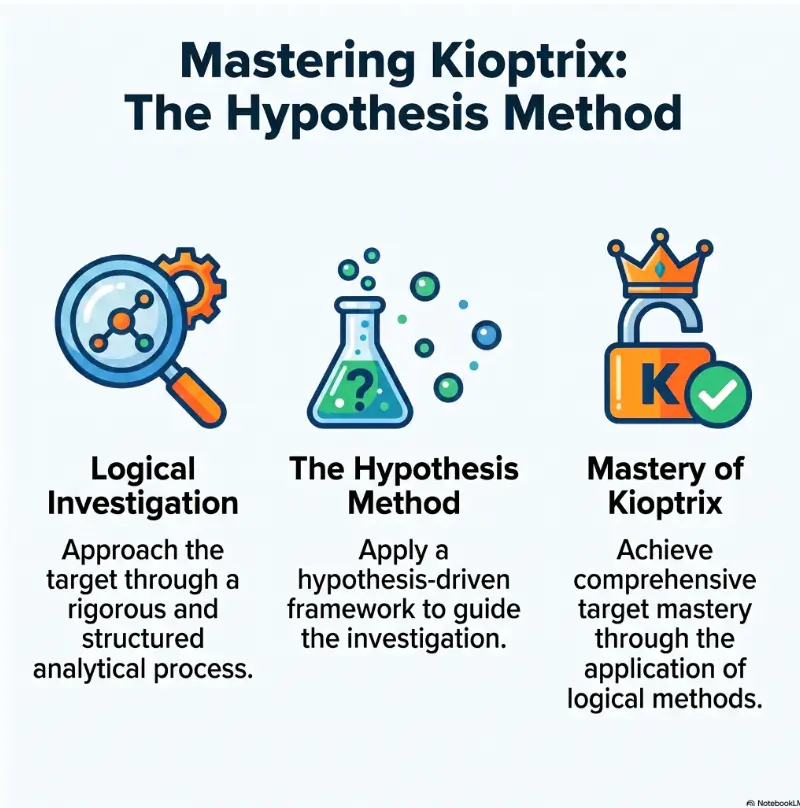
Before You Act: Keep This Inside Authorized Labs
Kioptrix practice belongs in legal, authorized lab environments. That means machines you own, intentionally vulnerable virtual machines, training platforms, school labs with written permission, or employer-approved environments with a clear scope.
This article explains a learning workflow. It does not provide permission to test real systems, public IP addresses, workplace networks, client assets, or anyone else’s infrastructure. In cybersecurity, the same command can be harmless in a home lab and deeply inappropriate somewhere else. Context is the lock. Authorization is the key.
Key takeaway
Use this method to improve reasoning in authorized labs only. When in doubt, stop and confirm scope before running tests. A calm learner with permission is practicing. A curious person without permission is creating risk.
If you are moving from Kioptrix into structured certification prep, professional work, or client-facing testing, pair your technical notes with clear documentation habits. A good next read is how to structure a professional OSCP-style report, because evidence that cannot be explained is evidence that quietly leaks value.
The Kioptrix Trap: Doing More, Learning Less
The classic beginner trap is not laziness. It is movement without memory.
You run a scan. Then another scan. Then a directory brute force. Then a web check. Then a search for an exploit. Then you reopen the first scan because you forgot what the first scan said. The terminal becomes a slot machine with a keyboard attached.
Why Beginners Confuse Activity With Progress
Kioptrix Level practice rewards curiosity, but it does not reward frantic curiosity. Beginners often feel that the next command will reveal the answer, so they keep feeding the machine more output. More text appears. More files appear. More possible paths appear. It feels productive because the screen is alive.
But learning does not happen just because output exists. Learning happens when you connect evidence to a testable idea. An open port is not a plan. A service banner is not a conclusion. A version number is not a victory parade.
A useful lab habit starts with one uncomfortable question: “What do I believe this evidence means?”
The Hidden Cost Of “Just Trying One More Scan”
One more scan is not always bad. In fact, careful follow-up enumeration is often the right move. The problem is running more tools because deciding feels harder than typing.
Every extra command creates a cost. You must read it, interpret it, store it, compare it, and decide whether it changes your plan. If you are not writing down the reason for the command, the cost compounds quietly.
That is how a 90-minute practice session becomes a foggy pile of output. At the end, you remember effort, but not reasoning. The box becomes a rumor.
When Tool Output Becomes Noise Instead Of Evidence
Tool output becomes noise when every result has the same emotional weight. A low-confidence finding, an obvious open service, a false positive, and a strong exploit clue all sit in the same mental bucket labeled “maybe important.” That bucket gets heavy fast.
A written hypothesis sorts the bucket. It lets you say, “This supports my current idea,” “This contradicts it,” “This is parked for later,” or “This is probably noise until another clue confirms it.” That small sorting action is where beginner practice starts turning into a method.
| Beginner behavior | What it feels like | What it often causes | Better alternative |
|---|---|---|---|
| Run every familiar tool | Productive | Too much output, weak reasoning | Write the question before the tool |
| Search every version number | Thorough | Exploit shopping too early | Confirm service behavior first |
| Change direction without notes | Flexible | Lost context and repeated work | Record why the path changed |
| Read a writeup at the first dead end | Efficient | Borrowed understanding | Write one more hypothesis first |
Written Hypotheses Turn Guessing Into A Lab Method
A hypothesis does not need to be dramatic. It does not need to sound like a research paper wearing a lab coat. In Kioptrix practice, a hypothesis is simply a testable sentence about what may be true.
For example: “The web server may be running an outdated application because the banner and page structure suggest an older LAMP stack.” That sentence is not a final answer. It is a lantern. It tells you where to look next and what kind of evidence would matter.
What A Useful Hypothesis Looks Like In A CTF Lab
A useful hypothesis has three qualities: it is specific, testable, and falsifiable. Specific means it points at a real clue. Testable means there is a next action. Falsifiable means there is a result that would make you change your mind.
Weak hypothesis: “Maybe web is vulnerable.”
Better hypothesis: “The HTTP service may expose an old admin panel because the default page and directory naming look consistent with a legacy web app. I will enumerate common directories and check response codes. If no hidden paths, login forms, or application fingerprints appear, I will lower this path’s priority.”
The second version gives your next 15 minutes a spine. It also gives your future review something to inspect.
Evidence First, Conclusion Second
Beginners often reverse the order. They find a result, search for a famous exploit, and then try to make the evidence fit. That is how confirmation bias sneaks into the room with muddy boots.
Evidence-first practice asks you to slow down. What do you actually know? Which port is open? Which service responded? Which version is confirmed, and which version is only guessed by a tool? Does the application behavior match the version claim? Did a scan report a possibility, or did you verify it manually?
This is especially important when learning with older vulnerable machines. Legacy lab environments may produce strange banners, stale fingerprints, or tool results that require human interpretation. A written hypothesis helps you avoid treating every automated finding as a royal decree.
The Tiny Sentence That Keeps You Honest
The sentence is this: “I will abandon or revise this hypothesis if…”
That phrase is a pocket-sized antidote to stubbornness. It forces you to define what losing evidence looks like before your ego starts decorating the tunnel walls.
Key takeaway
A written hypothesis is not a guess with nicer shoes. It is a testable claim with a built-in exit door. The exit door matters because it keeps you from spending the whole evening polishing the wrong idea.
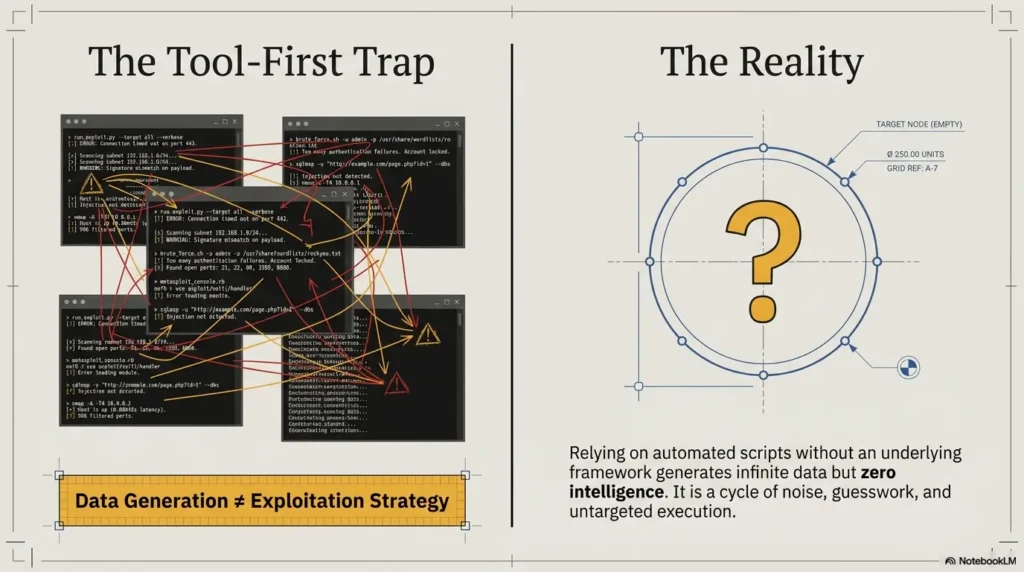
The First Clue Usually Lies Before Exploitation
Many learners want to get to exploitation quickly because exploitation feels like the exciting part. The shell pops, the screen changes, the room gets electricity. But the first real lesson usually appears earlier, in enumeration.
Kioptrix-style labs are excellent because they teach that “finding the way in” is rarely a single thunderbolt. It is more often a set of small observations that start to hum together.
Why Enumeration Deserves A Written Theory
Enumeration is not just collecting facts. It is building a map of what might matter. If you only collect output, your notes become a storage unit. If you collect evidence under hypotheses, your notes become a decision system.
For example, if you see ports associated with web, SMB, and database services, you can write separate hypotheses for each path. You do not need to fully investigate everything at once. You need to decide which path has the strongest combination of access, evidence, and testability.
A learner working through Kioptrix enumeration practice may improve faster by writing fewer commands and better reasons. That sounds suspiciously simple. It is also where the floorboards stop creaking.
How Service Versions, Banners, And Ports Become Testable Clues
A port tells you a door exists. A banner may tell you what name is painted on the door. A version number may hint at the door’s age. None of these alone proves that the door is open, broken, or useful.
Turn each clue into a small test:
- Port: What service appears to be reachable?
- Banner: Is the service identity confirmed by more than one method?
- Version: Is the version exact, guessed, hidden, or inconsistent?
- Behavior: Does the service respond in a way that supports the version claim?
- Access: Does the service allow anonymous, default, guest, or low-friction interaction in the lab?
Those questions keep your practice grounded. They also reduce the beginner habit of searching every version string like a raccoon investigating a glitter drawer.
Here’s What No One Tells You: The Exploit Is Rarely The First Lesson
The exploit is often the loud part, not the first lesson. The first lesson may be that you trusted a tool too quickly. Or skipped a boring service. Or ignored a default page. Or treated a dead end as failure instead of information.
When you write hypotheses, the machine starts teaching you before you “win.” That is the point. A lab box is not only a lock to open. It is a mirror for your process.
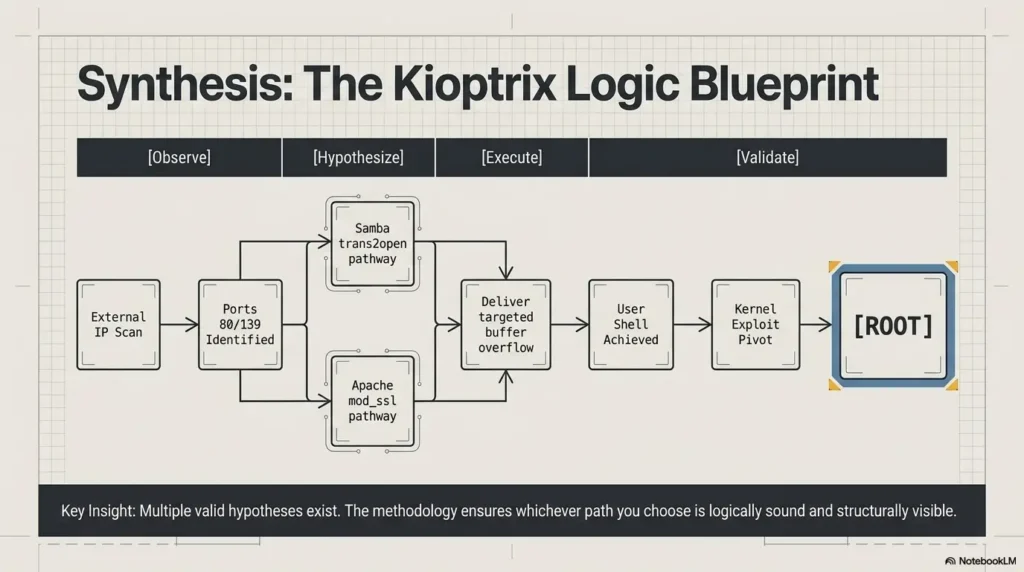
The Kioptrix Hypothesis Loop
1. Observe
Record the port, service, page, error, permission, or behavior you actually saw.
2. Hypothesize
Write what may be true and why the evidence points that way.
3. Test
Choose one next action that could support or weaken the idea.
4. Revise
Keep, change, abandon, or park the hypothesis before moving on.
Do Not Chase Every Rabbit Hole
A rabbit hole in Kioptrix practice is a path that keeps consuming time without producing stronger evidence. It may look promising because it has technical texture: unusual responses, old service names, cryptic errors, forum posts, or exploit references. The texture is what makes it sticky.
Hypotheses do not eliminate rabbit holes. They give you a way to exit them with dignity.
The Mistake: Treating Every Result As Equally Important
Not every result deserves the same depth of investigation. A service that offers no interaction, no version confidence, no unusual behavior, and no access clue should not automatically get the same attention as a service that exposes a login, default content, anonymous access, or application-specific fingerprints.
The trick is not to ignore weak clues forever. The trick is to avoid letting weak clues steer the car while stronger clues sit in the back seat eating crackers.
How To Pause Before A Tool Spiral Starts
Before running another tool, write the question the tool is supposed to answer. This is the fastest anti-spiral move available.
Instead of “run gobuster,” write: “I want to test whether the web service exposes hidden directories that support the legacy web-app hypothesis.”
Instead of “try SMB stuff,” write: “I want to test whether anonymous SMB access reveals user, share, or file clues that change my service priority.”
That one sentence turns a tool from a nervous tic into an instrument.
A Simple Parking Lot Note For Unresolved Clues
Parking lot notes are for clues that are not strong enough to pursue now but too interesting to throw away. The format can be plain:
- Clue: What I noticed.
- Why parked: Why I am not chasing it right now.
- Return condition: What would make me come back.
Example: “Port X returned an unusual banner. Parked because HTTP has stronger evidence and clearer tests. Return if web path stalls or if later credentials suggest this service matters.”
Key takeaway
A parked clue is not a forgotten clue. It is a clue with a return ticket. This keeps your notes flexible without letting every shiny result hijack the session.
Your Notes Should Disprove You, Not Protect Your Ego
Good notes are not a trophy case. They are a workshop. Some shelves hold clean findings. Some hold broken assumptions. Both are useful.
Beginners often write notes that preserve what they tried. Stronger learners write notes that reveal why they tried it, what happened, and how their thinking changed. That difference is quiet, but it is enormous.
Why “I Might Be Wrong” Is A Power Move
Writing “I might be wrong” is not weakness. It is control. It means you are not fused to your first idea. You can inspect it, test it, and set it down when it stops serving the evidence.
In Kioptrix practice, this matters because beginner frustration often comes from identity pressure. You do not merely think, “This path failed.” You think, “I failed.” That emotional jump is unhelpful and wildly expensive.
A hypothesis log keeps the failure attached to the claim, not the person. The claim was wrong. Good. Now it has paid rent.
The Difference Between Confirmation And Verification
Confirmation looks for evidence that supports what you already believe. Verification checks whether the belief survives contact with reality.
In lab work, confirmation sounds like: “This version has an exploit, so this must be the path.” Verification sounds like: “Does the target actually run the affected component, expose the required condition, and behave consistently with the exploit assumptions?”
The second sentence is less glamorous. It also prevents a thousand little disasters.
Most Failed Boxes Are Failed Assumptions
When learners get stuck after finding open ports, the issue is often not a missing tool. It is an untested assumption. They assume the obvious web path must be correct. They assume an exploit failed because the syntax was wrong. They assume a service is irrelevant because it looks boring. They assume privilege escalation should begin with the first checklist item they remember.
Writing hypotheses exposes those assumptions early. It turns “I am stuck” into a sharper question: “Which belief am I currently depending on, and did I test it well enough?”
Show me the nerdy details
A hypothesis log improves practice because it externalizes working memory. Instead of holding service clues, commands, failed tests, and emotional guesses in your head, you move them into a visible structure. That reduces cognitive load and makes error correction easier.
It also creates falsifiability. A claim such as “SMB may expose useful anonymous information” is better than “try SMB” because you can define what would support or weaken the claim. For example, anonymous listing succeeds, share names suggest user context, or file access reveals credentials. If those tests fail, you can lower the path’s priority instead of drifting.
Finally, written hypotheses improve post-lab review. You can inspect your decision points, not just your commands. That is where durable learning hides.
A Four-Line Hypothesis Template That Actually Works
You do not need a giant note-taking system to improve your Kioptrix practice. In fact, a giant system can become another maze. Start with four lines.
The best template is the one you will use when tired, slightly annoyed, and tempted to paste commands from memory. Keep it small enough to survive your worst practice session.
Line 1: What I Think May Be True
This line names the claim. It should be narrow enough to test.
Example: “The HTTP service may expose a legacy web application path that leads to initial access.”
Avoid vague claims such as “web is probably vulnerable.” Vague claims are fog machines. They make the room feel interesting while hiding the furniture.
Line 2: Why I Think It May Be True
This line records the evidence. You are not writing a novel. You are giving your future self enough context to understand why the idea existed.
Example: “The default page, server header, and directory naming pattern suggest an older stack; other services currently show weaker interaction.”
If you cannot write the evidence, you may not have a hypothesis yet. You may have a hunch. Hunches are allowed. Just label them honestly.
Line 3: What I Will Test Next
This line chooses one next action. Not seven. One. You can always write another hypothesis after the result.
Example: “I will enumerate common web directories and check any login, upload, or admin-like paths manually.”
This does not mean you must avoid tools. Tools are excellent when they answer a question. The written test keeps them from becoming keyboard incense.
Line 4: What Result Would Prove Me Wrong
This is the line most beginners skip, and it is the line that saves the most time.
Example: “If directory enumeration shows only default content, manual checks reveal no app behavior, and no version-specific evidence appears, I will park HTTP and inspect SMB next.”
Now you have an exit condition. You are not trapped by your own idea.
Copy-this hypothesis log
Hypothesis: I think _____ may be true.
Evidence: I think this because _____.
Next test: I will test it by _____.
Disproof: I will revise or abandon this if _____.
If you already use Obsidian, a markdown folder, a plain text file, or a spreadsheet, place this template where you can reach it quickly. If you are building a broader notes system, compare it with an Obsidian OSCP enumeration template and adapt only what you will actually use.
Tools, Notes, And Costs: What Is Worth Paying For?
Kioptrix practice can be cheap. A vulnerable VM, a local hypervisor, a Linux attack box, and disciplined notes can take you far. The expensive part is usually not software. It is wasted practice time.
That said, some learners benefit from paid courses, note apps, cloud labs, books, certification subscriptions, or coaching. The question is not “free or paid?” The better question is “What bottleneck am I paying to remove?”
Free Is Enough When Your Problem Is Consistency
If your main problem is scattered sessions, weak notes, or quitting too early, paid tools may not fix it. A paid platform can still become a fancier fog machine if your method is loose.
For budget-conscious learners, start with a simple lab routine and a hypothesis log. Add structure before adding subscriptions. A 15-minute review after each session may teach more than another month of unused access.
Paid Help May Be Worth It When Feedback Is The Bottleneck
Paid training can be useful when you need feedback, accountability, curated progression, realistic labs, or report review. It may also help career changers who need a learning path rather than another pile of bookmarks.
Before paying, ask what the product or service actually improves. Does it give better labs? Better explanations? Better structure? Better feedback? Better practice under time limits? Or is it mostly a collection of videos you will feel guilty about not watching?
| Option | Best for | What to compare | Money-waste warning |
|---|---|---|---|
| Free notes plus local labs | Beginners building consistency | Ease of setup, repeatable routine, review habit | Endless setup tweaking instead of practice |
| Paid note app or knowledge base | Learners managing many boxes | Search, templates, screenshots, export options | Pretty notes with weak reasoning |
| Paid lab platform | Structured practice and progression | Difficulty path, explanations, legal scope, community support | Starting too advanced and burning out |
| Course or coaching | Learners needing feedback | Instructor quality, review depth, practice assignments | Buying motivation instead of using a schedule |
Good, Better, Best Setup For A Hypothesis-Based Lab
Do not overbuild your system. The goal is to practice, not to create a cathedral of folders where learning goes to nap.
| Setup tier | What it includes | Best fit | Upgrade only when |
|---|---|---|---|
| Good | Plain text notes, screenshots folder, four-line hypothesis template | First Kioptrix boxes | You cannot find old evidence quickly |
| Better | Markdown notes, per-host template, evidence table, session review checklist | OSCP-style prep and repeat practice | Your notes need cross-box pattern tracking |
| Best | Knowledge base, tagging, screenshots naming rules, report-ready evidence structure | Portfolio, interview stories, serious certification prep | You are producing reports or public writeups |
For learners comparing Kioptrix with broader lab options, Kioptrix vs TryHackMe can help you think through whether you need raw independence, guided progression, or both.
From Kioptrix Notes To Real Cybersecurity Thinking
The professional skill hiding inside beginner boxes is not “memorize this exploit.” It is evidence-based reasoning under uncertainty.
That skill appears everywhere in cybersecurity. SOC analysts form hypotheses about alerts. Pentesters form hypotheses about attack paths. Help desk workers form hypotheses about misconfigurations. Incident responders form hypotheses about timelines and scope. The tools change. The thinking pattern stays recognizable.
How Lab Habits Transfer To SOC, Pentest, And Troubleshooting Workflows
A SOC analyst might write, “This alert may represent credential misuse because the login time, source location, and device pattern differ from the user’s baseline.” Then they test the idea against logs, identity data, and endpoint signals.
A pentester might write, “This application may allow privilege escalation through broken access control because low-privilege users can reach admin-like endpoints.” Then they test authorization boundaries within scope.
A help desk worker might write, “This user’s VPN issue may be DNS-related because IP connectivity works but hostnames fail.” Then they test name resolution before reinstalling half the universe.
That is the same muscle. Kioptrix simply gives you a safe gym.
Why Evidence-Based Reasoning Matters More Than Memorized Exploits
Memorized exploits age. Reasoning compounds.
This does not mean technical knowledge is optional. You still need to understand protocols, web behavior, Linux permissions, authentication, file paths, services, and common vulnerability patterns. But memorized commands without reasoning become brittle.
A learner who understands why a test matters can adapt when syntax changes, tools fail, banners lie, or a lab behaves strangely. A learner who only copied a path from a walkthrough may be left staring at the prompt like it has started speaking in riddles.
Real-world example: From Stuck To Specific
A learner starts a Kioptrix-style box after work. They find several open ports and immediately chase the web service because it feels familiar. After 45 minutes, they have run directory scans, checked source, searched version strings, and collected a small swamp of output.
Then they stop and write one hypothesis: “HTTP may not be the initial access path because my tests only show default content and no application-specific behavior. SMB may be more useful because it allows interaction and may expose names or shares.”
That sentence changes the session. They do not magically solve the box. They simply stop treating “stuck” as a fog bank. They now have a test: verify SMB interaction, document what is accessible, and compare that evidence against the web path.
The lesson is not “always choose SMB.” The lesson is that a written claim can turn frustration into a next action.
Session review checklist
- Which hypothesis was strongest at the start?
- Which evidence made you change direction?
- Which clue did you ignore too long?
- Which tool did you run without a clear question?
- Which failed path taught something useful?
- What would you test earlier next time?
FAQ
Should Beginners Write Hypotheses Before Running Tools?
Yes, at least before major tests. You do not need to write a hypothesis before every tiny command, but you should write one before changing direction, launching a longer scan, testing an exploit path, or starting privilege escalation. The point is to make your reason visible.
How Detailed Should Kioptrix Practice Notes Be?
Detailed enough that you can understand your decisions later. Write the evidence, the test, the result, and what changed. You do not need to paste every line of output. Save important evidence and summarize the reasoning around it.
Is It Bad To Use Writeups When Learning Kioptrix?
No, but timing matters. Try writing one more hypothesis before opening a writeup. If you do use one, record what clue you missed, why you missed it, and what test would have found it. A writeup should become feedback, not a replacement for thinking.
What Should I Write Down During Enumeration?
Record confirmed services, version confidence, unusual behavior, access possibilities, strong clues, weak clues, and parked clues. Most importantly, write what each clue suggests and what you plan to test next. Enumeration notes should guide decisions, not merely archive output.
Why Do I Keep Getting Stuck Even After Finding Open Ports?
Open ports are starting points, not answers. You may be missing service behavior, version verification, authentication clues, application paths, or privilege context. Write a hypothesis for each promising service and compare which one has the strongest evidence and clearest next test.
How Do Written Hypotheses Help With Privilege Escalation Practice?
Privilege escalation can become checklist theater if you run everything without interpretation. A hypothesis helps you connect local evidence to a path. For example, writable directories, unusual SUID files, sudo permissions, cron jobs, service configs, or credential reuse should each become a testable idea.
Can This Method Help With Other CTF Labs Besides Kioptrix?
Yes. The method works for many legal CTF labs, vulnerable machines, certification practice boxes, and troubleshooting exercises. The exact services and tools may change, but the habit remains useful: evidence, hypothesis, test, result, revision.
How Do I Know When To Abandon A Hypothesis?
Abandon or park a hypothesis when repeated tests fail to strengthen it, when stronger evidence appears elsewhere, or when the required condition is disproven. You can return later if new evidence changes the picture. Abandoning a weak idea is not quitting. It is steering.
Run One Box With A Hypothesis Log
The next step is not to redesign your entire learning system. That would be very on-brand for the human brain, but not necessary.
Run one Kioptrix-style box with a hypothesis log. Before each major test, write four lines: what you think, why you think it, what you will test, and what would prove you wrong. That is enough.
Your 15-Minute Start
- Open your notes before opening extra browser tabs.
- Create sections for enumeration, initial access, privilege escalation, and review.
- Write your first hypothesis after the initial scan results.
- Choose one test that directly answers the hypothesis.
- After the result, mark the hypothesis as supported, weakened, disproven, or parked.
- Repeat only when a major decision point appears.
After the box, review only three things: wrong turns, missed evidence, and better next tests. Do not turn the review into a courtroom drama. You are not prosecuting yesterday’s self. You are training tomorrow’s hands.
That is where Kioptrix practice gets quieter. Not easier, exactly. Quieter. The machine still resists. Tools still mislead. Dead ends still happen. But your notes begin to hold the thread, and the thread is what gets you through the maze.
Last reviewed: 2026-07