


From Motion to Judgment:
Mastering the Kioptrix Methodology
Most beginner sessions on Kioptrix Level do not break down because the lab is too hard. They break down because the learner cannot yet tell whether they are following a method or just decorating uncertainty with terminal output.
One hour of scans, tabs, exploits, and copied commands can feel intensely technical while teaching almost nothing about enumeration or hypothesis-driven testing.
This post helps you use Kioptrix as a clean, repeatable environment for learning how evidence leads to action. The goal is not a flashy root shell. It is a calmer, more transferable way to think.
The Reveal
Labs do not just reveal targets. They reveal habits. Some scale beautifully; others follow you into every box.
The Outcome
Leave with something better than a screenshot: a method you can explain, repeat, and trust.
Table of Contents
Fast Answer: Kioptrix Level teaches a lesson many beginners miss: real cybersecurity progress comes less from clever guesses and more from disciplined sequence. The lab rewards learners who observe carefully, form narrow hypotheses, test one thing at a time, and revise when evidence disagrees. That habit transfers beyond the lab into troubleshooting, interviews, and calmer, more credible technical work.
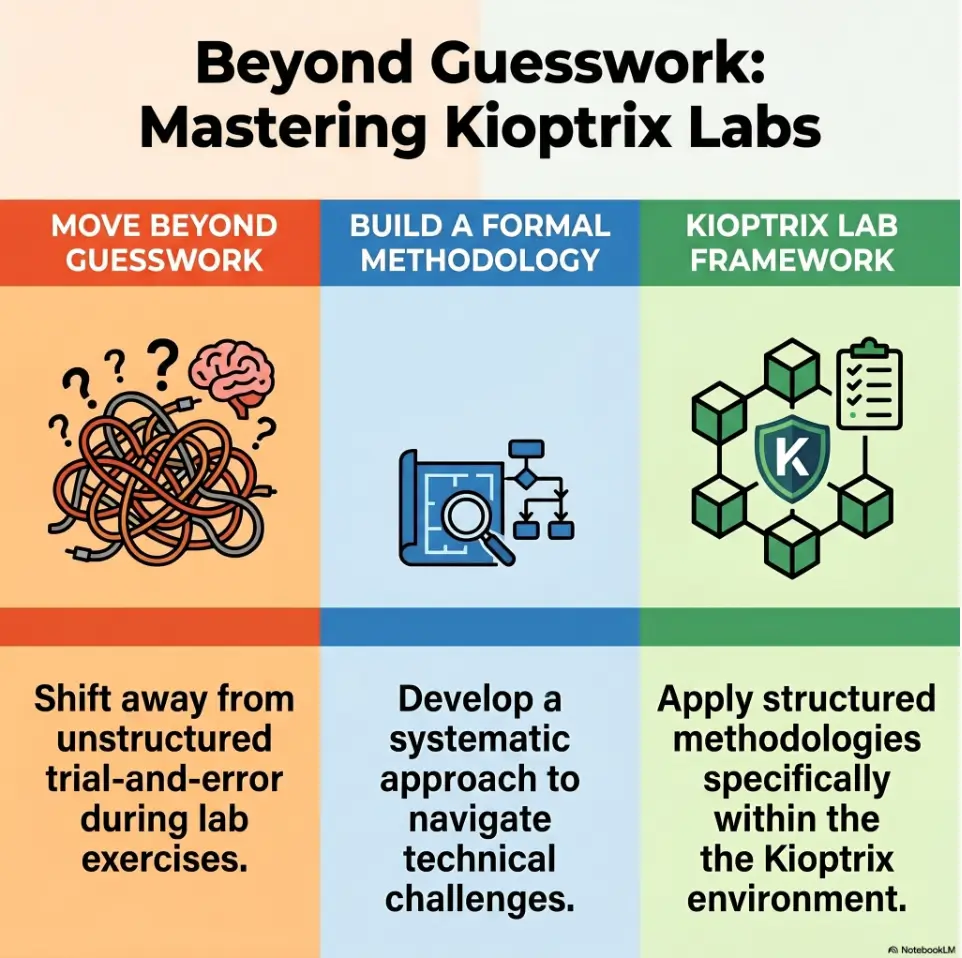
Why Kioptrix Level Still Works for This Lesson
The real value is not the box, but the behavior it reveals
Kioptrix Level still matters because it strips away some of the theatrical fog that clings to modern lab culture. There are fewer shiny distractions. Fewer dashboard fireworks. Fewer places to confuse tool output with understanding. That makes the learner easier to observe, including by themselves.
I have seen this happen repeatedly. A learner opens a famous modern lab, throws ten tools at it, and feels “serious” because the terminal is busy. Then they open Kioptrix, slow down, and suddenly the whole session becomes a character test. Did they map the target? Did they write down assumptions? Did they notice what changed after each action? That is where the lesson lives.
Virtualization manuals quietly reinforce why these older labs remain practical. Oracle’s VirtualBox documentation explains host-only networking as a way to create a network containing the host and a set of virtual machines without relying on the physical network, which is exactly the kind of low-friction isolation that helps repeatable lab practice feel sane instead of brittle. If you need a more grounded setup before that first boot, a dedicated guide to Kioptrix network setup can make the environment less mysterious from the start.
Why older labs often teach cleaner thinking than noisier modern targets
Older labs are not automatically better. They are just often cleaner for teaching cause and effect. In a simpler environment, the learner can more easily trace why they did something, what signal they saw, and what conclusion they drew. The intellectual weather is calmer. You can hear your own reasoning footsteps.
That matters because beginners often do not need more complexity. They need fewer moving parts. A modern target can be a crowded airport. Kioptrix is more like an empty train platform in winter. You hear every mistake. You also hear every good decision. For readers still deciding whether this family of labs fits their stage, what Kioptrix actually is and why Kioptrix works for beginners help frame the promise without over-romanticizing it.
The hidden curriculum: observation before action
The hidden curriculum of Kioptrix is not exploitation. It is restraint. Before you try to break anything, you are invited to look. Not in a romantic, cinematic way. Just in the plain old technical sense: what is exposed, what is likely, what is missing, what deserves a second pass.
OWASP’s testing guidance is built around ordered categories of information gathering and analysis rather than random command flurries, and that structure mirrors the mindset Kioptrix can teach when used well.
- Older labs reduce noise and expose process.
- Simple setups are better for repetition and comparison.
- Observation is not delay. It is part of the work.
Apply in 60 seconds: Before touching the target, write down what you want to learn from the first 10 minutes.
Method vs Guesswork: What Learners Actually Need to See
What “method” looks like in a beginner lab
Method is not being fancy. Method is being legible. It means you can explain why your next action follows from the last piece of evidence. It means your scan is not random, your note-taking is not decorative, and your exploit attempt is not a dart thrown in mild panic.
A beginner using method might say: “I identified exposed services, I prioritized the one with the clearest attack surface, and I am testing this because the version information and behavior point in that direction.” That sentence may not sound glamorous. Good. Glamour has wrecked many lab notebooks.
What guesswork sounds like when it wears a technical costume
Guesswork almost never introduces itself honestly. It arrives dressed as urgency. It says things like:
- “Let me just try this real quick.”
- “I saw someone use this exploit once.”
- “Maybe Metasploit will tell me.”
- “The port is open, so it must be relevant.”
Notice what is missing from those lines. Evidence. Priority logic. A narrowed hypothesis. Guesswork loves costumes. Sometimes it dresses as confidence. Sometimes as hustle. Sometimes as “being hands-on.” In practice, it is often just impatience with a keyboard.
Why random success can teach the wrong lesson
This is the cruel part. Guesswork sometimes works. Not often enough to build skill, but often enough to build bad habits. A learner gets a shell after a sloppy process and quietly absorbs the wrong conclusion: “My workflow is fine.” The box is rooted, but the lesson is half-broken.
I once watched a learner jump to the correct path for the wrong reason, then spend the next three sessions trying to recreate luck as if it were a repeatable method. That is like winning once at darts with your eyes half-closed and deciding vision is optional. If that habit sounds familiar, the problem is often not intelligence but why copy-paste commands fail in Kioptrix practice.
Show me the nerdy details
In practice, method means maintaining a chain between observed service data, version clues, likely misconfigurations, and a bounded test. Guesswork breaks that chain. The learner may still land on a working exploit, but the causal story is missing, which makes transfer to a new target much weaker.
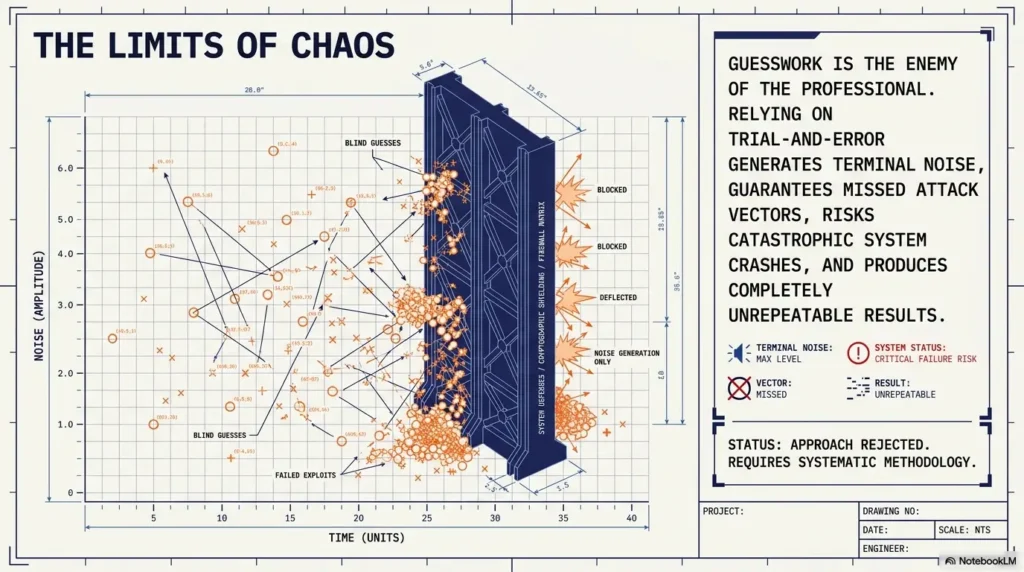
Where Guesswork Begins to Feel Like Progress
Copy-paste momentum is not the same as understanding
One of the easiest traps in Kioptrix is copy-paste momentum. The commands keep moving. Output scrolls. Tabs multiply like anxious rabbits. The learner feels alive and technically busy. But if you ask, “Why this command now?” the room suddenly gets very quiet.
This is not a moral failure. It is a beginner pattern. When people feel uncertainty, they often replace understanding with action volume. In cybersecurity labs, that looks like command chains borrowed from walkthrough memory instead of decisions formed from present evidence.
When tool-hopping becomes a substitute for reasoning
Tool-hopping can feel like intelligence because it creates variation. New tool, new hope. New output, new dopamine. But too often it is just uncertainty changing jackets. You are not reasoning more deeply. You are shopping for a shortcut.
There is a humble discipline here that matters enormously: stay with one clue long enough to understand what it changes. If one service is exposed, what does that imply? If a version string appears, what paths become more plausible and which become less so? Good learners do not merely collect clues. They let clues exclude possibilities. That is the same spirit behind choosing the first service to investigate on Kioptrix instead of treating every discovery like an emergency siren.
Small wins can hide a weak process
A minor breakthrough can disguise a structural problem. Maybe you find a default credential. Maybe a service banner hands you a useful hint. Maybe one exploit lands. Fine. But did your process deserve that result, or did the box simply forgive you?
That question matters more than beginners usually think. Labs are not only places to get in. They are places to discover what kind of operator you are becoming. And a session that “works” while your reasoning stays muddy is less valuable than a session that stops halfway but leaves your logic cleaner.
Decision Card: When does motion help, and when does it hurt?
| If you are doing this | It usually means | Better next move |
|---|---|---|
| Running 4 tools in 10 minutes | You may be outsourcing judgment | Pick one service and write one hypothesis |
| Copying commands from memory without notes | You are preserving output, not reasoning | Add a “why this next?” line before each step |
| Trying exploits before mapping the target | You are hoping the box will rescue you | Return to enumeration and prioritize evidence |
Neutral action: use this card after your next session and mark which row sounded most like you.
The Enumeration Gap: Why Good Learners Pause Longer
Reading the system before trying to break it
Enumeration is where method gets its spine. This is the phase many beginners rush because it looks less exciting than exploitation. No fireworks. No immediate shell. Just observation, narrowing, pattern recognition, and patience. In other words, the grown-up part.
I have had sessions where the most useful thing I did in the first 20 minutes was not launch anything dramatic. It was simply notice that one clue mattered more than the others. That sounds small. It is not. The whole lab often turns on exactly that kind of quiet discrimination.
How patient enumeration narrows the attack surface
Good enumeration does not only gather information. It reduces chaos. That is the crucial difference. You are not trying to know everything. You are trying to know enough to stop guessing widely. Every service identified, every version clue, every behavioral detail should shrink the problem a little.
OWASP’s testing material is full of this spirit. The scope of a test, what can be inferred, and what should be verified are treated as ordered work, not improvisational jazz played by caffeinated raccoons. In practical terms, a strong Kioptrix enumeration workflow or a simpler recon routine for repeatable sessions usually beats one dramatic shortcut.
Let’s be honest… rushing feels productive because it is louder
Rushing has excellent branding. It produces visible activity. Fast typing. New windows. Urgent emotions. Enumeration, by contrast, can feel almost suspiciously calm. It asks you to slow down in a culture that often rewards the appearance of speed.
But the deeper truth is simple: slow early often means faster later. If your first phase cuts the attack surface in half, the rest of the session changes. You stop treating every open port like a fire alarm. You start acting like someone who understands triage. Readers who want to lean into that slower discipline may find why Kioptrix rewards patience a useful companion idea.
- Read first, then act.
- Let each clue remove possibilities.
- Noise reduction is a real technical skill.
Apply in 60 seconds: On your next box, list only the two most promising surfaces before you test anything.
Don’t Confuse Motion With Method
Running more commands does not equal deeper analysis
There is a common beginner superstition that more commands means more sophistication. It does not. Sometimes it means you have not decided what the problem is yet. Commands are not wisdom tokens. They are tools. And tools used without decision logic can make a learner look busy while leaving them conceptually hungry.
This is why some learners finish a session exhausted but cannot explain it. They have logs. They have screenshots. They have output. What they do not have is a coherent story of cause and effect.
Why beginners often overvalue exploit attempts and undervalue notes
Exploit attempts feel like the “real” work because they are dramatic. Notes feel like homework. That is backwards. Notes are where method becomes portable. Without notes, each session evaporates. With notes, each session leaves behind a decision pattern you can reuse. A simple technical journal for Kioptrix sessions or even a lightweight recon log template can turn that portability from wishful thinking into habit.
Broadcom’s current VMware documentation describes snapshots as preserving a virtual machine’s state, including memory, settings, and disk state, which is useful for experimentation and repetition. That matters because disciplined lab work is not only about one run. It is about preserving a state, trying a path, rolling back, and comparing decisions cleanly.
The cost of skipping the “why this next?” question
Every time you skip the “why this next?” question, you pay a small tax. At first the cost is invisible. Later it arrives as confusion, weak retention, or interview answers that sound like a command history instead of a reasoning history.
That is why I recommend a painfully simple ritual: before every meaningful action, write one sentence explaining why it is the next logical move. It feels annoying for about seven minutes. Then it starts to feel like handrails.
Eligibility Checklist: Is your current session actually method-based?
- Yes / No: I can explain why my next action follows from a specific clue.
- Yes / No: I know which service or behavior I am prioritizing first.
- Yes / No: I am writing decisions, not just commands.
- Yes / No: I could restart the session and reproduce the same logic.
Neutral action: if you answered “No” twice or more, restart the session with a narrower scope instead of pushing harder.
Common Mistakes That Turn Kioptrix Into a Guessing Game
Starting with exploitation before building a map
This is perhaps the most common self-inflicted wound. A learner wants progress, so they jump to exploitation before they have a meaningful map of the environment. The energy feels bold. The process is usually brittle.
Starting too early with exploitation is like trying random keys in a building before checking which door you are standing at. Sometimes the building is kind and lets you in anyway. That does not make the method good.
Treating every open port like an invitation to panic
Beginners often interpret each open port as a demand. Something is there, so it must be urgent. But open does not mean important. It does not even mean promising. Ports are clues, not instructions shouted through a megaphone.
The better question is not, “What can I do with every open service?” It is, “Which exposed behavior is most likely to move this session forward based on context?” That tiny shift saves enormous amounts of wasted energy. When readers struggle with that triage step, seeing how to interpret Kioptrix open ports or common recon mistakes in early sessions often helps.
Using walkthroughs too early and calling it learning
Walkthroughs are not evil. They are timing-sensitive. Used too early, they can turn a reasoning exercise into a choreography exercise. You stop asking what you think and start asking what the page says. That is not always useless, but it is a different activity.
I have absolutely used walkthroughs after a genuine stuck point. That can be wise. But the distinction matters. A walkthrough should answer a bounded question after effort, not replace the effort itself. There is a large difference between consulting a Kioptrix walkthrough after real effort and reaching for it before your own logic has had a chance to breathe.
Recording commands, but not decisions
Command logs are not the same as notes. They tell you what happened on the screen. They do not tell you why you believed one path was better than another, what you ruled out, or where your assumptions bent. Weak notes create the illusion of documentation while omitting the only parts that teach judgment.
The lesson is blunt: if your notes cannot explain your choices, they are preserving theater, not thought.
Show me the nerdy details
A strong lab note usually contains four layers: evidence collected, current interpretation, next bounded test, and outcome. That structure lets you compare assumptions against results. Over time, it becomes a private methodology archive rather than a pile of terminal fragments.
Who This Is For, and Who It Is Not For
Best fit: learners who want a repeatable thinking process
If you want a lab that helps you build a repeatable reasoning loop, Kioptrix fits beautifully. It gives you enough structure to practice sequence and enough simplicity to notice yourself thinking. That combination is underrated.
Strong fit: career changers building interview-ready stories
Career changers often need more than technical exposure. They need a way to talk about how they think under uncertainty. Kioptrix is excellent for that because the story is not “I used tool X.” The story is “I saw clue Y, formed hypothesis Z, and adjusted when evidence changed.” That is the language of judgment. For that audience, there is real value in using Kioptrix as a career-changer lab and in learning how to turn practice into better interview stories.
Not ideal: people chasing speed, shortcuts, or screenshot trophies
If your main goal is to finish as fast as possible, build a dramatic post, or collect rooted boxes like souvenir magnets, Kioptrix may frustrate you. It is less generous to shallow performance than some learners expect.
Not enough on its own: learners who never reflect after the lab
Even a good lab cannot rescue a bad reflection habit. If you finish and move on without reviewing where method ended and guessing began, you leave value on the table. Reflection is not a decorative ending. It is the extraction phase.
Coverage Tier Map: What changes as your learning goal changes?
| Tier | Primary goal | How Kioptrix helps |
|---|---|---|
| Tier 1 | Basic exposure | Shows the flow from enumeration to exploitation |
| Tier 2 | Process building | Teaches sequence, note discipline, rollback practice |
| Tier 3 | Interview readiness | Creates stories about judgment and iteration |
| Tier 4 | Long-term operator growth | Builds habits that transfer beyond CTF-like tasks |
Neutral action: mark your current tier before your next session so you stop practicing three goals at once.
A Better Practice Loop: Observe, Hypothesize, Test, Reassess
Step 1: Gather signals without forcing a conclusion
The first step is observation without premature certainty. You are gathering signals, not auditioning for a movie trailer. Let the environment tell you what kind of target it is before you decide what story you want it to fit.
This is harder than it sounds. Human brains love quick closure. Technical brains are no exception. We see one service and want an answer now. Resist that urge. At this stage, your goal is not certainty. It is signal quality.
Step 2: Form one narrow hypothesis at a time
Once you have usable clues, build one narrow hypothesis. Not five. One. The point is to make the next action meaningful. “This service behavior suggests this path may be worth testing” is strong. “Anything could work, let’s try a bunch of stuff” is just chaos with coffee.
Step 3: Test with intention, not with spray-and-pray energy
Testing should be bounded. You should know what would count as confirming, weakening, or falsifying the hypothesis. That sounds formal, but it becomes practical fast. It helps you stop earlier when a path is weak and commit more calmly when it is strong.
Step 4: Reassess when the evidence bends
This is where maturity shows. When evidence bends, you bend with it. You do not cling to a pet theory because you already spent 25 minutes on it. Sunk cost is not methodology. It is ego with a stopwatch.
Here’s what no one tells you… restarting carefully is often a sign of maturity, not failure
One of the healthiest lab habits I ever learned was the willingness to restart. Not because I was lost beyond repair, but because my process had become muddy. A careful restart can be a form of respect for the work. It lets you rebuild the chain cleanly instead of dragging a tangled rope across the rest of the session.
Short Story: I remember a session where I felt gloriously productive for almost 40 minutes. I had tabs open, notes half-written, exploit references scattered around, and that strange beginner confidence that feels smart right before it embarrasses you. Then I tried to explain my last three decisions in plain English. I couldn’t. Not really. I had clues, but no sequence.
So I rolled the machine back, closed most of the tabs, and started over with one rule: every next step had to earn its place. The second run looked slower from the outside. Fewer commands. Longer pauses. But within 25 minutes, the box felt less like a puzzle machine and more like a conversation. By the end, I had not only a result, but a map. That was the day I stopped worshipping momentum. A disciplined snapshot strategy for Kioptrix makes that kind of restart feel practical instead of punitive.
- Observe before concluding.
- Test one narrow hypothesis at a time.
- Reassess as soon as evidence weakens the path.
Apply in 60 seconds: Add four note headers to your next lab page: Observe, Hypothesis, Test, Reassess.
What Good Notes Capture That Weak Notes Miss
Evidence, assumptions, and dead ends
Good notes capture evidence, assumptions, and dead ends. Weak notes capture commands and vibes. That difference is everything. If you only record what you typed, you preserve mechanics. If you also record what you believed and why, you preserve judgment.
Dead ends matter especially. They are not embarrassing debris to hide. They show how you narrowed the field. They also become future warning signs. The second time you recognize a dead-end pattern, you save time. The third time, you start looking like someone with judgment.
Why “what I expected” matters as much as “what happened”
This is one of the most underrated note-taking tricks in lab work: write what you expected before you run the test. Then compare it with what happened. The gap teaches you more than the result alone.
If your expectation was wrong, great. That is not failure. That is calibration. Your notes become a private series of little corrections, like tuning an instrument that was slightly off-key.
Turning lab notes into future decision templates
Over time, strong notes become templates. You stop writing from scratch each session. You begin to recognize recurring structures: service identification, narrowing, hypothesis formation, verification, privilege path exploration, rollback decisions. That is when note-taking stops feeling academic and starts feeling operational. A purpose-built Kioptrix note-taking tool or even broader advice on note-taking systems for pentesting can help readers turn this into a durable workflow.
Quote-Prep List: Gather these before you compare your process across labs.
- Top 3 clues you noticed first
- The first hypothesis you formed
- One dead end and why it was weak
- The sentence that justified your successful next step
Neutral action: use the same four prompts after every session for three labs and compare patterns.
From Lab Habit to Real Skill: Why This Difference Matters Later
How method improves troubleshooting beyond CTF-style environments
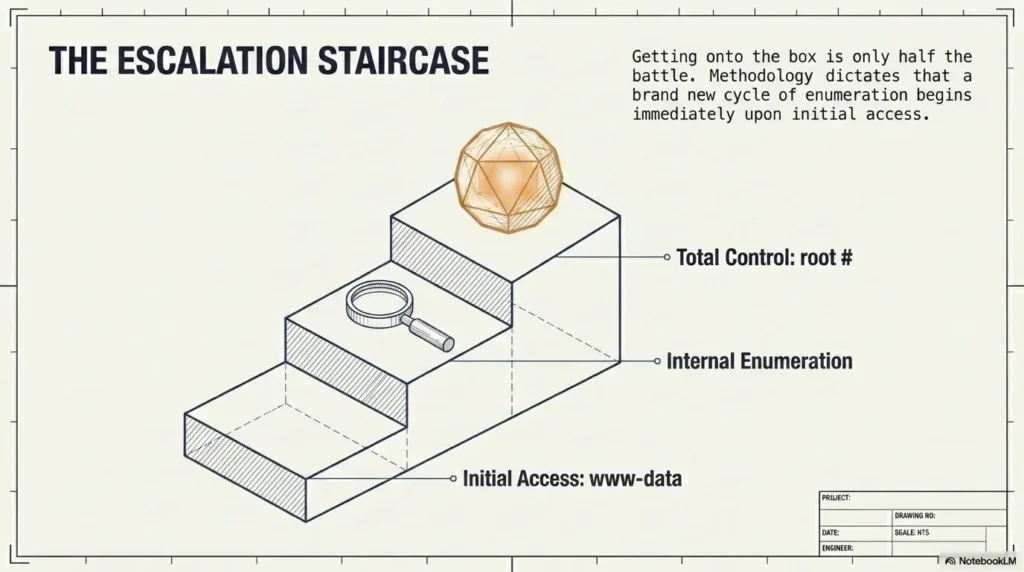
The reason this matters later is simple: real environments are not impressed by random success. Troubleshooting in the wild demands sequence. You gather signals, form hypotheses, test carefully, and avoid widening the blast radius with impulsive changes. The muscles you build in Kioptrix can carry into that world surprisingly well.
That does not mean an old vulnerable VM is the same thing as production security work. It is not. But the thinking habit underneath, careful narrowing rather than frantic guessing, transfers beautifully.
Why interviewers remember judgment more than tool names
Interviewers often remember how you decided what to do next more than the brand names of your tools. Anyone can recite “I used Nmap, Nikto, Metasploit, Burp.” That sentence says almost nothing about your judgment. A better answer sounds like this: “I enumerated first, prioritized the service with the clearest signal, tested one path, and changed course when the evidence did not support my assumption.”
That answer does not merely sound calmer. It sounds employable. And if you are actively shaping those narratives, using Kioptrix work for LinkedIn credibility pairs naturally with stronger interview-ready lab stories.
The bridge from Kioptrix to professional credibility
Professional credibility is often a tone problem before it is a knowledge problem. Learners oversell. They narrate the terminal. They confuse completion with readiness. Kioptrix can help correct that if you let it. It teaches a humbler and more durable posture: I observed, I reasoned, I tested, I adapted.
There is a kind of credibility that arrives not with bigger claims, but with cleaner thought. In cybersecurity, that is rarely wasted. That is especially true for help desk workers using Kioptrix to show judgment and for IT generalists trying to build a more security-shaped story.
Mini Calculator: Score your last session.
Input 1: How many times did you write a “why this next?” sentence?
Input 2: How many exploit attempts happened before your notes had a clear priority?
Output: If Input 1 is lower than Input 2, your session leaned toward guesswork. If Input 1 is higher, your process likely had better structure.
Neutral action: repeat the score for your next two sessions and look for trend, not perfection.
Next Step: Run One Session With a “Why This Next?” Rule
Pick one Kioptrix target and limit yourself to a written sequence
Do not overcomplicate your next session. Choose one Kioptrix target. Use a stable isolated setup. Keep your notes visible. Your goal is not speed. Your goal is sequence. The fewer moving parts, the easier it is to catch yourself thinking. For some readers, that means starting with a first Kioptrix lab that feels manageable rather than trying to solve your entire identity in one sitting.
After every action, write one sentence explaining why it was the next logical move
This single rule is almost absurdly effective. It forces reasoning into the open. It slows impulsive behavior. It makes weak actions feel weak before they waste half an hour. And it creates a paper trail of judgment you can review later.
Review your notes at the end and mark where method ended and guessing began
This is where the hook closes. The difference between method and guesswork is rarely discovered in the middle of action. It becomes clearest in review. When you reread the session, certain turns will suddenly glow. Here, I followed evidence. Here, I got impatient. Here, I hoped the exploit would rescue my uncertainty.
That review is gold. It turns one lab into two lessons: what the target taught you, and what your own habits revealed. For readers who want to formalize that reflection, a Kioptrix self-assessment routine is a natural next layer.
Infographic: Method vs Guesswork in One Kioptrix Session
Guesswork Path
Open port → panic → tool-hopping → random exploit tries → lucky hit or confusion → weak retention
Method Path
Open port → note context → form narrow hypothesis → intentional test → reassess → repeatable learning
Bottom line: Both paths can produce activity. Only one reliably produces transferable skill.
FAQ
Is Kioptrix Level too old to teach useful cybersecurity skills?
No. It is old, but age alone does not remove training value. Kioptrix is still useful for learning structured enumeration, hypothesis-driven testing, note discipline, and rollback-based experimentation. What it teaches best is not modern production realism, but thinking clarity.
Can beginners use Kioptrix to learn methodology, not just exploitation?
Yes, and that is one of its best uses. Beginners often benefit from environments with less noise because it becomes easier to see why one decision made sense and another did not. If you use the lab with a note-taking structure, it becomes a methodology trainer.
How do I know whether I am using method or just guessing?
Ask one question before each meaningful action: “Why is this the next logical move?” If you can answer with a clue-based reason, you are closer to method. If your answer is basically “maybe this works,” you are drifting toward guesswork.
Should I avoid walkthroughs completely when practicing Kioptrix?
No. Walkthroughs are best used after genuine effort and a clearly defined stuck point. Used too early, they replace reasoning. Used later, they can help you compare your process with a stronger one and learn where your map went soft.
What should I write down during a Kioptrix session?
Write down evidence, assumptions, hypotheses, tests, outcomes, and dead ends. Also record what you expected before a test and how the result changed your next decision. That is far more valuable than a bare command log.
How long should one Kioptrix practice session be?
For many beginners, 30 to 60 minutes is a strong range. Long enough to build momentum, short enough to preserve attention and review quality. Sessions that run too long often become more impulsive, not more insightful. If you want to calibrate that rhythm more carefully, choosing the right Kioptrix session length is worth a look.
Does slow enumeration actually make me better, or just slower?
It usually makes you better first, then faster later. Careful early work reduces the number of weak paths you chase. The speed comes as a side effect of better discrimination, not as a separate trick.
Can Kioptrix help me talk about my skills in interviews?
Yes. It gives you material for stories about observation, prioritization, adapting to evidence, and learning from dead ends. Those are more compelling than simply listing tools you touched.
What is the best mindset for repeating the same lab?
Treat repetition as comparison, not repetition for its own sake. The point is to test whether your process is becoming clearer, calmer, and more reproducible. If the second run teaches you more about your reasoning, it is not repetitive at all.
Closing Thoughts
The quiet truth we started with is still the one worth keeping: in cybersecurity, progress comes less from guessing than from method. Kioptrix Level still works because it reveals that truth in plain daylight. It shows where learners rush, where they borrow confidence from tools, where they confuse noise with knowledge, and where better habits begin.
So do one honest thing in the next 15 minutes. Boot one target. Open one blank note. Add four headings: Observe, Hypothesis, Test, Reassess. Then force every meaningful action to answer one sentence: Why this next? That one rule will not make you flashy. It will make you harder to fool, including by yourself.
Last reviewed: 2026-04.