
Startup security, audit readiness, and enterprise trust
SOC 2 Compliance Checklist for Startups:
Build Audit-Ready Trust Without Wasting Months
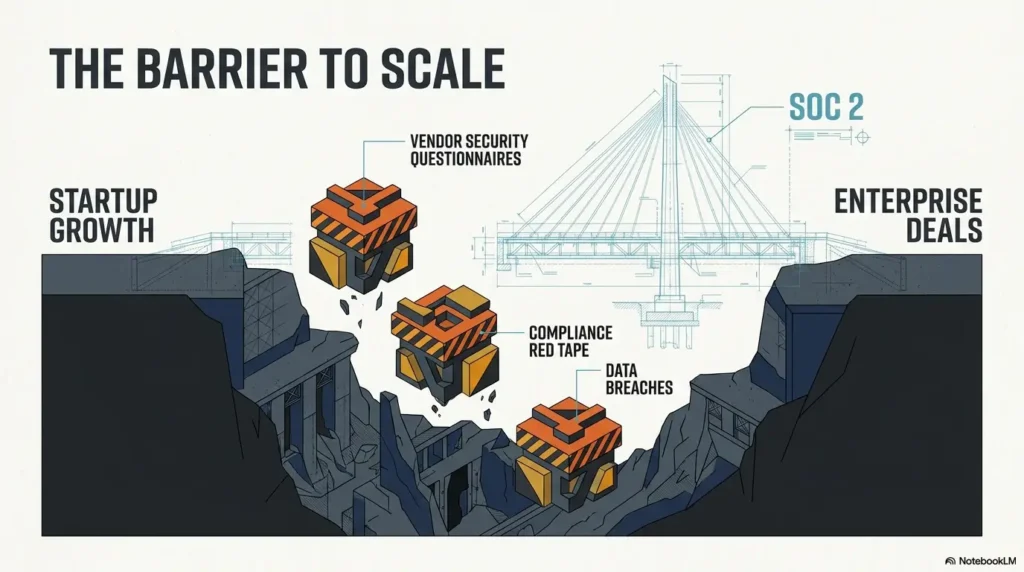
SOC 2 can feel like a heavy door at the end of the enterprise sales hallway. One buyer asks for your report, another sends a 300-question security questionnaire, and suddenly your tidy startup sprint board has grown antlers. The good news: a young SaaS company does not need a corporate-sized compliance machine to start well.
What you need is scope, plain-English policies, real controls, steady evidence, and a buyer-ready story. The winning move is not to collect every shiny compliance tool like souvenirs. It is to decide what your product actually does, what customers are relying on, and how you will prove those promises without turning your team into spreadsheet ghosts.
This guide gives founders, security leads, operations owners, and first-time compliance managers a practical SOC 2 readiness path. Use it to avoid expensive detours, prepare for Type 1 or Type 2 conversations, and build trust that survives both auditor review and buyer scrutiny.
Scope before spend
Know what belongs in the audit before buying software or writing policies.
Evidence before panic
Build proof as work happens, not after the auditor starts asking.
Trust before theater
Turn security controls into clearer sales conversations and fewer buyer delays.
The quiet win: SOC 2 readiness is less about looking “enterprise” and more about proving you can be trusted when no one is watching. 🔐
Snapshot
This article is for US and UK B2B SaaS startups preparing for enterprise sales, vendor security reviews, or a first SOC 2 audit. You will learn how to choose scope, decide between Type 1 and Type 2, organize policies, collect evidence, compare free versus paid help, and run a focused 30-minute scope meeting today.
Before You Act: SOC 2 Is a Trust Report, Not a Magic Shield
A startup SOC 2 checklist should begin with scope, customer promises, Trust Services Criteria, policies, access controls, vendor management, incident response, change management, evidence collection, and audit timing. SOC 2 reports are commonly used to help customers understand how a service organization manages controls related to security, availability, processing integrity, confidentiality, and privacy.
That does not mean SOC 2 proves your product is impossible to breach, your company is legally safe, or your sales deal is guaranteed. Think of it as a structured trust document. It describes your system, your controls, the criteria tested, and the auditor’s opinion for a specific period or point in time.
Before you act
This guide is educational and operational. It is not legal advice, audit advice, privacy advice, or a substitute for qualified professional review. Before making contractual claims, sharing security documents, choosing audit scope, or promising timelines to buyers, confirm details with your auditor, counsel, privacy advisor, and security owner.
The safest mindset is simple: document what is true, improve what is weak, and avoid claiming more than your evidence can support. Compliance language has sharp edges. “We are preparing for SOC 2,” “we have completed a SOC 2 Type 1 report,” and “we have a SOC 2 Type 2 report covering the Security category for the period from X to Y” are not interchangeable sentences.
For official background, the AICPA’s Trust Services Criteria are the foundational criteria used for SOC 2 work. The NIST Cybersecurity Framework can also help startups think in practical control categories, especially when building a young security program.
Founder Fit: Who Should Start SOC 2 Now
SOC 2 readiness is most useful when it removes a real business blocker. If your startup is selling to bigger companies, handling sensitive customer data, or repeatedly answering security questionnaires, SOC 2 may stop being a “later” project and become sales plumbing.
The mistake is starting because everyone in your founder chat is suddenly talking about compliance. That path usually leads to expensive tools, unused policy templates, and a team that performs security for auditors rather than building it into the company.
For SaaS Teams Selling to Bigger Buyers
If your prospects include mid-market or enterprise buyers, SOC 2 can become part of the buying ritual. Procurement may ask for it. Security teams may request it. Legal may want the report under NDA before approving a contract.
In this situation, SOC 2 is not just a badge. It is a way to reduce buyer doubt. A strong readiness program can shorten security review cycles because your answers become consistent, documented, and supported by evidence.
For Startups Handling Customer Data, Not Just Security Theater
If your product stores customer files, business records, personal information, authentication data, financial-adjacent data, health-adjacent data, logs, API tokens, or proprietary workflows, buyers will naturally ask how that data is protected.
Your first job is not to sound impressive. Your first job is to be accurate. What data do you receive? Where does it go? Who can access it? Which vendors touch it? How long is it retained? What happens if something breaks?
Not For Teams That Need ISO 27001 First
Some buyers, industries, or regions may ask for ISO 27001, specific privacy certifications, penetration testing, or contractual controls before SOC 2. If your primary customers are outside the US, or if your market has a specific certification expectation, confirm the buyer requirement before choosing the audit path.
A useful question for sales calls is: “Which security assurance documents are required to complete procurement?” That one sentence can prevent months of work on the wrong proof.
Not For Founders Looking for a Badge Without Controls
A weak SOC 2 program can create more risk than no program at all. If policies say one thing and daily operations say another, the mismatch becomes visible during evidence review.
Startups do not need perfection. They do need honesty. A small team with clear controls, clean ownership, and steady evidence often looks more trustworthy than a larger team with decorative policy wallpaper.
Key takeaway
Start SOC 2 when it supports a real buyer requirement, customer trust need, or data-risk responsibility. Do not start only because competitors added a security badge to their footer.
Scope First: The Tiny Decision That Saves 6 Weeks
Scope is the quiet hinge of your SOC 2 project. Get it right and everything else becomes easier. Get it wrong and your audit plan grows tentacles.
Scope defines what system, services, infrastructure, people, processes, locations, vendors, and criteria are included in the report. For a startup, this is where you decide whether the audit covers one core SaaS product, multiple modules, a new AI feature, support operations, data pipelines, or only a customer-facing platform.
Define the Product Boundary Before Buying Tools
Before you compare compliance platforms, write down the system boundary in plain English. A useful starter sentence is: “This SOC 2 report will cover the controls supporting our hosted SaaS application used by customers to…”
Then list what is outside the boundary. For example, your marketing website may be excluded if it does not process customer data. A prototype feature may be excluded if it is not generally available and not part of customer commitments. Your auditor can help confirm the final scope, but you should arrive with a thoughtful draft.
Choose Security First, Then Add Criteria Only When Needed
Security is the common starting category for SOC 2. Additional categories can make sense, but they should earn their seat at the table.
If you promise uptime, availability may matter. If you handle sensitive business data under contractual restrictions, confidentiality may matter. If personal information handling is central to your product, privacy may matter. If your product’s core value depends on complete, accurate, timely processing, processing integrity may matter.
Map Customer Commitments to Real System Behavior
Pull your sales deck, website security page, order forms, DPAs, privacy notice, SLAs, and support language into one review. Compare the promises with what the system actually does.
If sales says “enterprise-grade encryption,” your evidence needs to show how encryption is configured and managed. If contracts say support tickets are handled confidentially, your support tool and permissions may enter scope. If your privacy notice says data can be deleted on request, you need a process that works beyond good intentions.
Here’s What No One Tells You About Scope
Scope is not just an audit decision. It is a sales, product, legal, and engineering decision wearing a sensible coat.
If a founder narrows scope too much, buyers may still ask about the excluded areas. If scope is too broad, the team may spend weeks collecting evidence for systems that do not matter to the deal. The sweet spot is a report that covers what buyers rely on and what your company can truthfully support.
Mini scope checklist
- Which product or service will the report cover?
- Which customer data types are processed, stored, or transmitted?
- Which cloud providers, databases, support tools, analytics tools, and vendors touch that data?
- Which customer promises should be reflected in controls?
- Which teams own daily control operation?
- Which systems are intentionally excluded, and why?
Type 1 or Type 2: The Report Your Buyer Actually Wants
The Type 1 versus Type 2 decision is where many startups discover the difference between “we have controls” and “we can prove those controls operated over time.” Buyers may use both phrases casually, but auditors do not.
A Type 1 report evaluates the design of controls at a point in time. A Type 2 report evaluates whether controls operated effectively over a defined review period. For enterprise buyers, Type 2 is often more persuasive because it shows control operation, not just control design.
Use Type 1 When You Need a Point-in-Time Starting Line
Type 1 can be useful when your startup needs a credible first step, especially if customers are asking whether formal audit work has begun. It can also help uncover gaps before a longer Type 2 period begins.
However, Type 1 should not be oversold. It is not the same as showing that controls operated consistently for months. Treat it as a starting line, not a finish-line parade.
Use Type 2 When Enterprise Buyers Need Operating Evidence
Type 2 is usually the stronger answer for mature procurement conversations because it covers a period of operation. The review period may vary, but the core idea is consistent: you need evidence that controls happened when they were supposed to happen.
That means access reviews, change approvals, incident tracking, vendor reviews, training, backups, vulnerability follow-up, and other control activities need timestamps, owners, and proof.
Don’t Promise Type 2 Before Your Evidence Exists
The most expensive SOC 2 sentence is often spoken on a sales call: “Yes, we will have Type 2 soon.” Soon can become a trap if the team has not started evidence collection, chosen scope, or confirmed auditor timing.
A safer buyer-facing phrase is: “We are actively preparing for SOC 2 and can share our current security documentation under NDA while we confirm audit timing.” Your legal and audit advisors should review the exact wording.
The Awkward Middle: When Sales Needs Proof Now
Many startups sit in the awkward middle: no SOC 2 report yet, but enough security maturity to answer serious questions. In that phase, assemble a lightweight trust packet.
- Security one-pager with factual controls
- Current penetration test or vulnerability assessment summary, if available
- Data processing and privacy documents
- Incident response overview
- Vendor security questionnaire answers
- Roadmap statement for SOC 2 readiness, reviewed by counsel if customer-facing
| Report option | Best for | Buyer expectation | Main risk |
|---|---|---|---|
| Readiness assessment | Finding gaps before audit | Helpful, but not a SOC 2 report | Sales may overstate it |
| SOC 2 Type 1 | Showing control design at a point in time | Useful early proof | Does not show months of operation |
| SOC 2 Type 2 | Enterprise procurement and mature trust reviews | Stronger operating evidence | Requires disciplined evidence over time |
Trust Services Criteria: Pick the Right Five-Door Hallway
The Trust Services Criteria categories can feel like five doors in a long hallway. You do not need to open every door because it exists. You choose based on customer reliance, product behavior, contracts, and risk.
For many startups, Security is the required beginning. The other categories should be selected with care because each can expand policies, controls, evidence, and audit effort.
Security: The Non-Negotiable Starting Point
Security addresses protection against unauthorized access, unauthorized disclosure, and damage that could affect the system’s ability to meet commitments. In startup terms, this includes identity management, MFA, access reviews, endpoint practices, cloud configuration, vulnerability management, incident response, change management, and monitoring.
If you are preparing for your first SOC 2, start by making Security boring in the best possible way. Admin access is controlled. Changes are reviewed. Vendors are known. Incidents have a process. Evidence is collected before anyone panics.
Availability: When Uptime Promises Become Audit Scope
Availability becomes relevant when customers rely on system uptime, service commitments, business continuity, capacity planning, backup procedures, recovery targets, or SLA statements.
If your website promises a specific uptime target, or your contracts include availability obligations, the audit may need to address how you monitor, maintain, and recover the service. Do not let the marketing page write checks the operations team has never seen.
Confidentiality: When Customer Data Needs Special Handling
Confidentiality matters when your customers entrust information that must be protected according to agreements or clear expectations. This can include business documents, nonpublic customer records, proprietary information, or datasets with contractual restrictions.
Controls may involve classification, encryption, access restrictions, retention rules, disposal processes, and vendor handling. A small SaaS team can manage this well, but only if someone owns the data map.
Privacy and Processing Integrity: When the Product Raises the Stakes
Privacy may apply when personal information is central to your product and your commitments. Processing integrity may apply when completeness, accuracy, timeliness, or authorized processing is critical to the service.
For example, a workflow automation tool may need processing integrity if customers rely on accurate transaction handling. A customer data platform may need privacy if personal information rights, notices, and data handling commitments are central to the product. Confirm these choices with your auditor rather than adding categories because they sound impressive.
Trust Services Criteria decision guide
Start here for most SaaS audits.
Use when uptime and recovery commitments matter.
Use when protected customer information is central.
Use when personal information commitments are in scope.
Use when accuracy, completeness, and timing are core.
- SOC 2 Budget Calculator for Startups
- Vendor Security Questionnaire: Startup Answer Guide
- Security Metrics for Founders: What to Track Before Buyers Ask
- MVP Threat Modeling for Startups
- Startup Secrets Management: Keys, Tokens, and Access Control Basics
Policy Stack: Write What Your Team Can Actually Follow
Policies are not ceremonial parchment. They are operating promises. A startup policy stack should be clear enough that a new employee can follow it and specific enough that evidence can prove it happened.
The danger is copying a 60-page policy set from a bigger company. It may sound grand, but if your five-person team cannot follow it, it becomes audit lint.
Access Control Policy
Your access control policy should explain how users receive access, how roles are approved, how MFA is required, how access is reviewed, and how access is removed when someone leaves.
For a startup, the policy should also address contractors, founders, service accounts, shared inboxes, emergency access, and admin privileges. Those are the small doors buyers inspect first because they often reveal how security works in real life.
Information Security and Incident Response Policies
Your information security policy should define the broad rules for protecting systems and data. It may cover acceptable use, device security, data handling, monitoring, reporting obligations, and security responsibilities.
Your incident response policy should be more practical than poetic. Who declares an incident? Who investigates? Who communicates? How are incidents documented? What happens after resolution? A simple, rehearsed process is better than a dramatic binder no one opens.
Change Management and Vendor Management Policies
Change management explains how code, infrastructure, configuration, and emergency fixes are reviewed and approved. For startups, this often means pull request reviews, deployment records, ticket links, and exception handling.
Vendor management explains how third parties are reviewed before use and on a set cadence afterward. If a vendor touches customer data, authentication, logging, support, analytics, hosting, or billing, it deserves attention.
Data Retention and Disposal Policy
Data retention policies are where idealism often meets the database basement. Start by documenting what data you keep, why you keep it, where it lives, and how deletion requests or contractual retention rules are handled.
If your product cannot delete certain records immediately because of backup architecture, audit logs, legal needs, or technical dependencies, document the real process clearly. The goal is not magical deletion. The goal is controlled, explainable retention and disposal.
| Policy | Startup version should answer | Evidence example |
|---|---|---|
| Access control | Who gets access, who approves it, and when it is removed? | Access request ticket, role approval, quarterly review |
| Incident response | Who responds, documents, communicates, and reviews? | Incident log, post-incident review, tabletop notes |
| Change management | How are product and infrastructure changes reviewed? | Pull request, deployment record, approval trail |
| Vendor management | How are data-touching vendors approved and reviewed? | Vendor inventory, SOC report, DPA, review notes |
| Data retention | What data is kept, for how long, and how is it disposed? | Retention schedule, deletion ticket, disposal log |
Evidence Engine: Build Proof Before the Auditor Asks
Evidence is the part of SOC 2 that turns good intentions into observable control operation. Without evidence, your control may be real in spirit but invisible in the audit record.
The trick is to build evidence into daily work. Do not create a separate compliance circus if your engineering, HR, support, and operations systems already produce reliable proof.
Screenshots Are Not a Strategy
Screenshots can help, but they are fragile. They miss context, dates, ownership, and review logic unless captured carefully. A folder full of random screenshots is not an evidence engine. It is a snow globe of anxiety.
Better evidence connects a control to an owner, frequency, source system, and review procedure. For example: “The engineering lead reviews production access quarterly using the identity provider export and documents approval in the access review ticket.”
Connect Controls to Owners, Frequency, and Evidence
Every control should have a human owner. Not a department. Not “engineering.” A named role, such as Head of Engineering, Security Lead, People Ops Manager, or CTO.
Every control also needs a frequency. Continuous, per change, weekly, monthly, quarterly, annually, or upon hire. This frequency becomes your evidence rhythm. Miss the rhythm and your audit window may develop gaps.
Automate Logs Where Possible, Explain Manual Steps Clearly
Automation helps when it reduces missed evidence. Identity provider logs, ticketing systems, cloud logs, code review trails, endpoint management records, and compliance platforms can make proof easier to collect.
Manual controls are not automatically bad. They just need clear steps. A quarterly vendor review performed manually can still be auditable if it has a checklist, owner, date, review notes, and approval record.
Let’s Be Honest About Evidence
Evidence collection fails when it depends on memory. A busy startup will always choose the urgent customer bug over “remember to save that approval PDF.” Design evidence collection so it happens as close to the work as possible.
If your deployment process already requires pull requests, reviews, and CI records, use that. If your access requests happen in chat, move approval into a ticket or workflow that can be exported. Your future audit self will send you flowers.
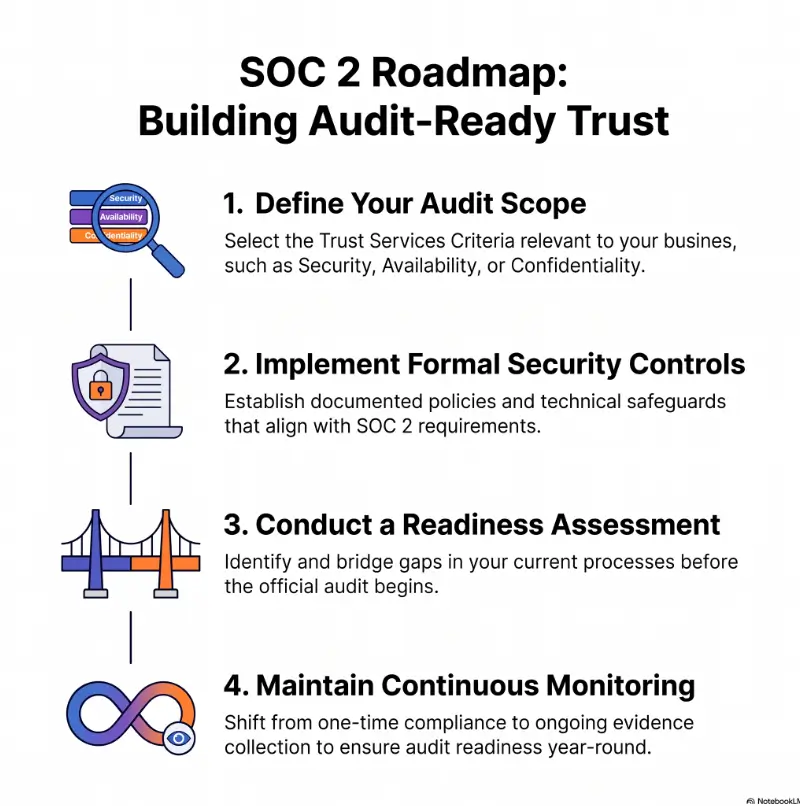
SOC 2 readiness flow
Define product, data, vendors, teams, and criteria.
Map policies to daily access, change, vendor, and incident work.
Collect proof by owner, frequency, system, and timestamp.
Fix gaps before audit fieldwork turns them into drama.
Use accurate documents to support buyer confidence.
Show me the nerdy details
A clean evidence matrix often has these columns: control ID, control description, owner, frequency, source system, evidence artifact, population, sample logic, last performed date, exception notes, and remediation status.
For Type 2 readiness, the awkward questions are usually about completeness. Did the control operate for every required period? Did every new hire complete onboarding steps? Were all production access users included in the access review? Were all high-risk vendors reviewed, or only the easy ones?
That is why mature evidence feels less like a folder and more like a map. It shows what happened, when it happened, who did it, and what changed if something failed.
Access Controls: The Small Doors Buyers Inspect First
Access controls are where startup trust becomes visible. Buyers want to know that only the right people can reach the right systems for the right reasons. Auditors want to see that this is not merely a noble sentence in a policy document.
For an early-stage team, the goal is practical discipline: MFA, least privilege, clear onboarding, fast offboarding, periodic review, and special care for admin access.
MFA for Admin and Cloud Systems
Multi-factor authentication should be required for important systems, especially identity providers, cloud infrastructure, code repositories, password managers, email, HR systems, support tools, and production administration.
Do not stop at “most people use MFA.” For SOC 2 readiness, you need to know where MFA is enforced, who is exempt, why any exception exists, and how exceptions are reviewed.
Least Privilege for Employees and Contractors
Least privilege means people get the access they need to do their job, not the access that seemed convenient during onboarding. In startups, privilege often spreads quietly because everyone is moving fast and wearing six hats.
Contractors deserve special attention. Limit duration, scope, and data exposure. If a contractor leaves but still has access to a repository, analytics dashboard, or shared support inbox, that is not a small housekeeping issue. It is a trust crack.
Joiner, Mover, Leaver Reviews
Access control is a lifecycle. Joiners need approved access. Movers need role changes. Leavers need timely removal. The “mover” category is easy to forget in small companies because job roles evolve faster than titles.
Create a checklist for each stage. Keep it short. Tie it to HR, contractor management, or founder approval. A three-step process that is always followed beats a 28-step ceremony that dissolves by Friday.
Quarterly Access Reviews Without Spreadsheet Chaos
Quarterly access reviews can be simple. Export user lists from critical systems, compare them against current staff and contractor roles, document reviewer decisions, remove unnecessary access, and retain proof.
If you use spreadsheets, standardize them. If you use a compliance tool, confirm it pulls the right systems and does not create a false sense of completeness. The review is only as good as the population being reviewed.
Access review quick test
- Can you list every user with production access?
- Can you explain why each admin user needs that role?
- Can you show who approved access?
- Can you prove leavers were removed on time?
- Can you identify shared accounts and service accounts separately?
Cloud, Code, and Change: The Startup Control Triangle
In SaaS startups, many SOC 2 conversations eventually return to three places: cloud configuration, code changes, and vulnerability follow-up. This is the control triangle where engineering reality meets audit evidence.
You do not need a castle with flaming moats. You need a repeatable way to prevent obvious mistakes, review important changes, and respond when weaknesses are found.
Cloud Configuration Baselines
Cloud baselines define the minimum acceptable setup for your infrastructure. They may include MFA, logging, encryption, network restrictions, backup settings, monitoring, secrets handling, and administrative roles.
A small startup can begin with a documented baseline and periodic review. As the environment grows, infrastructure-as-code, configuration monitoring, and cloud posture tools may become worth the cost.
Pull Request Reviews and Deployment Approval Trails
Pull request review is often a natural control because it already lives inside engineering work. The key is making sure the review process matches the policy.
If your policy says all production changes require review, then direct commits to production branches, emergency changes, and infrastructure changes need a defined path. Auditors may ask for a sample of changes and evidence that the control operated.
Vulnerability Scanning and Patch Follow-Up
Vulnerability scanning is useful only if findings are triaged and tracked. A scan report sitting untouched in a folder has the nutritional value of cardboard.
Create severity definitions, remediation targets, owner assignment, exception handling, and closure evidence. If a vulnerability cannot be fixed immediately, document the risk decision and compensating controls.
Emergency Changes Without Audit Panic
Startups need emergency changes. Systems break. Customers wait. Engineers act quickly. SOC 2 does not require pretending emergencies never happen.
What matters is having an emergency change process: document what happened, who approved it, why the normal path was bypassed, what testing occurred, and whether retrospective review was completed.
| Control area | Good | Better | Best |
|---|---|---|---|
| Cloud configuration | Manual baseline checklist | Scheduled review with owner and evidence | Automated monitoring with tracked exceptions |
| Code review | Pull requests required for main branch | Approval rules and linked tickets | Policy-aligned workflow with tested emergency path |
| Vulnerability management | Periodic scans | Ticketed triage and remediation targets | Risk-based SLA, metrics, and exception review |
| Secrets management | Password manager for human secrets | Centralized secrets store for apps | Rotation, access review, and monitoring |
Vendor Risk: Your Quiet Liability Chain
Vendor risk is easy to underestimate because vendors often arrive one harmless subscription at a time. A support tool here, an analytics tool there, a logging tool somewhere in the machinery. Soon your customer data has a travel itinerary.
SOC 2 readiness should include a vendor inventory, approval process, risk ranking, and recurring review. This does not have to be heavy, but it must be real.
Identify Vendors That Touch Customer Data
Start with vendors that process, store, transmit, secure, monitor, support, or analyze customer data. Include cloud providers, email systems, support platforms, logging tools, analytics products, payment processors, CRM systems, file storage, HR systems, and AI tools if customer data can enter them.
For each vendor, document the data type, business purpose, owner, access method, contract status, and security review status. If no one can explain why a vendor exists, that is a useful discovery.
Collect SOC Reports, DPAs, and Security Pages
For critical vendors, collect relevant assurance documents. This may include SOC reports, data processing agreements, security documentation, privacy terms, subprocessors, penetration test summaries, or compliance pages.
Do not merely download the document and declare victory. Review whether the report period is current, whether the services used by your company are covered, whether exceptions matter, and whether complementary user entity controls apply to you.
Rank Vendors by Data Sensitivity
A vendor that hosts production data deserves a deeper review than a design tool used for public marketing graphics. Rank vendors by data sensitivity, system importance, access level, business dependency, and customer impact.
This makes the vendor program manageable. Your team can apply deeper review to critical vendors and lighter review to low-risk tools.
Review Critical Vendors on a Set Cadence
Set a recurring cadence for critical vendor review. Annually is common for many startups, but your cadence should reflect risk, contracts, and audit scope.
During review, confirm the vendor is still needed, the owner is current, the data use is unchanged, security documents are refreshed, and any concerns are documented. Vendor review is less glamorous than product launch day, but it keeps trust from leaking through side doors.
Key takeaway
Vendor management is not about collecting logos. It is about knowing who touches customer data, why they touch it, what proof they provide, and when you last checked.
Tools, Costs, and Paid Help: Spend Where the Audit Friction Actually Lives
SOC 2 has become a software market as much as a compliance exercise. That can be helpful. It can also tempt a startup into buying automation before it knows what needs automating.
The best way to choose SOC 2 tools or services is to identify your real friction: scoping, policy writing, evidence collection, access reviews, vendor management, auditor coordination, security remediation, or buyer communication.
When a Free DIY Approach Is Enough
A very early startup may not need paid compliance software on day one. If you have a small team, few critical systems, and no immediate audit deadline, you can start with a scoped inventory, policy drafts, access review spreadsheet, vendor register, ticketing workflow, and evidence folder.
DIY works best when someone has the time and judgment to manage it. If the founder is also the sales lead, product owner, security owner, and emergency plumber of the company, DIY can quietly decay.
When Paid Compliance Software May Be Worth It
Paid compliance platforms can help when you need automated evidence collection, system integrations, control mapping, vendor workflows, task reminders, auditor collaboration, and reusable security questionnaire answers.
Before buying, ask which systems the platform integrates with, how evidence is collected, how exceptions are handled, whether your auditor accepts the evidence format, and how much manual cleanup remains. A tool that creates beautiful dashboards but misses half your systems is a chandelier in a server closet.
When a Consultant or vCISO Can Save Money
Professional help may be worth considering when scope is unclear, buyer pressure is high, the team lacks security leadership, or the audit timeline is tight. A good consultant or vCISO can help translate audit expectations into practical startup controls.
Be careful with providers who promise easy compliance without asking hard questions. Useful help should clarify tradeoffs, identify evidence gaps, and leave your team with operating habits, not just polished documents.
What to Ask Before Paying
Whether you are comparing software, audit firms, readiness consultants, or security service providers, ask practical questions before signing.
- What specific SOC 2 problem does this solve for our team?
- Which systems are integrated, and which remain manual?
- How are control exceptions tracked?
- Will this support Type 2 evidence over time?
- How much founder, engineering, and operations time is still required?
- Can we export evidence if we switch providers later?
- Does the provider understand startup SaaS environments?
- Will customer-facing claims be reviewed for accuracy?
| Option | Best fit | Budget impact | Watch out for |
|---|---|---|---|
| DIY checklist and spreadsheets | Small teams exploring readiness | Lowest direct cost, higher time cost | Missed evidence, unclear ownership |
| Compliance software | Teams needing recurring evidence and integrations | Subscription cost plus setup time | Automation gaps, unused features |
| Readiness consultant | Teams needing scope, policy, and gap guidance | Project or retainer cost | Generic templates without operational fit |
| vCISO or security lead support | Startups with enterprise pressure and no security owner | Higher cost, potentially high value | Unclear deliverables or limited hands-on execution |
| Auditor-only path | Teams already mature and organized | Audit fee plus internal labor | Discovering gaps too late |
The FTC’s security guidance for businesses is also useful for practical security thinking, especially for teams that need plain-English reminders about risk, access, data minimization, and vendor oversight.
Buyer-Ready Narrative: Turn Controls Into Sales Confidence
SOC 2 readiness should help sales without turning security into theater. The goal is a buyer-ready narrative: clear, accurate, repeatable answers that explain how your company protects customer trust.
Security teams inside larger buyers can usually smell exaggeration from three rooms away. Calm specificity beats heroic adjectives.
Create a Security One-Pager for Prospects
A security one-pager can help prospects understand your current posture before they send a long questionnaire. Keep it factual and reviewed.
- Product and hosting overview
- Data protection summary
- Access control practices
- Encryption summary
- Vendor review process
- Incident response overview
- Audit status and planned milestones, stated carefully
- Contact path for security questions
Prepare NDA-Based SOC Report Sharing
SOC 2 reports often contain sensitive details about systems, controls, exceptions, and vendors. Startups should have a controlled sharing process, often under NDA, with tracking for who received the report.
Do not send reports casually in long email threads. Establish a process with legal, sales, and security so the team knows what can be shared, with whom, and under what conditions.
Explain Gaps Without Sounding Unprepared
Every startup has gaps. The difference is whether you can explain them clearly. A mature answer says what exists now, what risk remains, what mitigation is in place, who owns the next step, and when review will occur.
For example: “We do not currently support customer-managed encryption keys. We encrypt data in transit and at rest, restrict production access, and review access quarterly. We are tracking customer-managed key demand as part of our enterprise roadmap.”
Convert Security Questionnaires Into Reusable Answers
Security questionnaires are not just chores. They are buyer research wearing formal shoes. If the same questions appear repeatedly, they reveal what your market cares about.
Create a reviewed answer library. Each answer should have an owner, source of truth, last-reviewed date, and approved wording. This reduces sales scramble and prevents accidental overpromising.
Key takeaway
A buyer-ready security narrative should be factual, current, and reusable. The best sales enablement is not louder confidence. It is cleaner evidence.
FAQ
What is SOC 2 compliance for startups?
SOC 2 compliance for startups usually means preparing controls and evidence for an independent SOC 2 audit report. For SaaS companies, it often helps enterprise buyers understand how the startup protects systems and customer data.
How early should a startup start preparing for SOC 2?
A startup should start preparing when SOC 2 becomes relevant to sales, customer trust, vendor reviews, or data risk. Many teams begin readiness work months before they need a report because Type 2 evidence requires operating history.
Is SOC 2 legally required in the US?
SOC 2 is generally not a universal legal requirement in the US. It is commonly a customer, vendor, procurement, or market expectation. Some companies may also have contractual or regulatory obligations that affect security and privacy controls, so legal review is wise.
What is the difference between SOC 2 Type 1 and Type 2?
SOC 2 Type 1 evaluates whether controls are suitably designed at a point in time. SOC 2 Type 2 evaluates whether controls operated effectively over a defined period. Buyers often prefer Type 2 because it includes operating evidence.
Which SOC 2 Trust Services Criteria should a startup choose?
Many startups start with Security. Availability, Confidentiality, Privacy, and Processing Integrity should be added when customer commitments, product behavior, data type, or buyer requirements justify them. Confirm the final choice with your auditor.
How much evidence does a startup need before a SOC 2 audit?
It depends on report type, scope, controls, and audit period. A Type 2 audit requires evidence that controls operated over time. Start collecting evidence before the review period begins so you do not discover missing proof after the window opens.
Can a startup pass SOC 2 without compliance software?
Some startups can complete SOC 2 without dedicated compliance software, especially with simple systems and disciplined evidence management. Paid tools may help when integrations, recurring evidence, access reviews, vendor workflows, and task ownership become hard to manage manually.
Who owns SOC 2 inside a small startup?
Ownership varies. A founder, CTO, security lead, operations manager, or vCISO may coordinate the program. However, control ownership should be distributed: engineering owns technical controls, people operations owns onboarding evidence, and leadership owns risk decisions.
Next Step: Run a 30-Minute Scope Meeting Today
The fastest useful move is not buying a tool or drafting a grand policy constitution. It is a focused scope meeting. Put the founder, engineering owner, operations owner, and sales or customer-facing owner in one room for 30 minutes.
Open a blank document. Write the product boundary. List customer data types. Identify critical vendors. Choose likely Trust Services Criteria. Name one owner for each control area. Then create a 90-day evidence calendar.
15-minute starter version
- Write one sentence describing what product the SOC 2 report should cover.
- List the top five systems that touch customer data.
- Name the person who owns access reviews.
- Name the person who owns change management evidence.
- Name the person who owns vendor review.
- Schedule the first evidence review for next week.
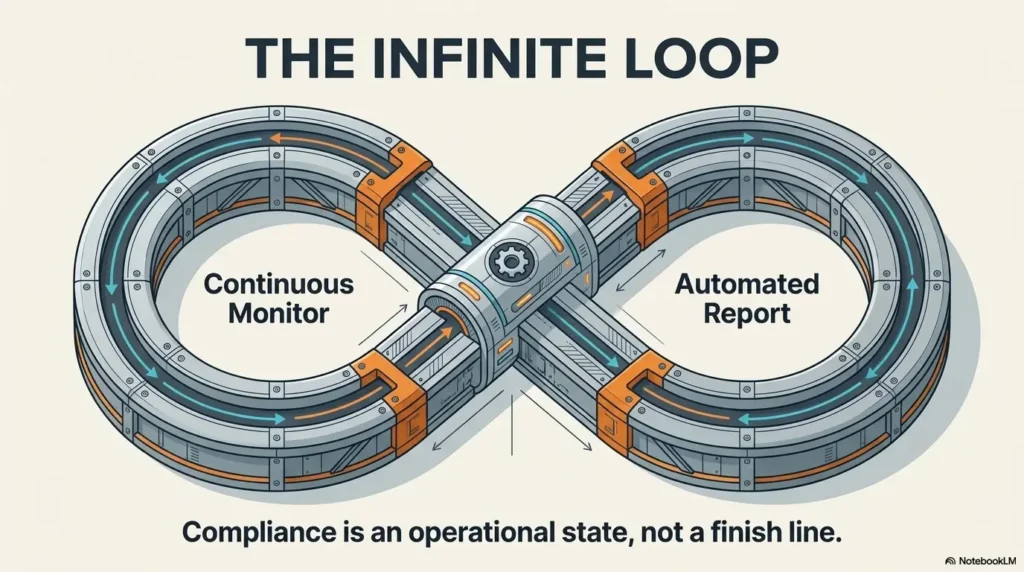
SOC 2 readiness is not a mountain you conquer in one heroic weekend. It is a rhythm: scope, control, evidence, review, improvement. Start with the rhythm today, and the audit stops looking like a thundercloud. It becomes what it should have been all along: proof that your startup can be trusted with the work customers are asking you to hold.
Last reviewed: 2026-08