Nikto vs Nmap NSE: Selection and Request Scope

Compare Nikto and Nmap NSE by the specific permitted question and checks selected. Record tool revisions, request scope and potential side effects, then review the evidence each run actually produces.

Practical cybersecurity guides, labs & compliance
Compare Nikto and Nmap NSE by the specific permitted question and checks selected. Record tool revisions, request scope and potential side effects, then review the evidence each run actually produces.
Compare Dirb and Gobuster with the target context, wordlist, recursion, filters and pacing recorded. Use response baselines and candidate validation to assess coverage rather than treating a larger result count as better evidence.
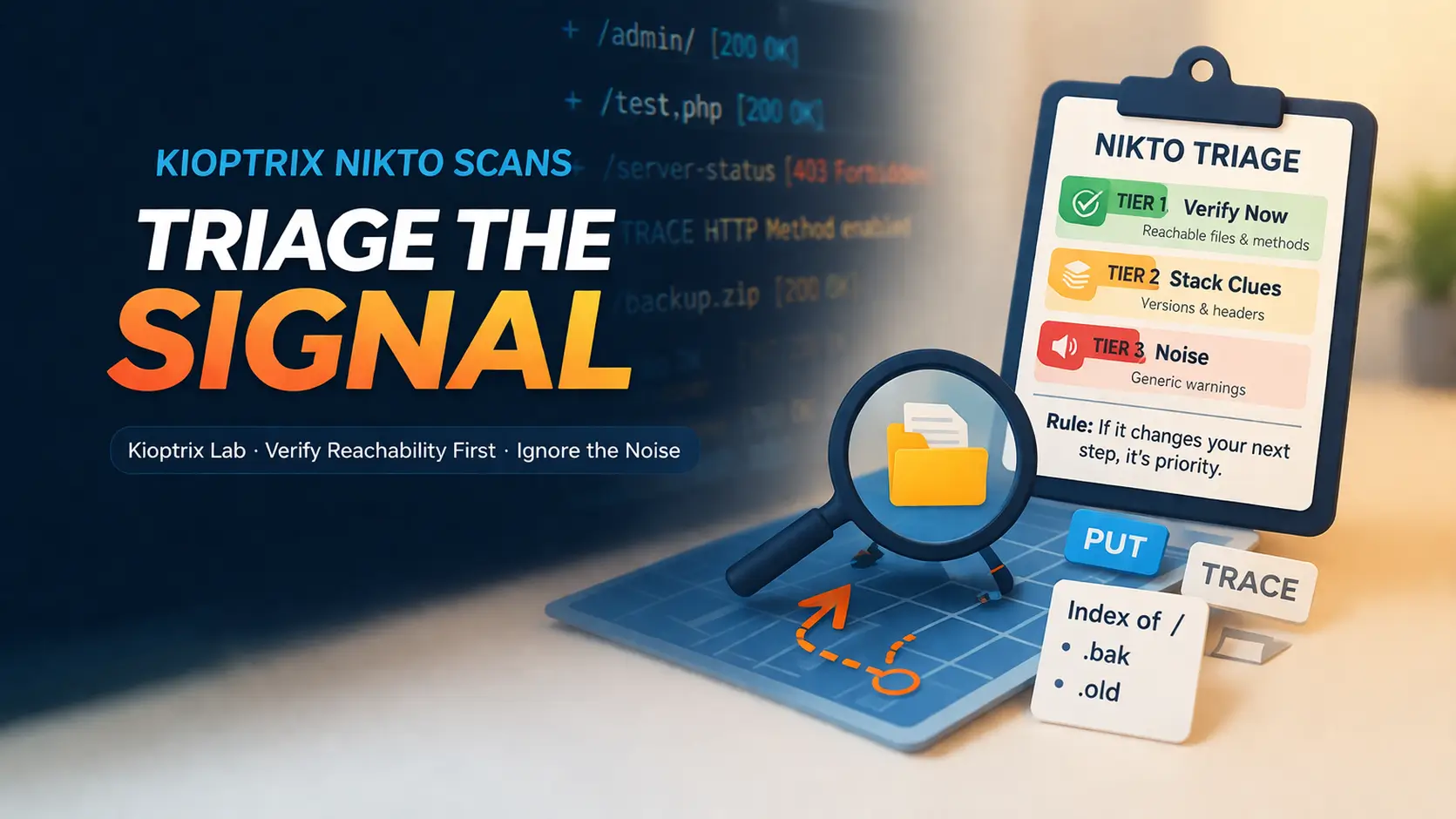
Review Nikto alerts as candidates by preserving request context and checking the matching response. Use the interpretation table and finding record to assess applicability, missing prerequisites and a proportionate next check.
Map HTTP, application and database clues without assuming they form a confirmed LAMP stack. Use the dependency record to separate endpoint observations, product evidence and provisional relationships.
Review a Nikto alert against its exact request, response and a relevant baseline. Use the disposition record to distinguish a supported finding, a false positive and an unresolved question without forcing a disruptive proof.
Interpret Apache scan clues with the exact request, hostname context, redirects and raw response. Use the origin review to distinguish frontend or proxy behavior from verified server-build information.
Compare legacy Apache responses with the destination, hostname, TLS context and path recorded. Use the comparison record to separate virtual-host selection and server clues from verified build or patch information.
Compare FFUF wordlists under the same request conditions, candidate normalization and workload limits. Use response baselines and a recorded filter rule to review useful coverage, missed candidates and uncertainty.