Kioptrix Level Apache Enumeration for Legacy Linux Web Servers

Kioptrix Apache enumeration

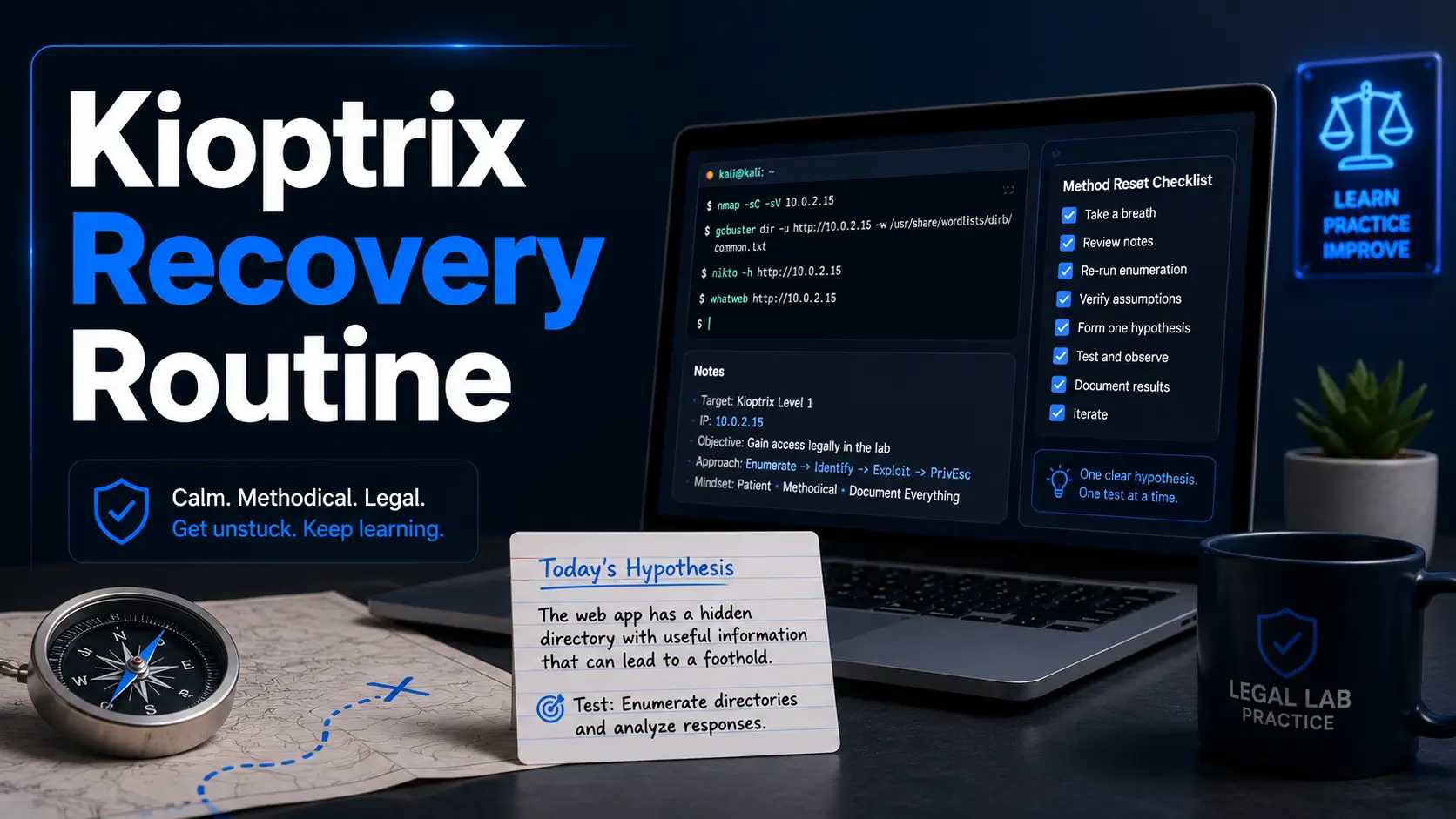
Mastering Kioptrix: The Art of Apache Enumeration Kioptrix Level Apache enumeration is the kind of work that looks dull right before it saves you from wandering in circles. On legacy Linux web servers, the biggest clue is often not a dramatic flaw. It is a default page, a stray header, an SSL detail, or a … Read more

Kioptrix SMB Protocol Negotiation Failed on Modern Kali: smb.conf Client Settings That Fix It

Kioptrix SMB negotiation failed on Kali

Mastering Legacy SMB Protocol Negotiation On a modern Kali box, one stale SMB assumption can waste an hour faster than a bad password ever will. The classic Kioptrix SMB protocol negotiation failed error usually isn’t a dead service; it’s a modern Samba client refusing to speak an older dialect the target still expects. Instead of … Read more

Kioptrix read-only SMB share exploitation: finding writable subpaths via recursion (lab-only)

read-only SMB share exploitation

Beyond the Read-Only Label: Precision SMB Exploitation In Kioptrix-style labs, a read-only SMB share is often just the first misleading layer. The true vulnerability frequently lives one or two folders deeper, hidden beneath the surface of a restrictive share summary. “Share permissions and NTFS ACLs do not always agree. Writable pockets can hide inside an … Read more

Chisel vs Ligolo-NG: Use-Case Selection Table for Port Forwarding & Proxying (Pick the Right Tunnel Fast)

Chisel vs Ligolo-NG

Silent Failures & Network Primitives At 2:07 AM, tunnels don’t fail loudly. They fail quietly, with the exact kind of “it should work” confidence that ruins sleep. If you’re choosing Chisel vs. Ligolo-NG for port forwarding and proxying, the real mistake isn’t picking the “wrong” tool. It’s picking the wrong network primitive and then spending … Read more

Ligolo-NG Setup Guide: Troubleshooting Tunnel Failures in NAT Environments (Without Guessing)

Ligolo-NG setup guide

Ligolo-NG Setup Guide Solving the NAT-induced “Velvet Curtain” effect. “Agent connected.” Tunnel started. Then every packet you send into the internal network evaporates like it hit a velvet curtain. The fastest way out is not another restart, not another route you half-remember. It’s a 5-minute truth test that tells you which layer is lying. This … Read more

Pen Test Report Reading Guide for Founders: The “Ignore This and You’re in Trouble” Items

how to read a penetration test report

The Dangerous Reality of Penetration Test Reports The most dangerous line in a penetration test report is not “Critical.” It’s “Medium” paired with a screenshot that quietly proves an attacker path. If you’re a founder, you didn’t pay for a PDF so you could debate CVSS scores at midnight. You paid to find the few … Read more

Bug Bounty vs Pentest vs Continuous Scanning: Why the Order of Stages Decides Your Security ROI

security testing strategy

Security Operations: Why Sequencing Trumps Tools Most security programs don’t break from lack of effort. They break from bad sequencing. Teams run continuous scanning, pentesting, and bug bounty in the wrong order, then wonder why the same high-risk issues keep resurfacing with new invoices attached. For US B2B teams, the pain is painfully familiar: scanner … Read more

Pen Test Statement of Work (SOW) Template: 12 Clauses Every Startup Must Include

Pen Test SOW Template

The Startup-Proof Pen Test Statement of Work (SOW) A penetration test can be “done” and still leave you exposed—not because the technical findings failed, but because the contractual guardrails weren’t there. Built for the moment every startup hits: one extra endpoint, one vague rule, or a report filled with screenshots but zero answers. If your … Read more

OSCP Exam Time Management: A 24-Hour Schedule (Hour-by-Hour) + Pivot Rules

The Operator’s Playbook: Beyond the Hour 19 Wall At hour 19, the exam doesn’t beat you with a “hard box.” It beats you with a folder named final-final2, one missing screenshot, and the quiet lie that you’ll “remember it later.” This is what OSCP pressure actually looks like: you have signals everywhere—ports, banners, half-working creds—but … Read more

OSCP Nmap Host Discovery When Ping Fails: -Pn vs -sn (What Changes in Real Labs)

Nmap

Taming the “Host Seems Down” Ghost: A Guide to Reliable OSCP Enumeration There’s a special kind of OSCP lab misery where you know the box exists—yet Nmap stares back with “0 hosts up.” You don’t just lose minutes. You lose momentum, then judgment, then the whole rhythm of enumeration. The Truth: Most “ping failed” moments … Read more