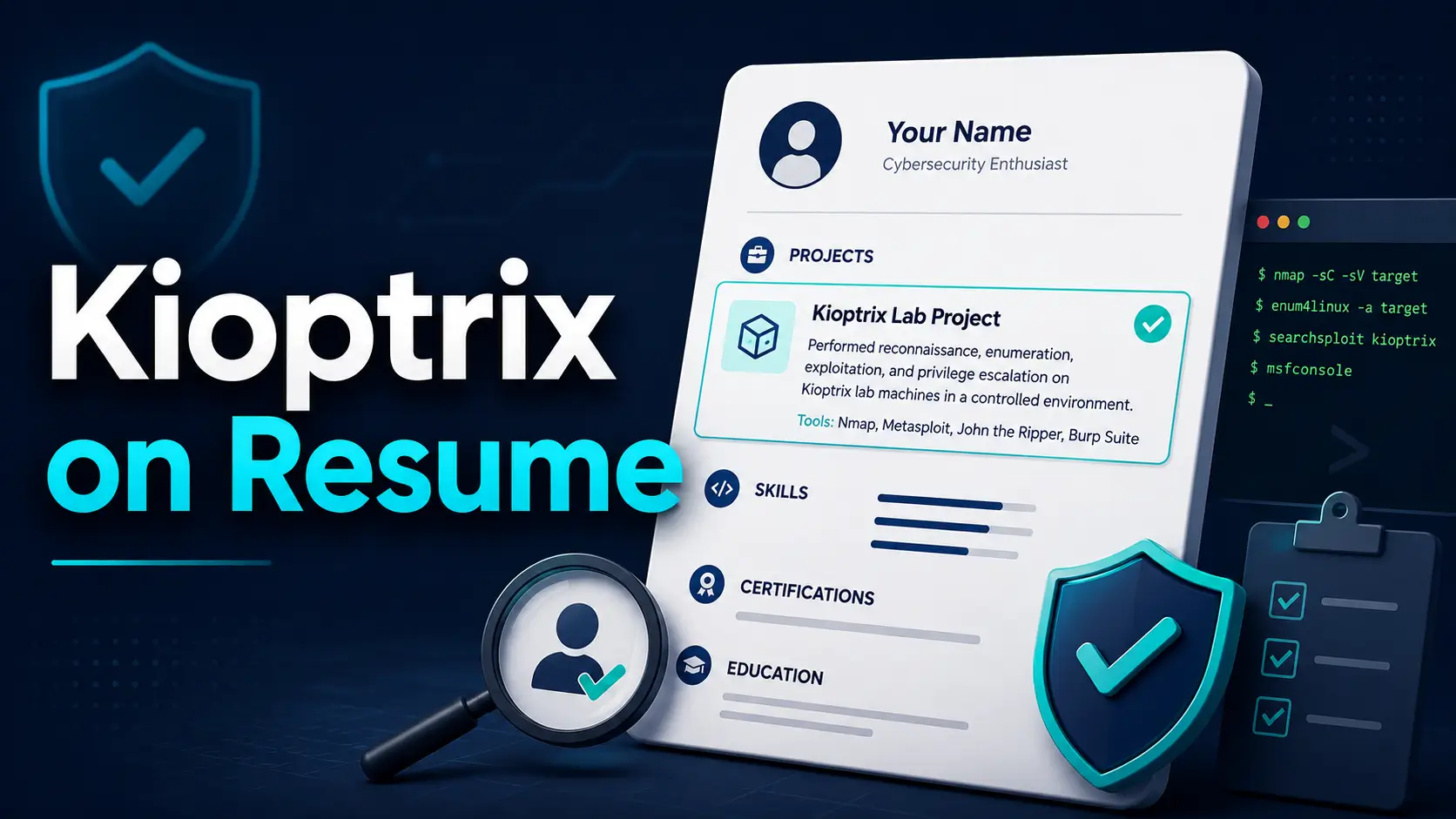
Small Line. Big Signal.
A Kioptrix line on a resume can do two very different things. Written well, it says, “I practice carefully, document my work, and understand security basics.” Written badly, it says, “I watched one walkthrough at midnight and now own a tiny cyber cape.”
For entry-level cybersecurity job seekers, IT career changers, students, and home-lab learners, the challenge is not whether Kioptrix is worth mentioning. It often is. The challenge is positioning it as a hands-on cybersecurity lab project, not as professional penetration testing experience.
Guessing costs you credibility. Overclaiming can make a recruiter nervous. Underexplaining can make useful practice disappear into resume fog.
Kioptrix Resume Positioning in One Box
Use Kioptrix as project evidence, not job experience. A strong resume bullet should name the lab, describe the authorized local environment, identify the practical skills used, and point to proof such as a sanitized report, GitHub README, or technical journal.
- Best section: Cybersecurity Projects, Home Lab, or Technical Projects.
- Best wording: completed, documented, analyzed, validated, reported.
- Risky wording: hacked, owned, professional pentest, real-world attack.
- Best proof: a clean write-up that explains decisions, not just commands.
Table of Contents
The Resume Problem: Kioptrix Sounds Impressive, Until It Sounds Inflated
Kioptrix is useful because it gives beginners a contained place to practice vulnerability assessment, enumeration, exploit validation, privilege escalation, and documentation. That is the good news.
The awkward news: a resume is not a campfire story. Recruiters and hiring managers do not need a dramatic “I rooted the box” line. They need to understand what you actually practiced, how you approached the problem, and whether you can explain it without smoke machines.
Why “rooted Kioptrix” is not enough
“Rooted Kioptrix” may sound exciting inside a Discord channel. On a resume, it is too thin. It tells the reader the ending, not the work. It leaves out your environment, your process, your constraints, your notes, and your judgment.
A stronger resume line translates the lab into workplace language:
- What did you enumerate?
- How did you validate findings?
- What did you document?
- What would you recommend fixing?
- What evidence can you show?
That shift matters. Security teams hire people who can communicate risk, not just collect screenshots like trading cards.
What recruiters actually need to understand
A recruiter may not know the exact Kioptrix level. A technical interviewer probably will. Your resume has to serve both readers. The recruiter needs plain language. The technical reviewer needs enough specificity to trust that you touched the keyboard yourself.
Good wording sits in the middle: clear enough for HR, concrete enough for security.
- Name the lab as an authorized practice environment.
- Describe the techniques in ordinary professional language.
- Connect your work to evidence, reporting, or remediation thinking.
Apply in 60 seconds: Replace “rooted Kioptrix” with “completed and documented a vulnerable VM lab focused on enumeration, exploit validation, and privilege escalation.”
The credibility test: skill, scope, evidence
Before you add Kioptrix to your resume, run it through three little gates:
- Skill: Can you name what you practiced without hiding behind tool names?
- Scope: Can you state that it was a local authorized lab, not paid client work?
- Evidence: Can you show notes, a report, a README, or a short case study?
If the answer is yes, Kioptrix can belong on your resume. If not, it may need one more practice session and a calmer cup of coffee.
Money Block: Resume Eligibility Checklist
Use this yes/no check before adding Kioptrix to your resume.
| Question | Yes means | No means |
|---|---|---|
| Did you complete the lab yourself? | You can discuss your own process. | Redo it without copying a walkthrough. |
| Do you have notes or a report? | You have proof beyond memory. | Create a short sanitized write-up first. |
| Can you explain the main finding? | You are ready for interview follow-up. | Review the method, not just the commands. |
| Did you keep the wording ethical? | The line is safer to publish. | Add “authorized local lab” language. |
Neutral action: If you answered “no” twice or more, improve the proof before adding the bullet.
Who This Is For, and Who Should Skip It
Kioptrix is most useful on a resume when it fills a real evidence gap. Early in a security career, that gap can be wide enough to park a moving truck in it. Lab work gives you something concrete to discuss before you have paid security experience.
Good fit: entry-level security, SOC, IT support, junior pentest, internship applicants
If you are applying for a SOC analyst role, IT support job with security duties, junior security internship, or beginner pentest-adjacent position, Kioptrix can show initiative. It says you did more than watch theory videos. You set up a lab, worked through friction, wrote notes, and practiced structured thinking.
That matters because entry-level resumes often look strangely similar: Security+, TryHackMe, a college project, maybe a help desk job, and a skills section crowded with tools. A well-framed Kioptrix project can give your resume a pulse.
Good fit: career changers building proof before paid experience
Career changers need bridges. Kioptrix can be one plank on that bridge, especially if your previous work involved troubleshooting, documentation, systems support, QA, customer support, military work, or teaching.
The bridge gets stronger when you connect the lab to transferable skills:
- following a method under uncertainty
- documenting evidence clearly
- explaining technical risk to a non-specialist
- checking assumptions before acting
If you are building a broader routine, pairing the resume bullet with a steady practice record such as a 30-day Kioptrix practice routine can make your story more believable.
Not ideal: senior roles where lab work crowds out real incident, client, or production experience
If you already have years of professional security work, Kioptrix should rarely take premium resume space. Senior resumes need impact: incidents handled, vulnerabilities reduced, controls improved, cloud systems secured, audits supported, teams led.
A lab can stay in a portfolio, but it should not push aside production outcomes. At that level, Kioptrix becomes seasoning, not the meal.
Let’s be honest: one VM is a spark, not a bonfire
One completed VM does not make someone a penetration tester. It does show curiosity and grit. Those are not small things, but they need proportion.
Think of Kioptrix as a small candle in a dark room. Useful. Visible. Not a lighthouse yet.
The Best Resume Section for Kioptrix: Projects, Labs, or Technical Experience?
Where you place Kioptrix affects how the reader interprets it. The safest default is a project section. It gives the work a home without implying employment.
Use “Cybersecurity Projects” for early-career resumes
A “Cybersecurity Projects” section is clean, honest, and easy to scan. It lets you place Kioptrix near other proof such as a home lab, detection project, report-writing sample, or vulnerability management exercise.
Example section label:
- Cybersecurity Projects
- Security Home Lab Projects
- Technical Projects
- Hands-On Security Labs
The plainness is a feature. No velvet rope needed.
Use “Home Lab” when Kioptrix is part of a larger practice environment
If Kioptrix sits inside a repeatable lab setup with Kali, VirtualBox or VMware, snapshots, private networking, documentation, and session reviews, “Home Lab” may be better.
This works especially well if you have related content such as a Kioptrix network setup, a snapshot strategy for lab recovery, or a repeatable Kioptrix session routine.
Use “Technical Skills” only for tools, not the whole story
Your skills section can mention tools used during Kioptrix, such as Nmap, Nikto, Burp Suite, Metasploit, Linux, and basic scripting. But the Kioptrix project itself should not be crammed into a skills list.
Tools alone do not show judgment. A hundred tool names on a resume can feel like a junk drawer with a keyboard.
Avoid hiding it under certifications
Kioptrix is not a certification. Do not place it under “Certifications” or write it in a way that looks like a credential. That creates confusion and can make the rest of your resume feel less trustworthy.
Money Block: Section Placement Decision Card
| Use this section | When it fits | Trade-off |
|---|---|---|
| Cybersecurity Projects | You are early-career and need proof of practice. | Best all-around choice, but keep it concise. |
| Home Lab | You have multiple labs, notes, and repeatable setup. | Stronger story, but needs evidence. |
| Technical Skills | You only need to list tools used. | Too shallow for the full project. |
| Certifications | Almost never. | Can look misleading. |
Neutral action: Put Kioptrix under “Cybersecurity Projects” unless your resume already has a stronger “Home Lab” section.
The One-Line Formula That Keeps You Credible
A good resume bullet does not need to be ornate. It needs to be defensible. You should be able to read it aloud in an interview and feel your blood pressure remain friendly.
Formula: lab name + objective + techniques + outcome + evidence
Use this structure:
Completed [lab name] in [authorized environment] to practice [objective], using [techniques/tools], producing [outcome/evidence].
That formula keeps you anchored. It prevents two common problems: sounding too vague or sounding like you conducted a professional client engagement when you did not.
Example bullet for Kioptrix Level 1
- Completed Kioptrix Level 1 in an authorized local VM lab, practicing network discovery, service enumeration, exploit validation, and Linux privilege escalation; documented methodology and remediation notes in a sanitized report.
This line works because it names the environment, the skills, and the output. Use it only for work you actually completed. For partial work, write “Practiced service enumeration in Kioptrix Level 1” and name the stopping point. For guided work, state that you used a walkthrough and explain what you later reproduced yourself. Claim log analysis or tested detections only if you actually collected logs or tested the rules; otherwise describe them as proposed log sources and detection ideas.
Example bullet for multiple Kioptrix levels
- Completed multiple Kioptrix vulnerable VM labs to build a repeatable assessment workflow, including reconnaissance, web and SMB enumeration, vulnerability research, privilege escalation review, and post-lab reporting.
If you completed several levels, avoid turning the bullet into a scoreboard. The number matters less than the pattern you built. If you tracked your work, a Kioptrix progress tracker can support that story.
Example bullet for a SOC-leaning resume
- Reviewed Kioptrix lab steps from a defender’s perspective, proposing relevant log sources, detection opportunities, and remediation notes.
This version is useful when you are not applying to offensive security roles. It turns the same lab into a detection and analysis exercise.
Show me the nerdy details
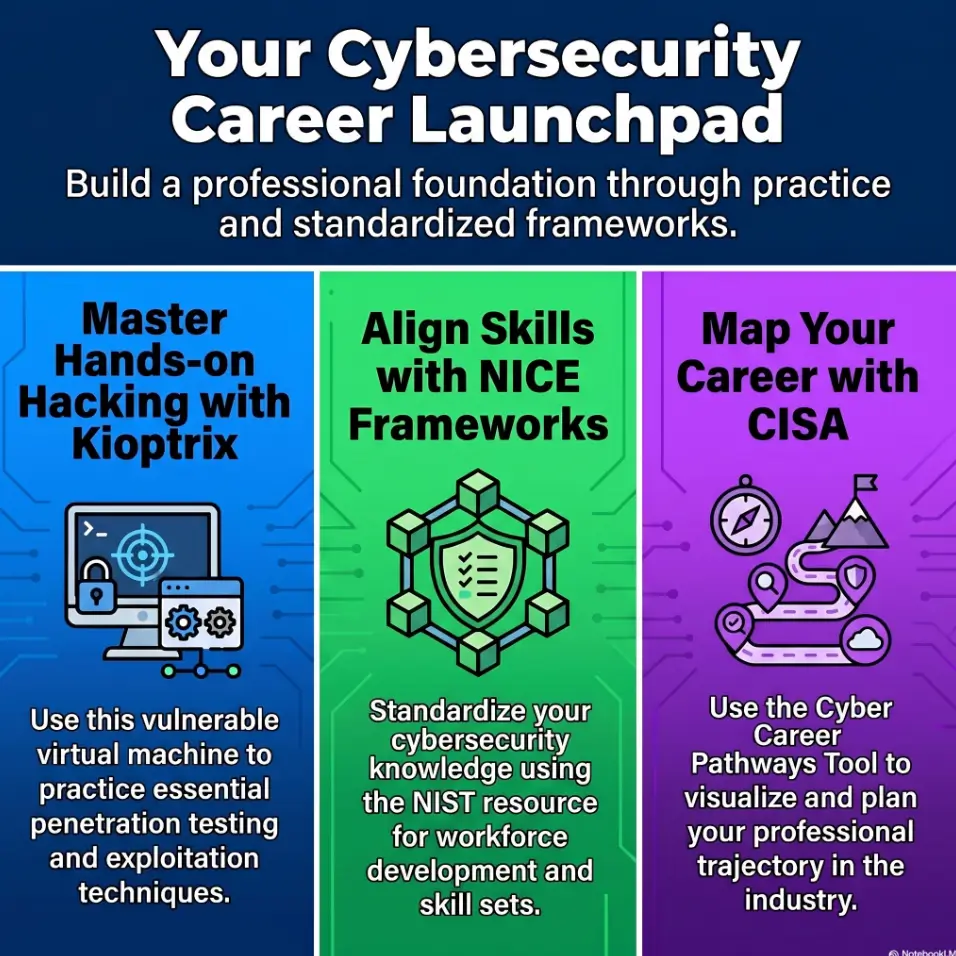
The strongest resume bullets translate lab work into work-role language. NIST’s NICE Framework describes cybersecurity work through tasks, knowledge, and skills. A Kioptrix lab is not a job role by itself, but it can support skill claims when you map your activity to clear actions: discovering assets, identifying services, validating a vulnerability, documenting evidence, explaining risk, and recommending remediation. That mapping is why “completed Kioptrix Level 1 and wrote a report” is stronger than “used Nmap, Nikto, Metasploit, and Linux.” The first shows a work pattern. The second is only an equipment list.
Say This, Not That: Resume Phrases That Pass the Sniff Test
Cybersecurity language has a scent. Some words smell like discipline. Some smell like a hoodie in a movie poster. Resume writing is partly odor control.
Say: “Completed vulnerable VM lab focused on enumeration and privilege escalation”
This phrase is simple and accurate. It tells the reader the format and the purpose. It also avoids implying that you performed security testing against a real organization.
Avoid: “Performed professional penetration test”
Professional penetration testing usually involves scope, authorization, rules of engagement, reporting standards, client communication, legal boundaries, and business risk. Kioptrix can teach pieces of the technical workflow, but it is not the same thing.
Better:
- Practiced penetration testing methodology in an authorized local lab.
- Completed vulnerable VM lab and documented findings in report format.
- Built beginner assessment workflow using recon, enumeration, validation, and remediation notes.
Say: “Documented methodology and remediation notes”
This phrase is quietly powerful. Documentation is where many beginners lose the plot. A clean report shows you can think after the terminal scroll stops.
If writing reports is still new, build from a simple Kioptrix lab report format or use report writing tips for Kioptrix practice to make your evidence easier to scan.
Avoid: “Hacked Linux server”
That wording is noisy and vague. It may be true in a casual sense, but it does not help your resume. It also risks sounding careless.
Better:
- Validated known vulnerabilities in a vulnerable Linux VM within an isolated lab.
- Practiced Linux privilege escalation basics and documented root-cause notes.
- Analyzed exposed services and mapped findings to practical remediation steps.
Here’s what no one tells you: boring language often sounds more senior
Senior security people often sound almost disappointingly calm. They say “validated,” “observed,” “documented,” “scoped,” “triaged,” and “recommended.” They do not need thunderclaps.
Use the calm verbs. They carry the candle.
- Use professional verbs: analyzed, documented, validated, mapped, reported.
- Avoid edgy verbs: hacked, owned, pwned, attacked.
- Make the lab context visible so nobody misreads the scope.
Apply in 60 seconds: Search your resume for “hacked,” “owned,” or “pentest” and replace any inflated phrase with authorized-lab language.
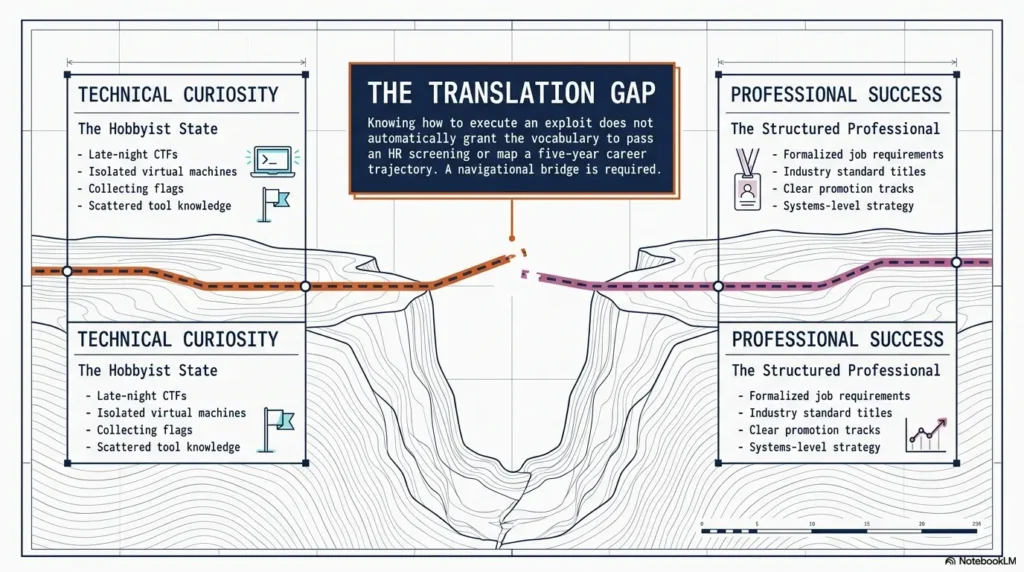
Common Mistakes That Make Kioptrix Look Like Resume Padding
Kioptrix becomes resume padding when it is listed without proof, judgment, or relevance. The line looks decorative, like a tiny cybersecurity sticker slapped on a suitcase.
Mistake 1: Listing tools without describing decisions
“Nmap, Nikto, Burp, Metasploit, Linux” is not a project. It is a pile. Tools matter, but decisions matter more.
Try this instead:
- Used Nmap service detection to prioritize exposed services for manual review.
- Compared automated findings against manual enumeration before validating risk.
- Recorded false starts and adjusted the testing path based on evidence.
If enumeration is the weak spot, review a repeatable Kioptrix enumeration process before writing the bullet.
Mistake 2: Claiming “penetration tester” from one boot-to-root box
One boot-to-root lab is practice. It is not a job title. You can say you practiced penetration testing methodology. You should not imply you performed professional penetration tests unless you actually did.
Mistake 3: Publishing copy-paste walkthroughs with no reflection
A copied walkthrough is easy to spot. The commands appear, the thinking does not. Add reflection: why you tried a path, what failed, what you would check earlier next time, and how a real system owner might fix the issue.
A short Kioptrix session review can turn a routine lab into proof of learning.
Mistake 4: Forgetting remediation, detection, or business impact
Even offensive practice should end with defensive thinking. What would reduce the risk? Patch? Disable a service? Restrict network exposure? Improve logging? Change credentials? Segment the environment?
Remediation language makes your lab feel less like a trophy shelf and more like security work.
Mistake 5: Using edgy wording that makes recruiters nervous
Recruiters are not allergic to technical skill. They are allergic to risk. Words that sound reckless can create doubt, especially for junior candidates.
You want the reader thinking: “This person has discipline.” Not: “Will this person run scans against production because curiosity sneezed?”
Add Proof Without Turning Your Resume Into a Walkthrough
Your resume should not become a step-by-step exploit guide. It should point to proof. The proof can live in GitHub, a personal portfolio, or a sanitized PDF report.
Link to a clean GitHub repository
A good GitHub repo for Kioptrix does not need fireworks. It needs structure:
- README with lab scope and authorization statement
- environment summary
- methodology overview
- key findings
- remediation notes
- lessons learned
If your notes are scattered, start with Kioptrix documentation habits or a technical journal for Kioptrix practice. Recruiters may not read every line, but a clean repo tells a story before anyone opens a file.
Include a sanitized PDF report
A PDF report is useful if you want to show technical communication. Keep it short. A beginner-friendly lab report can be five to seven pages, not a novel that grows moss.
Suggested report structure:
- Executive summary
- Lab scope
- Environment
- Methodology
- Findings
- Remediation recommendations
- Lessons learned
Add screenshots only if they explain process, not trophy-hunting
Screenshots should clarify. They should not scream. Use them to show evidence, decision points, and report quality. Avoid stuffing in every terminal window.
A good screenshot has a caption that explains why it matters. A bad screenshot is just green text wearing sunglasses.
Keep exploit details responsible and educational
Kioptrix is a vulnerable lab, and many walkthroughs already exist. Still, your portfolio should stay professional. Avoid weaponized framing. Keep commands limited to the authorized lab context. Do not include real target data, personal credentials, or anything that suggests unauthorized testing.
Tiny proof, big signal: a short README can carry the candle
A short README can outperform a long, messy write-up. Hiring readers often skim. Give them structure, clarity, and one or two evidence links.
Short Story: The README That Changed the Interview
Maya had completed Kioptrix Level 1, but her first resume bullet sounded like it had been written during a sugar rush: “Hacked vulnerable Linux machine and got root.” She was proud, but the line made her uneasy. So she rewrote it. She added “authorized local VM lab,” named the techniques, and linked a short README. The README did not reveal a dramatic secret.
It simply showed her scope, process, notes, one screenshot, and three remediation ideas. In the interview, the hiring manager skipped the flashy tool list and asked about her documentation. Maya explained why she checked one service before another, what she misunderstood at first, and how she would explain the risk to a small business owner. The room changed. She was no longer trying to sound like a hacker. She sounded like a learner who could be trusted with real systems someday.
Money Block: Proof Prep List
Gather these before you add a portfolio link to your resume.
- One-sentence lab scope: authorized, local, isolated VM environment.
- Tool list with purpose, not just names.
- Three to five process steps written in plain English.
- One sanitized screenshot that supports a finding.
- Two remediation notes.
- One lesson learned that shows reflection.
Neutral action: Build the proof first, then write the resume bullet from that proof.
What Skills Kioptrix Can Credibly Demonstrate
Kioptrix can support several beginner security claims, but only if you describe them clearly. The phrase “hands-on experience” is not magic dust. You need to name the work.
Network discovery and service enumeration
You can credibly say you practiced identifying live hosts, open ports, and exposed services in a lab environment. You can also mention service detection, banner review, and prioritization.
For example, a line tied to Kioptrix open ports can show that you understand the difference between “I scanned something” and “I used scan results to decide what to inspect next.”
Vulnerability research and exploit validation
Kioptrix can show that you researched a finding, compared evidence, and validated whether a known weakness applied in the lab. That is more credible than saying you “found CVEs” without explaining how you confirmed relevance.
Linux privilege escalation basics
Privilege escalation is easy to overstate. Keep it beginner-accurate. You practiced basic Linux post-exploitation checks, permissions review, kernel or service research, and evidence collection in a vulnerable VM.
If you want a stronger skill trail, connect your project to a resource such as Kioptrix Level 1 privilege escalation checklist or broader Kioptrix privilege escalation practice.
Documentation and technical communication
This may be the most resume-friendly skill of all. Many junior candidates can run tools. Fewer can explain what happened, why it mattered, and what to do next.
Risk explanation and remediation thinking
Employers care about reducing risk. A Kioptrix write-up that includes remediation notes shows you are not only chasing access. You are thinking about the system owner.
Authorized local VM lab. No real target ambiguity.
Recon, enumeration, validation, privilege review.
README, notes, report, screenshots, lessons learned.
SOC, junior pentest, IT support, GRC, internship.
Result: A resume bullet that sounds specific, ethical, and interview-ready.
How to Frame Kioptrix for Different Cybersecurity Roles
The same Kioptrix lab can support different resumes. The trick is emphasis. A SOC analyst and a junior pentester do not need the same story, even if they practiced in the same VM.
For SOC analyst resumes: emphasize detection logic and logs
SOC roles care about monitoring, triage, alerts, logs, suspicious behavior, and escalation. Reframe Kioptrix as attacker-behavior practice that helps you understand what defenders might observe.
Example:
- Reviewed Kioptrix lab activity from a SOC perspective, mapping reconnaissance and exploitation phases to potential log sources, alert ideas, and remediation notes.
If you built notes after each session, a Kioptrix session summary can become evidence of disciplined review.
For junior pentester resumes: emphasize methodology and reporting
Junior pentest resumes should show method, not bravado. Mention scope, enumeration, validation, privilege escalation, and reporting.
Example:
- Built a repeatable Kioptrix assessment workflow covering host discovery, service enumeration, vulnerability validation, privilege escalation review, and structured report writing.
Related practice like Kioptrix methodology or Kioptrix Level 1 methodology can support a portfolio path.
For IT support resumes: emphasize Linux, networking, and troubleshooting
IT support hiring teams may not need a deep exploit narrative. They need signs that you can troubleshoot systems, understand ports and services, and communicate clearly.
Example:
- Used Kioptrix lab practice to strengthen Linux troubleshooting, basic networking, service identification, and technical documentation skills in an isolated VM environment.
This is especially helpful if you are moving from help desk toward security. A focused guide like Kioptrix for help desk workers can help you keep the framing practical.
For GRC-adjacent resumes: emphasize risk notes and remediation language
Governance, risk, and compliance roles do not require you to sound like an exploit developer. They need clear risk translation.
Example:
- Translated Kioptrix lab findings into plain-language risk statements and remediation notes, practicing security communication for non-technical stakeholders.
For internships: emphasize learning discipline, not hero language
Internship resumes can be more learning-forward. The key is to show consistency and reflection.
Example:
- Completed Kioptrix vulnerable VM practice as part of a beginner security learning plan, documenting methodology, mistakes, remediation notes, and lessons learned after each session.
Money Block: Role-Fit Coverage Map
| Tier | Resume angle | Best evidence |
|---|---|---|
| Tier 1 | Beginner learning discipline | Session notes and lessons learned |
| Tier 2 | IT support crossover | Networking and Linux troubleshooting notes |
| Tier 3 | SOC analyst readiness | Detection ideas and log mapping |
| Tier 4 | Junior pentest practice | Methodology and sanitized report |
| Tier 5 | GRC or risk communication | Risk statements and remediation summary |
Neutral action: Choose the tier that matches the job description before writing the bullet.
The Missing Piece: Turn the Lab Into a Mini Case Study
A resume bullet is the signpost. A mini case study is the road behind it. You do not need a 30-page epic. You need a clean page that proves you can think.
Start with the environment
Begin with scope. Say the lab was local, isolated, and authorized. Mention the VM, attacker machine, hypervisor, and network mode if relevant.
Example:
“Environment: Kioptrix Level 1 vulnerable VM hosted in VirtualBox on an isolated host-only network with Kali Linux as the testing machine.”
If setup caused pain, document it. Employers like learners who can troubleshoot. A page on choosing a hypervisor for Kioptrix or fixing VirtualBox host-only networking issues can become part of a broader learning trail.
Explain your process in 3–5 steps
Do not publish a giant command dump. Summarize the process:
- Identified the target host in the lab network.
- Enumerated exposed services and versions.
- Prioritized findings based on evidence.
- Validated a known vulnerability in the authorized lab.
- Documented remediation and lessons learned.
That structure is readable. It gives interviewers handles.
Show what changed after the lab
The best case studies include growth. What did you improve after the lab? Did your notes get cleaner? Did you stop trusting the first scan result? Did you learn to separate false positives from real leads?
Reflection makes the work human. It turns “I completed a box” into “I developed a method.”
Add “lessons learned” so it feels human
Lessons learned do not need to sound grand. In fact, simple lessons are often more believable:
- I learned to record failed paths because they explain my reasoning.
- I learned not to trust tool output until I could explain it.
- I learned to write remediation notes while the evidence was fresh.
Those sentences have weight. They show the quiet gears turning.
The quiet advantage: reflection beats tool-dropping
Tool-dropping says, “I touched many buttons.” Reflection says, “I know why the buttons mattered.” The second sentence wins interviews.
- Open with scope and authorization.
- Summarize your process in a few clear steps.
- End with remediation notes and lessons learned.
Apply in 60 seconds: Create a README heading called “What I learned” and add three honest bullets.
Ethical Boundaries: Make the Lab Context Clear
Cybersecurity resumes carry a special responsibility. The work involves systems, data, and trust. Even beginner lab wording should make authorization obvious.
State that Kioptrix was practiced in an authorized local lab
Use phrases such as:
- authorized local VM lab
- isolated home lab environment
- vulnerable VM practice environment
- lab-only security assessment workflow
These phrases are not legal decoration. They help the reader understand your scope.
Avoid implying real-world unauthorized testing
Never write anything that suggests you tested public systems without permission. Do not imply that Kioptrix gave you permission to scan unrelated infrastructure. Authorization is the border fence. Respect it.
The FTC and other public agencies often frame security around protecting people, systems, and data. Your resume should match that spirit. The goal is responsible capability, not digital peacocking.
Separate CTF learning from client-facing security work
CTF and vulnerable VM practice can help you learn. Client-facing security work adds scope management, communication, legal boundaries, business impact, and formal reporting. Keep those categories separate unless you have actually done both.
Keep exploit write-ups educational and sanitized
Your write-up should avoid irresponsible framing. Keep it educational, lab-scoped, and sanitized. Do not include unrelated targets, live IPs, personal data, or anything that creates confusion.
FAQ
Can I put Kioptrix on my resume?
Yes, if you completed the lab yourself and can explain your process. Put it under Cybersecurity Projects, Home Lab, or Technical Projects. Frame it as authorized lab practice, not professional experience.
Should Kioptrix go under projects or skills?
Put the Kioptrix lab under projects. Put tools such as Nmap, Linux, Burp Suite, Nikto, or Metasploit under skills only if you can discuss how you used them. The project tells the story. The skills list supports it.
Is Kioptrix enough for a cybersecurity job?
Not by itself. Kioptrix can support an entry-level resume, but employers usually want a broader mix of fundamentals, troubleshooting ability, communication, ethics, consistency, and role-fit evidence. It is a proof point, not a golden ticket.
How do I describe Kioptrix if I have no work experience?
Use plain project language. For example: “Completed Kioptrix Level 1 in an authorized local VM lab, practicing network discovery, service enumeration, exploit validation, Linux privilege escalation basics, and technical reporting.”
Should I link my Kioptrix walkthrough on GitHub?
Yes, if the walkthrough is clean, ethical, and written in your own words. A short README with scope, process, findings, remediation notes, and lessons learned is better than a long copy-paste command dump.
Can I say I did penetration testing after completing Kioptrix?
You can say you practiced penetration testing methodology in an authorized lab. Avoid saying you performed professional penetration testing unless you completed a scoped, authorized engagement for a real organization or client.
What tools should I mention with Kioptrix?
Mention only tools you used and can explain. Common examples may include Nmap for service enumeration, Nikto for web checks, Burp Suite for web testing, Linux commands for system review, and Metasploit if used responsibly in the lab.
How many Kioptrix levels should I list?
List the specific level if you completed one. If you completed several, say “multiple Kioptrix vulnerable VM labs” and emphasize the workflow you built. Do not turn the resume into a scoreboard.
What if my write-up includes mistakes?
That can be fine if you explain what you learned. Beginners are not expected to be flawless. They are expected to be honest, careful, and able to improve their method.
Can Kioptrix help with LinkedIn too?
Yes, but use the same restraint. A LinkedIn project entry should mention authorized lab practice, skills used, documentation, and one evidence link. For more focused positioning, a guide like Kioptrix Level for LinkedIn can help keep the wording professional.
Next Step: Write One Resume Bullet Today
The resume problem from the beginning was simple but sharp: Kioptrix can help you, or it can make you sound inflated. The difference is wording, scope, and proof.
You do not need to pretend a vulnerable VM was a professional engagement. You also do not need to hide useful practice in the attic. Name the lab. State the authorized environment. Explain the skills. Add evidence. Keep the tone calm enough to pass an interview without sweating through your chair.
Draft one honest Kioptrix bullet in 15 minutes
Use this version as a starting point:
- Completed Kioptrix Level 1 in an authorized local VM lab, practicing network discovery, service enumeration, vulnerability validation, Linux privilege escalation basics, and technical reporting with remediation notes.
Now tailor it to the job. SOC? Add detection. IT support? Add Linux and networking. Junior pentest? Add methodology and reporting. GRC? Add risk translation.
Add one evidence link
Your evidence link can be a GitHub README, a sanitized PDF report, or a portfolio page. If you are still building the habit, use Kioptrix evidence tracking to keep screenshots, notes, and report fragments organized.
Remove one inflated phrase
Delete anything that sounds bigger than the truth. Replace it with exact, calm language. A resume is not weakened by honesty. It is strengthened by precision.
Final check: would you defend this line in an interview?
Read your bullet aloud. Then ask yourself:
- Can I explain every tool I named?
- Can I describe the lab scope clearly?
- Can I explain one mistake I made and fixed?
- Can I describe one remediation idea?
One practical next step: open your resume, create a “Cybersecurity Projects” section, and write one Kioptrix bullet using the formula from this guide. Then add a single evidence link. Fifteen minutes is enough to turn a vague lab memory into a credible signal.
Original review: 2026-05.
Technical guidance updated: 2026-10-13. Qualified resume examples for completed, partial, and guided work, and distinguished detection ideas from tested log analysis.