Turn Lab Practice Into Interview Capital
A cybersecurity interview can turn strangely quiet when the question lands: “Tell me about a time you solved a hard technical problem.” You know you practiced. You know you learned. You may even have a folder full of Kioptrix Level screenshots, terminal output, and notes that look heroic at 1:12 a.m. But in the interview chair, “I ran Nmap and got root” can shrink like a wool sweater in hot water.
Kioptrix Level for building practical examples for behavioral interviews works best when you treat the lab as evidence of behavior, not as a trophy case. The real value is not just exploitation. It is authorization, scoping, enumeration, documentation, dead-end recovery, and communication.
THAT IS THE PART HIRING TEAMS CAN ACTUALLY USE.
No cosplay. No cyber peacocking. No suspicious “I hacked my school Wi-Fi” energy.
- ✓ Build credible STAR stories from Kioptrix practice.
- ✓ Show judgment without overclaiming.
- ✓ Explain technical work in plain workplace language.
- ✓ Keep every example safely inside authorized lab boundaries.
The Interview Frame That Changes Everything
A Kioptrix story is not “I defeated a box.” It is “I practiced a repeatable security workflow in an authorized lab and learned how to think, document, validate, and explain risk.”
That single shift can make a beginner lab sound like a junior professional’s learning record instead of a late-night command recital.
Table of Contents
Why Kioptrix Level Stories Work Better Than “I’m Passionate About Cybersecurity”
Passion is pleasant. Evidence is stronger. A hiring manager has heard “I’m passionate about cybersecurity” more times than a help desk technician has heard “I already restarted it.” The phrase may be true, but it does not show how you behave when the system refuses to cooperate.
Kioptrix Level practice gives you a small but useful proving ground. It can show how you approach unknown services, how you keep notes, how you decide what to test next, and how you recover when your first idea collapses like a cheap folding chair.
The hiring manager is listening for behavior, not bravado
Behavioral interviews are designed to reveal patterns. The interviewer is not only asking what you know. They are asking how you act under pressure, uncertainty, boredom, and mild embarrassment.
That is where Kioptrix becomes useful. A clean lab story can show patience, research discipline, technical curiosity, and ethical restraint. Those traits matter in a junior SOC analyst role, a help desk-to-security transition, an entry-level security analyst position, or even a GRC-adjacent role where careful language matters.
If your story only says, “I ran a tool and it worked,” the interviewer hears a thin cymbal crash. If your story says, “I scoped the lab, built a process, tested assumptions, and improved my report,” the interviewer hears rhythm.
From lab activity to workplace signal
The professional translation is the secret. A lab is not a job, but it can still demonstrate job-shaped behavior. Your task is to connect the dots without pretending that a vulnerable VM is the same as a production environment.
For example, a repeatable Kioptrix lab workflow can become a story about method, not magic. Kioptrix documentation habits can become a story about communication. recovering from Kioptrix dead ends can become a story about resilience.
Those are workplace signals. They tell an interviewer, “This person can learn in public, stay inside scope, and explain what happened without turning the room into a fog machine.”
The quiet advantage: beginner labs reveal your judgment
Beginner labs are underrated because they leave less room to hide behind complexity. In a simpler environment, your process becomes visible. Did you rush? Did you document? Did you verify? Did you use a walkthrough honestly? Did you understand what you copied?
Those choices say more than the final shell. A candidate who can clearly explain a beginner lab often sounds more trustworthy than a candidate who claims advanced feats but cannot explain the basic decision chain.
- Use Kioptrix to show a repeatable investigation process.
- Translate tools into decisions.
- Translate results into lessons.
Apply in 60 seconds: Write one sentence that begins, “This lab helped me practice…” and end it with a workplace skill.
Who This Is For, And Who Should Skip This Angle
Kioptrix stories are not perfect for every candidate. Used well, they can give structure to early experience. Used badly, they can make a beginner sound like they are wearing a red-team cape made of printer paper.
The key is fit. Your story should match your level, your role target, and your ability to explain authorization boundaries with calm precision.
Good fit: early-career cybersecurity candidates
This angle works well for junior SOC analyst candidates, security analyst applicants, help desk workers moving into security, and entry-level pentest candidates who need concrete examples. It can also help students and bootcamp graduates who have learned concepts but need behavioral stories.
For a SOC interview, your Kioptrix story might emphasize investigation flow, evidence quality, and escalation thinking. For an entry-level pentest conversation, it might emphasize enumeration, scope control, and reporting. For help desk-to-security, it might show curiosity plus disciplined troubleshooting.
If you are building a broader portfolio, connect this article with how to present Kioptrix on a resume and a focused Kioptrix interview answer. The goal is consistency: your resume, portfolio, and interview stories should all sound like the same careful person.
Good fit: career changers with thin professional experience
Career changers often have a strange problem. They may have strong work habits from another field but few security-specific examples. Kioptrix can bridge that gap if you use it as a practical learning record.
A former teacher might emphasize structured notes and explaining risk simply. A former warehouse supervisor might emphasize process discipline and safety boundaries. A former customer support rep might emphasize calm troubleshooting and clear communication. The lab supplies the technical setting. Your prior career supplies the behavioral muscle.
This is especially useful if you are also building a Kioptrix practice path for career changers or trying to turn small practice sessions into visible proof.
Not for: candidates trying to sound like elite red-team operators
If your target role is advanced red team, one Kioptrix story will not carry the room. It may still be useful as a learning origin story, but it should not be framed as enterprise-grade proof.
Overclaiming is a quiet interview hazard. It makes follow-up questions dangerous. If you say “I performed advanced exploitation,” the interviewer may ask about operational constraints, detection, reporting, client communication, cleanup, or legal approvals. If your answer has no floorboards, the room gets creaky fast.
Not for: anyone who cannot explain authorization boundaries
If you cannot clearly say where the lab ran, what systems were in scope, and why the practice was authorized, do not use the story yet. Cybersecurity hiring depends on trust. A candidate who sounds casual about permission can make the interviewer’s eyebrows climb a ladder.
Keep the wording simple: “I practiced in a locally controlled, intentionally vulnerable VM environment. I did not test public systems or systems I did not own or have permission to assess.”
Money Block: Is Kioptrix a Good Interview Story for You?
| Question | Yes / No | Next Step |
|---|---|---|
| Was the practice done only in an authorized lab? | Yes required | State the scope clearly in your opening line. |
| Can you explain what you did without reading commands? | Yes preferred | Practice a plain-English version. |
| Did you document decisions, not just output? | Yes preferred | Review your notes before the interview. |
| Can you name one lesson besides “I got root”? | Yes required | Turn that lesson into your Result. |
Neutral action line: Use the story only if the “Yes required” rows are genuinely true.
The STAR Method, Rebuilt for Kioptrix Practice
The STAR method can feel stiff when people treat it like a school worksheet. But for cybersecurity interviews, it is a gift. It stops your answer from wandering through tool names, half-remembered ports, and a dramatic finale involving coffee.
STAR means Situation, Task, Action, Result. Treat the examples and story builder as drafting aids: include only actions you actually took and results supported by your notes. Disclose walkthrough assistance, and do not invent completed reports or time savings. A solo lab does not by itself demonstrate teamwork or conflict resolution.
Situation: define the lab, not the exploit
Start with the environment. The interviewer needs to know this was legal, bounded, and educational. You can say:
“I practiced in an authorized Kioptrix vulnerable VM lab to improve my vulnerability assessment workflow.”
That sentence does several things. It names the lab. It names authorization. It names the professional skill. It also avoids sounding like you wandered into someone’s router wearing sunglasses indoors.
Task: choose the professional skill you wanted to prove
Do not make the task “get root.” That is the game objective, not the interview objective. Choose a skill that maps to work.
- Improve enumeration discipline.
- Build better technical notes.
- Practice validating assumptions.
- Write a clearer findings summary.
- Learn how to handle dead ends without jumping randomly.
For example: “My goal was to build a repeatable workflow for discovering services, researching likely risks, and documenting evidence clearly.” That sounds like a person a team can train.
Action: narrate decisions, not just commands
The Action part is where many candidates turn into a command-line audiobook. Do not recite every scan. Explain the decision chain.
You might say you started with network discovery, identified exposed services, checked versions, researched likely weaknesses, tested one hypothesis at a time, and recorded evidence as you went. If a path failed, say what contradicted your assumption and how you adjusted.
This is also where your Kioptrix lab notes, evidence tracking habits, and screenshot organization become more than housekeeping. They become proof of professional discipline.
Result: show learning, not just root
The Result should show a change. Did your process improve? Did your report become clearer? Did you learn to verify before assuming? Did you build a reusable checklist?
A strong result might sound like this:
“The result was not only completing the lab. I ended with a cleaner methodology, better notes, and a short report that explained the risk in plain language. I also learned to slow down before testing, which reduced wasted effort in later labs.”
That answer gives the interviewer something sturdy to hold.
Show me the nerdy details
For interview storytelling, the strongest technical evidence usually follows a chain: scope statement, discovery notes, service inventory, hypothesis, test, result, validation, and plain-English finding. This mirrors professional investigation logic. It also reduces the risk of tool-name dumping because each command or screenshot must answer one question: what did it prove, disprove, or change about the next decision?
Authorized lab only.
Pick one behavior to prove.
Explain why you moved next.
Show notes, findings, and validation.
Name the professional improvement.
The “Root Access” Trap: Don’t Make the Ending the Whole Story
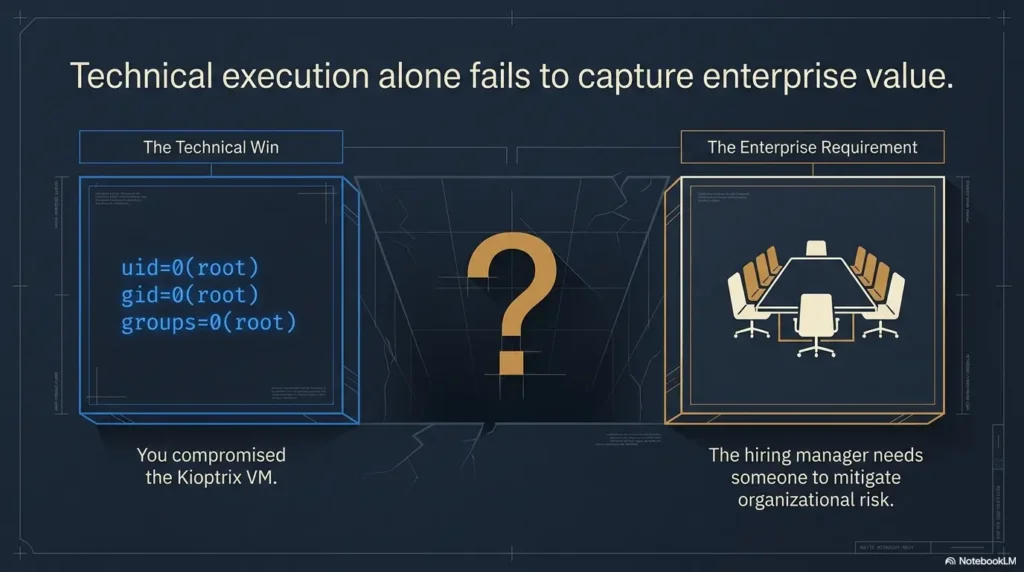
Root access is satisfying. It is the lab equivalent of a tiny brass band entering the room. But behavioral interviews rarely reward brass bands. They reward judgment.
When you make “I got root” the whole ending, you flatten the story. You also invite technical follow-up questions that may pull you away from the behavioral skill you wanted to prove.
Why “I got root” can sound thin
“I got root” tells the interviewer the game ended. It does not tell them how you think. It does not show whether you respected scope, recorded evidence, researched carefully, or learned anything you could repeat.
For entry-level roles, hiring teams often care more about teachability than theatrical victory. They want to know whether you can be trusted with alerts, tickets, systems, users, and imperfect information.
That means your ending should not be a fireworks show. It should be a professional lesson with a receipt.
Better ending: “Here is what I changed in my process”
A better ending sounds like this:
“After the lab, I changed how I document. I now separate raw output, confirmed findings, assumptions, and next actions. That makes my notes easier to review and helps me explain risk without mixing evidence and guesses.”
This is more useful than “root happened.” It shows growth. It also connects to the daily work of security teams, where messy notes can waste time, confuse escalation, or make a good finding look like soup.
Pattern interrupt: Root is not the résumé fairy
Root does not tap your résumé with a wand and whisper, “You are employable now.” The employable part is the repeatable behavior around the win.
Use your lab result as a doorway into process improvement. If you completed Kioptrix, ask: what did it teach you that you would do again in a workplace?
- Make the result about what improved.
- Connect the improvement to workplace behavior.
- Avoid making exploitation the entire plot.
Apply in 60 seconds: Replace “I got root” with “After this lab, I changed…” and finish the sentence.
Build One Interview Story Around Enumeration Discipline
Enumeration discipline is one of the best Kioptrix story angles because it sounds beginner-appropriate and professionally useful. It shows that you do not attack first and think later. That alone can separate you from the candidate who treats every open port like a piñata.
The behavioral competency: patience under uncertainty
Patience is not passive. In security work, patience means collecting enough information before choosing a path. It means accepting uncertainty without filling the gaps with fantasy.
A Kioptrix enumeration story can show that you started with asset identification, confirmed reachable services, recorded versions, compared findings, and resisted the urge to chase the first shiny clue.
That is practical. In a SOC role, the same patience helps when triaging alerts. In a pentest support role, it helps when building a reliable service inventory. In help desk security work, it helps when separating symptoms from causes.
Story angle: “I slowed down before speeding up”
This angle is simple and memorable. You can say:
“At first, I wanted to jump straight into exploitation. Instead, I forced myself to slow down and build a fuller picture of the target VM. That helped me avoid wasting time on a path that looked attractive but had weak evidence.”
Notice the honesty. You admit the temptation. Then you show control. That is behavior.
What to emphasize in the interview
Emphasize scope, discovery, service research, version checking, documentation rhythm, and hypothesis testing. Mention tools only as supporting evidence.
For technical depth, connect to resources like Kioptrix enumeration practice, a Kioptrix recon routine, and how to think about open ports in Kioptrix Level. The interview point is not that you know every flag. It is that you can move from evidence to next step without becoming a command goblin.
Money Block: Enumeration Story Decision Card
| When Your Story Says… | It May Sound Like… | Say This Instead |
|---|---|---|
| “I scanned it.” | Tool recital | “I built a service inventory before choosing a test path.” |
| “I found ports.” | Raw output | “I used open services to prioritize research.” |
| “Then I exploited it.” | Jumping ahead | “I tested the strongest hypothesis after checking evidence.” |
Neutral action line: Before the interview, rewrite every tool sentence as a decision sentence.
Build One Interview Story Around Handling Dead Ends
Dead ends are interview gold if you handle them honestly. Nobody wants a junior analyst who pretends every investigation flows like a violin concerto. Real troubleshooting has squeaks, wrong turns, missing context, and the occasional “why is DNS doing interpretive dance?” moment.
The behavioral competency: resilience without chaos
A dead-end story shows how you behave when your plan fails. Do you panic? Do you start random testing? Do you blame the tool? Or do you pause, review evidence, and choose the next most reasonable path?
That is a workplace skill. Security teams deal with noisy alerts, false positives, ambiguous logs, flaky tooling, and incomplete reports. Calm recovery is technical competence wearing a quieter jacket.
Story angle: “My first assumption failed”
A strong dead-end story might begin:
“During a Kioptrix lab, my first assumption about the most promising service path did not hold up. Instead of forcing it, I went back to my notes, compared the evidence, and rebuilt my next steps around what I could actually confirm.”
This shows humility without weakness. You are not saying, “I got lost.” You are saying, “I noticed the map was wrong and stopped walking into the lake.”
Here’s what no one tells you: calm is a technical skill
Calm changes what you see. When you are frustrated, every clue looks either useless or urgent. When you are calm, you can sort evidence, retest assumptions, and notice the plain thing you skipped earlier.
Use a Kioptrix decision process or a Kioptrix decision tree to structure your story. If your notes include a wrong turn, do not hide it. Turn it into the moment you learned to be more systematic.
Short Story: The Port That Looked Guilty
During one late practice session, a student became convinced that a single exposed service was the path forward. The version looked old. A forum thread looked promising. The whole thing had the confidence of a detective pointing at the wrong butler. After an hour of testing, nothing matched. Instead of forcing the path, the student opened a fresh note, wrote “confirmed” and “assumed” as two headings, and sorted every clue.
The embarrassing truth appeared quickly: most of the work had been built on one unverified assumption. The student restarted enumeration, found a more reasonable lead, and finished with a cleaner report than expected. In the interview, that became the best story. Not because the student was brilliant, but because they could say, “I learned to separate evidence from momentum.” That is the kind of sentence a hiring manager remembers after the room goes quiet.
- Name the failed assumption.
- Explain what evidence changed your mind.
- Show the process improvement that followed.
Apply in 60 seconds: Write one sentence that starts, “My first assumption failed because…”
Build One Interview Story Around Ethical Boundaries
Cybersecurity hiring is built on trust. Skill without boundaries is not impressive. It is a liability wearing a hoodie.
A Kioptrix story gives you a safe way to demonstrate that you understand permission, scope, isolation, and documentation. This matters for every security role, even if the job is mostly defensive.
The behavioral competency: trustworthiness
Trustworthiness is not just “I am a good person.” It is operational. It means you understand what you are allowed to test, what you are not allowed to test, what you should document, and when you should ask for clarification.
In professional environments, testing without permission can create legal, technical, and business risk. Even accidental scanning outside a lab can cause trouble. That is why your interview story should make the boundary visible early.
You can say: “I kept the lab isolated and only tested the intentionally vulnerable VM. I treated the exercise as practice for responsible assessment, not as permission to test anything else.”
Story angle: “I kept the lab isolated and documented scope”
This story angle is useful when asked about responsibility, judgment, or ethics. It works especially well for candidates who want to show maturity before discussing technical steps.
Connect it to practical habits. Did you use a host-only network? Did you avoid public targets? Did you label your notes as lab-only? Did you keep screenshots organized? Did you avoid copying exploit steps into places where they could be misunderstood?
If you are still building the setup, review Kioptrix network setup, home lab network layout, and offline lab setup so your story has a real foundation.
What not to say
Avoid casual phrases that sound like unauthorized activity. Do not say “I attacked machines” without context. Do not mention public IPs, school networks, employer systems, client assets, or anything where permission is unclear.
Also avoid making the story sound secretive. “I found a vulnerability and did not tell anyone” is not the mysterious jazz solo you think it is. In interviews, responsible disclosure and authorization matter.
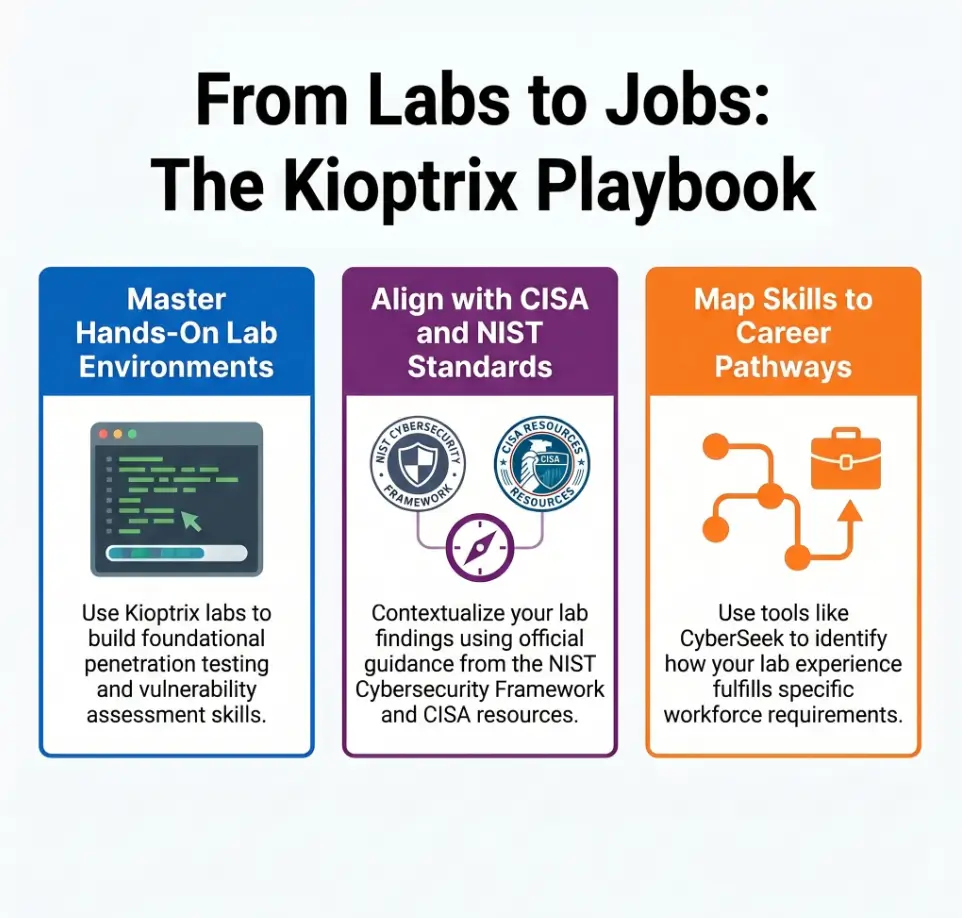
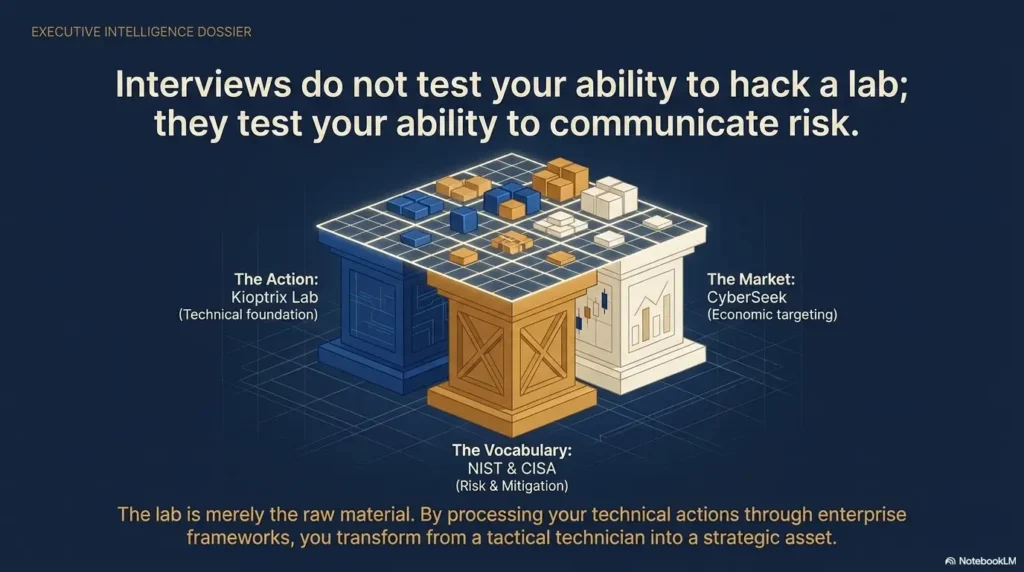
For broader professional framing, NIST publishes well-known cybersecurity guidance used across organizations, and CISA provides practical security resources for defenders and businesses. You do not need to recite frameworks in an entry-level interview, but you should sound aligned with responsible, documented, authorized work.
Build One Interview Story Around Communication, Not Exploitation
Many candidates underestimate communication because it feels less glamorous than shells, payloads, and terminal confetti. But in real teams, a finding that cannot be explained is a finding with its shoes tied together.
Kioptrix can help you practice writing and speaking about risk. That makes it powerful for behavioral interviews.
The behavioral competency: explaining risk to non-specialists
A junior security hire often needs to explain what happened, why it matters, and what should happen next. Not every audience wants the exploit chain. Some want impact, priority, evidence, and practical remediation.
Your interview story can show that you wrote the lab report as if a manager or teammate needed to act on it. That does not mean dumbing it down. It means removing static.
Story angle: “I wrote the report as if a manager had to act on it”
This is one of the strongest angles for candidates who are not yet deeply technical. It shows that you understand security work has a communication layer.
Instead of saying, “I found a vulnerable service,” you might say, “I documented the exposed service, the evidence that made it risky in the lab context, the likely impact if a similar issue existed in a real environment, and a practical remediation path such as patching, configuration review, or service restriction.”
That sounds like a person who can write a ticket without turning it into a treasure map.
Turn technical notes into business language
Use a simple structure:
- Finding: What was observed?
- Evidence: What supports it?
- Impact: Why could it matter?
- Recommendation: What should be changed?
- Limit: What did you not test or cannot claim?
This structure works for lab reports, interview stories, and junior workplace documentation. For more practice, compare a Kioptrix lab report, a Kioptrix enumeration report, and Kioptrix report writing tips.
Money Block: Report-to-Interview Translation Map
| Lab Note | Interview Translation | Workplace Signal |
|---|---|---|
| Open service found | I built an inventory before testing. | Methodical discovery |
| Version researched | I checked evidence before making claims. | Validation discipline |
| Path failed | I revised my assumption when results did not match. | Resilience |
| Finding summarized | I explained risk and remediation clearly. | Communication |
Neutral action line: Before an interview, convert three raw notes into three workplace signals.
Common Mistakes That Make Kioptrix Examples Sound Amateur
Most weak Kioptrix interview answers fail for the same reason: they confuse technical activity with professional evidence. The candidate did things, but the story does not show why those things mattered.
Here are the traps to avoid before your answer goes wandering into the fluorescent swamp.
Misstep 1: reciting tools like a grocery receipt
“I used Nmap, Nikto, Gobuster, Metasploit, and then…” is not automatically impressive. Tools are useful, but they are supporting actors. Your thinking is the lead.
Better: “I used scanning and web enumeration tools to answer specific questions about exposed services, then documented which findings were confirmed and which needed more validation.”
That version shows purpose. The tools serve the investigation.
Misstep 2: hiding every failure
A story with no friction can sound polished into plastic. Real learning includes mistakes, confusion, and correction. You do not need to confess every late-night typo, but you should include one meaningful obstacle.
For example: “My first path did not work, so I reviewed my notes and realized I had treated a possible clue as confirmed evidence.” That is a useful failure. It shows self-correction.
Misstep 3: using exploit details as the centerpiece
Exploit details may be relevant in a technical interview, but for behavioral questions, they should not swallow the answer. Keep the center on process, ethics, communication, and learning.
If the interviewer wants technical depth, they will ask. Then you can explain carefully, staying within safe lab context. Until then, do not turn a behavioral answer into a tactical fireworks crate.
Misstep 4: forgetting the “so what?”
Every lab story needs a “so what?” Why should the interviewer care? What behavior does the story prove?
Connect the story to one of these outcomes:
- Better troubleshooting under uncertainty.
- Cleaner documentation.
- More careful evidence handling.
- Improved communication of risk.
- Respect for scope and authorization.
- Ability to learn from dead ends.
If your story does not prove one of those, revise it.
- Make every tool support a decision.
- Include one honest obstacle.
- End with a workplace behavior.
Apply in 60 seconds: Add “so what?” to the end of your draft answer and write the real point.
The Interview Answer Template: Turn Kioptrix Into a 90-Second Story
A good behavioral answer should feel complete but not bloated. Around 90 seconds is often enough to show the situation, your task, what you did, and what changed.
You are not trying to narrate the entire lab. You are selecting one professional thread and pulling it cleanly through the answer.
Opening line: set the scene safely
Start with authorization and purpose:
“I practiced in an authorized Kioptrix lab environment to strengthen my vulnerability assessment workflow.”
This line immediately calms the room. It tells the interviewer you understand boundaries.
Middle: show the decision chain
Then show your process:
“I started with discovery, documented the exposed services, researched likely paths, tested carefully, and revised my assumptions when results did not match. I kept raw notes separate from confirmed findings so I could explain what I knew versus what I was still investigating.”
This middle section can flex depending on your chosen competency. For enumeration, emphasize discovery. For dead ends, emphasize assumption checks. For communication, emphasize reporting.
Ending: land the professional lesson
End with a workplace-ready lesson:
“The biggest takeaway was not the exploit. It was learning to slow down, validate evidence, and write findings clearly enough for someone else to act on them.”
That ending feels mature. It also gives the interviewer a follow-up path.
Optional closer: connect it to the role
If the role connection is natural, add one short closer:
“That is the same discipline I would bring to triaging alerts, investigating anomalies, or documenting security issues for a team.”
This is especially useful for junior SOC and security analyst interviews. For a pentest-adjacent role, you might say “scoping assessments, documenting evidence, and communicating remediation clearly.”
Money Block: 90-Second STAR Builder
Neutral action line: Use the generated sentence as a rough draft, then make it more specific and human.
When to Seek Help Before Using This Story in an Interview
Some Kioptrix stories are ready after a light polish. Others need review before they enter an interview room wearing a tie.
Get feedback when the story includes unclear permission, too much exploit detail, or a technical step you cannot explain simply.
Get feedback if your answer includes real targets
Remove anything involving public IPs, employers, schools, clients, friends, family networks, or systems where permission is unclear. Even if nothing bad happened, the story can sound careless.
Keep examples inside the lab. Say “authorized lab environment” and mean it.
Ask a mentor if your explanation sounds too exploit-heavy
A mentor, instructor, or career coach can help you rebalance the answer. If 80% of your story is exploit mechanics, you may be answering the wrong question.
Behavioral interviews reward self-awareness, process, and communication. Technical interviews can go deeper when invited.
Rework the story if you cannot explain each step simply
If one follow-up question makes the story collapse, rebuild it. You do not need to know everything, but you should understand your own answer.
Try explaining the story to a non-security friend. If they can repeat the main point back to you, the story has oxygen.
For safer professional language, review public guidance from NIST and career materials from CyberSeek. NIST is widely recognized for cybersecurity frameworks and guidance, while CyberSeek helps map roles, skills, and career pathways in the U.S. cybersecurity workforce.
FAQ
Can I use Kioptrix Level in a cybersecurity behavioral interview?
Yes, if you frame it correctly. Use Kioptrix Level as an authorized lab example that shows process, ethics, documentation, persistence, and communication. Avoid presenting it as professional penetration testing experience unless you also have real authorized work to support that claim.
Is Kioptrix enough experience for an entry-level cybersecurity job?
No single lab is enough by itself. Kioptrix can support a broader portfolio that includes networking basics, Linux practice, writeups, home lab notes, security fundamentals, and clear interview stories. It is one useful brick, not the whole cathedral.
Should I mention specific exploits in the interview?
Only briefly, and only when relevant. For behavioral questions, focus on your decision-making, troubleshooting, documentation, and lessons learned. If the interviewer asks for technical detail, explain within the safe context of the authorized lab.
How do I avoid sounding like I hacked something illegally?
State the scope clearly at the start. Say you worked in an authorized, intentionally vulnerable VM lab and did not test real systems or public targets. Avoid casual language that sounds like unauthorized activity.
What interview question does a Kioptrix story fit best?
It fits questions such as “Tell me about a time you solved a difficult problem,” “Tell me about a time you got stuck,” “How do you approach unfamiliar technical issues?” and “Tell me about a time you learned from a mistake.”
Should I put Kioptrix on my résumé?
You can mention it under a projects, labs, or cybersecurity practice section. Keep the wording professional. Emphasize vulnerability assessment practice, enumeration, documentation, evidence handling, and reporting rather than only “got root.”
What if I used a walkthrough?
Be honest. A strong answer might say you attempted the lab, got stuck, used a hint or walkthrough to understand the concept, then repeated the steps independently and documented what you learned. That shows learning integrity.
Is Kioptrix outdated?
Some Kioptrix machines are older, but they can still teach foundational methodology, especially enumeration, research habits, Linux familiarity, and interview storytelling. Do not present them as proof of modern enterprise exploitation expertise.
How long should my Kioptrix behavioral answer be?
Aim for about 60 to 90 seconds. That is usually enough to cover the Situation, Task, Action, and Result without drifting into a walkthrough. Keep one main lesson at the center.
Can a Kioptrix story help for SOC analyst interviews?
Yes. Emphasize investigation habits: scoping, evidence review, note-taking, false starts, validation, and clear escalation language. Those habits connect naturally to alert triage and incident investigation.
Next Step: Write One STAR Story Before You Touch Another Lab
The temptation is to do another lab. Another writeup. Another tool. Another late-night sprint through terminal vines.
But if your goal is interviews, pause first. Convert one existing Kioptrix experience into a usable STAR story before you add more raw practice to the pile.
The 15-minute action
Open a blank document and write four headings: Situation, Task, Action, Result. Then fill each one with plain language.
- Situation: Authorized Kioptrix lab environment.
- Task: One professional skill you wanted to practice.
- Action: Three to five decisions you made.
- Result: One lesson, improvement, or reusable habit.
If you already track practice, connect the story to your Kioptrix progress tracking, a weekly review template, or a session review habit. Your future self will thank you with fewer frantic pre-interview tabs.
Keep the first draft small
Aim for 180 to 220 words. That is enough to sound specific without turning into a lab report with shoes.
Use one story, one skill, one obstacle, and one lesson. If you try to include everything, the answer becomes a crowded elevator.
Final polish question
Ask yourself: “Would a hiring manager hear judgment, curiosity, and professionalism in this answer?”
If yes, the lab has become interview capital. If not, revise the story until it proves a behavior instead of merely reporting an event.
- Choose one Kioptrix moment.
- Attach it to one professional behavior.
- Practice it out loud until it sounds natural.
Apply in 60 seconds: Create a document titled “Kioptrix STAR Story 1” and add the four headings now.
Conclusion
The quiet friction from the beginning returns here: you do not need to walk into a cybersecurity interview with a grand legend. You need one credible story that shows how you think when the path is unclear.
Kioptrix Level practice can help you build that story when you frame it around authorized learning, careful enumeration, dead-end recovery, ethical boundaries, documentation, and communication. The lab gives you the scene. Your behavior gives it meaning.
Your next step is simple and small enough to do within 15 minutes: write one STAR story from a Kioptrix session, keeping the ending focused on what improved in your process. Then practice saying it out loud once. Not perfectly. Just honestly.
The strongest candidate is not always the one with the loudest tools. Sometimes it is the one who can say, calmly, “Here is what I knew, here is what I tested, here is what changed my mind, and here is what I learned.”
Last reviewed: 2026-05.
Technical guidance updated: 2026-10-13. Clarified that interview examples and generated answers must reflect verifiable personal experience.